
To better plan your first or nth trip to a city as dense with landmarks, architecture, museums, and delicious food as Rome is, you need to have a plan.
In this post, I’ve compiled a Rome bucket list. I was born and lived in this beautiful and complicated city for almost 40 years.
In this article, you will find the answer I give to friends who come to visit Rome from other parts of Italy and from other countries who ask me what are the things to do and see absolutely in Rome.
My list of things to do in Rome, Italy, includes monuments, artworks, sights, shopping, and food.
Not only the big 3: Colosseum, Roman Forum and Trevi Fountain. But also the most beautiful squares, shopping streets, parks, foods to taste, and off-the-beaten-path neighborhoods where you can breathe in a more authentic atmosphere.
Here’s what should be on your Rome bucket list
Create a personal list of things to see in Rome based on what suits you from this list.
1. See the Colosseum
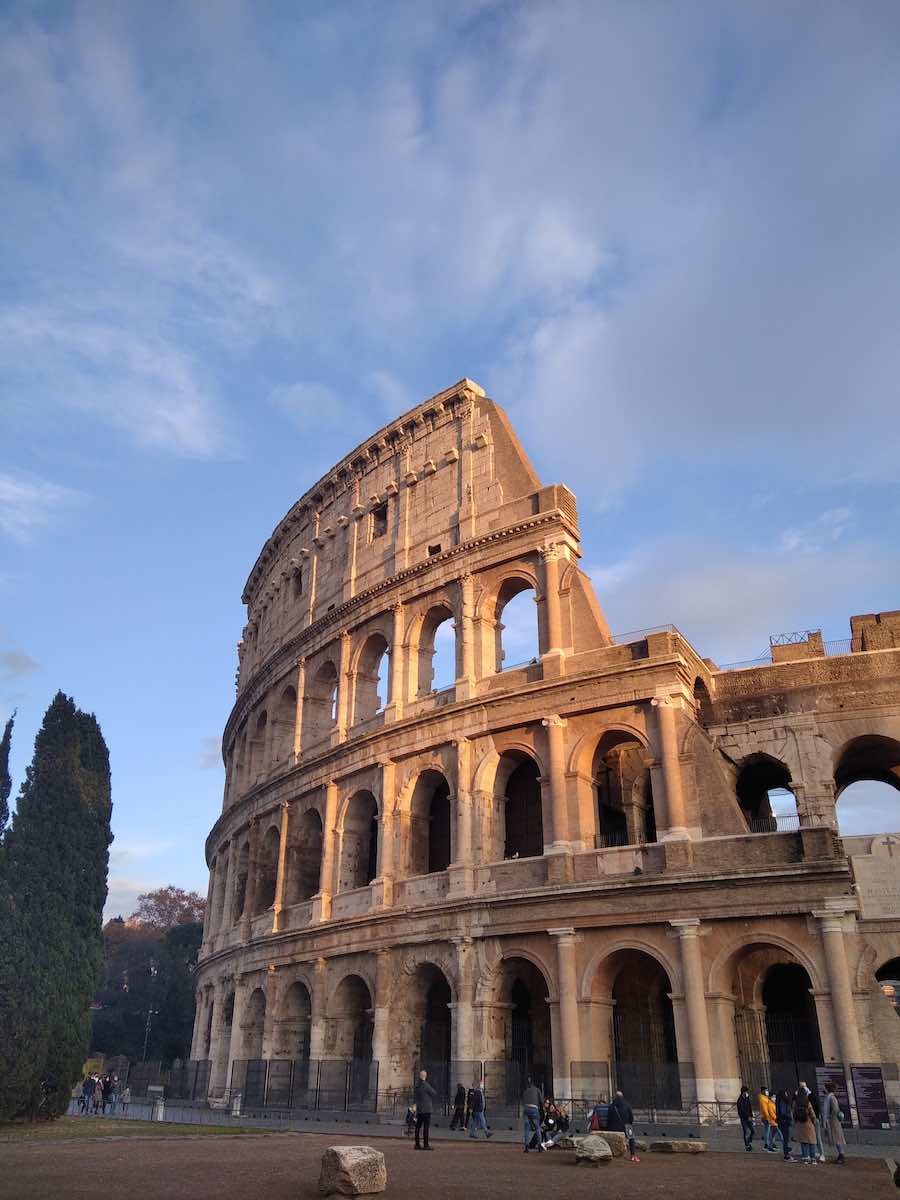
The Colosseum is the most spectacular and famous monument in Rome. I imagine it is already at the top of your Rome bucket list.
An elliptical amphitheater with walls almost 50 meters high could hold up to 80000 people during the Roman Empire. The Romans repeated the arch technique (which they had learned from the ancient Etruscans) throughout the perimeter and on three orders to build it.
Visiting the Colosseum is one of the top bucket list things to do in Rome. Inside the Colosseum were bloody fights between man and man and between men and beasts.
The Colosseum was completed between 70 and 79 A.D. and erected by order of Vespasian, founder of the Flavian dynasty.
He, victorious on his return from the war in Judea, once ascended the throne of the empire and won the Roman people’s consent by giving them the Colosseum, where they could watch the games for free.
The entrance ticket to the Colosseum costs €18 (including mandatory presale fees as the entrance is limited). It also allows access to the Palatine Hill and the Roman Forum and is valid for 24 hours from the first use.
Tickets must be booked online or by phone through the official website.
Upon entering the Colosseum, you’ll see the arena, what’s left of the stands, and the upper floors.
TIP: If you're short on time, you can walk around the monument and look for the best place to take a

picture, such as the top of the steps leading to Via Nicola Salvi.
2. Walk inside the Roman Forum and on the Palatine Hill

The Roman Forum and the Palatine Hill are now part of the Colosseum Archaeological Park.
In front of the Colosseum is a rather large area that enclosed the heart of ancient Rome’s religious, political, judicial, and commercial activities: the Roman Forum.
Before the 4th Century B.C., when King Tarquinius Superbus built the massive sewer “Cloaca Maxima, the entire area was a large swamp, and the settlements were concentrated on the hills such as the Palatine and the Capitoline.
After the paving and the peace between the tribes of the Sabines and Latins, the political and religious life of Rome flourished in the Roman Forum.
The numerous ruins you will see are from different eras and had the most diverse functions: the Roman Forum was in use for about a thousand years.
On the Palatine Hill is the Grotta del Lupercale, where legends say the mythical twin founders of Rome, Romulus, and Remus, were raised by a she-wolf.
The Palatine Hill is also home to the imperial villas of Augustus and Livia and the Renaissance Orti Farnesiani.
TIP 1: To truly understand the history of the Roman Forum and the buildings within it, I highly

recommend taking a guided tour, otherwise you will feel overwhelmed by the too many ruins.

The best is the Colosseum, Roman Forum and Palatine Hill guided tour. It will get you skip-the-line tickets to the landmarks and a local guide to help you understand the ruins.

This is a great tour to learn about Roman history.

You can check the availability of this tour here.
TIP 2:  If you're short on time, perhaps it is wiser to enjoy the spectacle of the ruins with a free walk

on the scenic road "Via Dei Fori Imperiali" instead of accessing the Roman Forum.
3. Eat the best gelato in the world
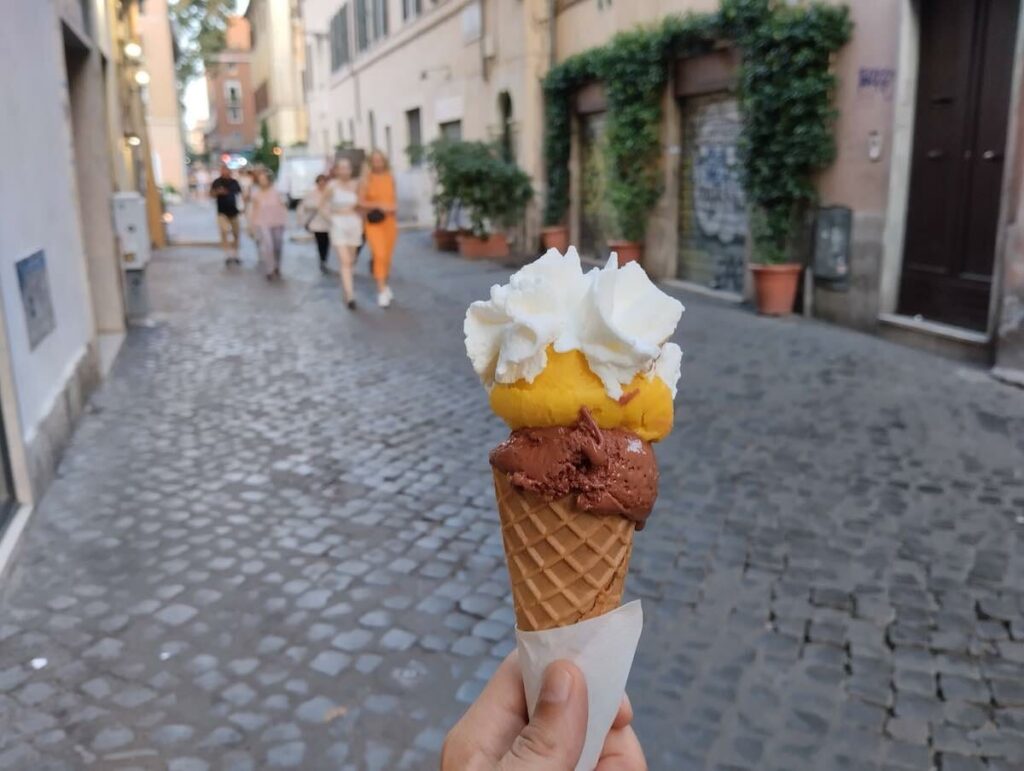
If you love Italian gelato, you’re in luck! Rome has about 1400 gelato shops, and many rank among the best in Italy.
Romans love to eat gelato any time of the day and year; they only give it up if it rains or is particularly cold.
You will find gelato shops on every corner of the historic center. Don’t let yourself be tempted by the gelato shop for tourists that is located in front of the Trevi Fountain or by the big brands like Venchi. Artisan gelato shops in Rome offer gelato made with quality ingredients.
If you find yourself near the Colosseum, take a break and head to the Fatamorgana Monti gelato shop, address: Piazza degli Zingari, 5 in the Monti neighborhood.
4. Feel like 60’s actress Anita Ekberg at the Trevi Fountain
Well, don’t take me literally… If you walk inside the water like in the scene of the movie La Dolce Vita, which has contributed immensely to spreading the popularity of Rome’s most beautiful fountain, you’ll likely be fined or arrested.
But you can still join dozens of other visitors in feeling emotional for finding yourself in front of such spectacular sculptures in travertine marble.
Indeed, the fountain is at the top of many people’s Italy bucket list.
The ideal would be to visit the fountain in the very early morning to beat the crowds or in the evening when it’s lit up, and the statues come alive, reflecting the movement of the water.
The sculpted scene occupies one of the sides of the Poli Palace. Commissioned by the Clergy in the 16th Century to beautifully collect the water at the end of the Acqua Virgo Aqueduct (built in 20 B.C. instead!). Now you know the most fascinating fact about the Trevi Fountain: it took nearly 2000 years to get the look it has today.
5. Eat supplì
Rome is a city abundant in street food to be enjoyed at all hours of the day. However, you won’t find it in the roadside stands, which are prohibited except in a few specific cases.
To find perhaps the most delicious Roman street food, you must enter a store selling pizza al taglio, a bakery, or a store specializing in supplì.
The recipe for happiness in 3 bites is fairly simple but time-consuming. The result fits in the palm of your hand: a cylinder of rice cooked in pork ragu and tomato sauce, with a piece of mozzarella in the center, covered in breadcrumbs and then fried in hot oil. To lick your lips!
In the historic city center, it costs between 2 and 3 euros, and you can find it here:
· I Suppli Dei Coronari | Via Dei Coronari, 25 (near the beautiful Piazza Navona)
· Antico Forno Roscioli | Via dei Chiavari, 34
NEED A VEGAN SUPPLI’? Go to Supplizo in Via Dei Banchi Vecchi, 143
6. Marvel at the Pantheon’s dome

It’s hard to tell which monument is the dearest to the locals’ hearts, the Colosseum or the Pantheon.
When Emperor Adrian built it in 125 AD, it was dedicated to all the universe’s deities (12 plus the Emperor, precisely).
Here, several royal figures of the Kingdom of Italy are buried, together with Raffaello, who was famous for Renaissance art.
The line at the gate is quick. Let yourself inside this magic, spiritual place: pass through the rectangular-plan pronaos with its 16 granite columns and enter the only internal hall with a circular plan. The feature that stands out is the immense dome.
A masterpiece of architecture and engineering, it houses the only window in the building. The Pantheon is, without doubt, the best-kept example of Roman architecture in Rome.
MIND: Even though the Pantheon is a church, to access it you'll need to get a €5 ticket.
7. Enjoy the view from Janiculum Hill
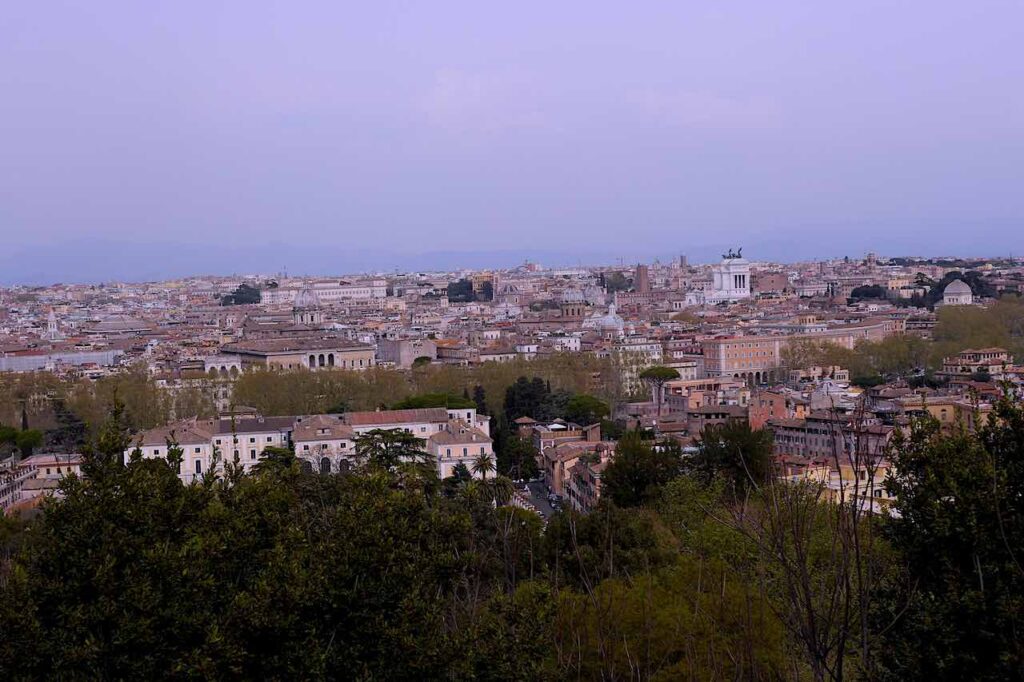
Here is the panoramic point of Rome par excellence. The Janiculum Hill is called so because, in ancient times, it hosted altars dedicated to the god Janus, the god of borders.
The panoramic terrace is located in Piazzale Garibaldi and overlooks the right bank of the Tiber River.
From here, you can admire the roofs and domes of all the ancient buildings you will visit during your tour of the historic center of Rome. There is also a park with busts on top of Janiculum Hill.
The Janiculum is one of the most romantic places in Rome (the eternal city); the atmosphere is special at sunset.
To get here, you can walk for about 20 minutes with about 90 meters of elevation gain from the heart of the Trastevere district (Piazza di Santa Maria in Trastevere) through the avenue “Passeggiata del Gianicolo. “
By public transportation, take bus 115 from Via Goffredo Mameli.
If the climb puts you off, consider other views in Rome’s historic center, like:
- Terrace of the Vittoriano monument (entrance to the elevators to the terrace €12)
- Pincio Terrace (you can access from a staircase that starts from the side of Piazza del Popolo)
- Terrace of the Orange Garden on the Aventine Hill
8. Climb the Spanish Steps
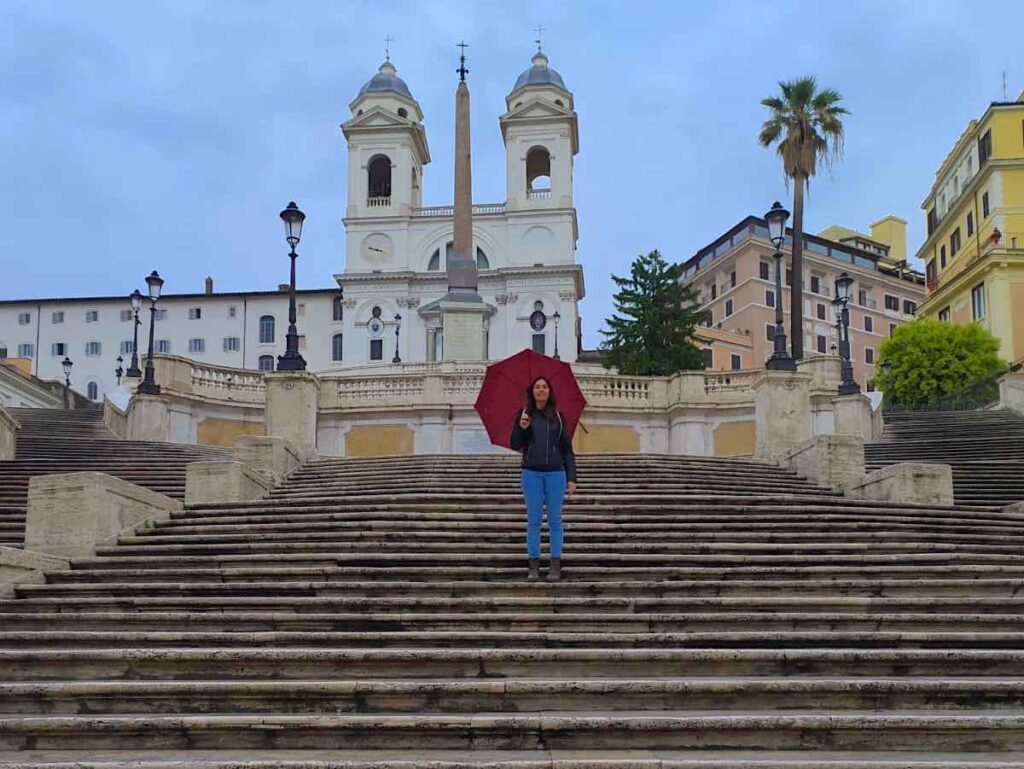
Here’s another of Rome’s most beautiful corners, or a square, even if it develops in height instead of on the level. The extraordinary architectural elements of the piazza will invite you to stop here.
The fountain depicting a sinking boat, “La Barcaccia,” is the work of Bernini’s father and son. The elegant staircase was designed by Francesco De Sanctis in the 18th Century to connect the piazza to the church and convent of Trinità dei Monti Church, commissioned by the King of France in the 16th Century. Visiting the fountain should be one of the top things on your Rome to-do list.
Piazza di Spagna has also hosted haute couture fashion shows.
9. Banquet with pizza al taglio

If Italy is famous for its round pizza, which Italians love to have for dinner, eating a whole pizza each, then the Italian capital is renowned for the “pizza al taglio. ” The English translation is not really accurate: it is not “slices,” but “pieces” of pizza.
The custom is to have it from the stores specializing in pizza al taglio, where you will find pizza by the slice with many different toppings. Here’s how to get your Roman pizza in 4 steps 😉
- Approach the counter.
- Choose the type of pizza you prefer through the showcase.
- Tell the clerk your choice: he will place the knives on the pizza to determine the quantity (it is done by eye; the clerk will indicate an amount with the knife, and you will say if it is okay or if you want a larger or smaller piece).
- Then the clerk weighs it, divides it into two pieces, puts them on top of each other like a sandwich, covers them with paper, and gives them to you ready to eat.
You can also sit in some stores and have your delicious pizza at a table.
Eating pizza by the slice is a way to sample different types of pizza. Among the toppings, you will find:
- Tomato and mozzarella
- Mushrooms and sausage
- Mozzarella and Ham
- Arugula, pachino and buffalo mozzarella
And many others!
Where can you taste the best pizza by the slice in the historic center of Rome?
- Antico Forno Roscioli | Via dei Chiavari, 34
- Pizza Rustica | Via Flaminia St.
TIP: Rome's pizza al taglio is one of Italy's most delicious and cheapest pizzas!
10. Hit Rome’s shopping streets
Shopping is one of the best experiences in Rome. One of the best shopping streets in Rome is Via Cola di Rienzo St. near St. Peter’s Square. Locals shop there any time of the year, especially during sales season in January and July.
Other perfect venues for shopping in Rome are:
- Via dei Giubbonari
- Via del Corso
- Via Ottaviano
- Via Appia Nuova
- Viale Marconi
- Via Del Corso, which connects Piazza Venezia to Piazza del Popolo
- the just a stone’s throw from Via Frattina, Via Condotti, and Via del Babuino.
For high-end shopping, I recommend these:
- Via Frattina
- Via Condotti
- Via del Babuino
TIP: Read also my guide to cheap clothes shopping in Rome.
11. Sit in the most beautiful piazza in the world

Piazza Navona will always hold a special place in my heart.
As a child, my grandparents used to bring me here to have fun on the carousel and to get sweets at the Christmas Market; therefore, each time meant happy times to me!
It’s nice to sit here and observe the architecture and the people passing by.
The square has a particular elongated shape because it rises in the place where once was the athletics Stadium of Domitian (85 A.D.)
The current appearance of the square dates back to the Baroque era (17th Century.) The papacy commissioned the great artists of the time, such as Bernini and Borromini, to design the three fountains, the Church of Sant’Agnese in Agone, and the palaces that overlook the square.
The fountains of Piazza Navona host some of the most beautiful marble sculptures in Rome.
It’s a satisfying activity to spend some time in the square and look around, perhaps enjoying a gelato from the gelateria Grom. There are often street artists and music.
12. Lunch with Roman pasta

Just like other Italians, the people from Rome are affectionately tied to pasta. Pasta is the most popular dish from Rome, especially at lunchtime, and is preferred in generous portions and tasty condiments.
You’ll find pasta in every restaurant in Rome. Restaurants often go out of their way to create original toppings to complement the typical Roman pasta, which has made its way around the world:
- Carbonara: a condiment made with jowl bacon (or bacon), egg yolks
- Gricia: with jowl bacon and pepper
- Amatriciana: with jowl bacon, tomato sauce, pecorino cheese
- Cacio e pepe: with pecorino cheese and pepper
And for vegans?
- Arrabbiata: with tomato sauce and chili pepper
- Aio e oio: with garlic, oil, and chili pepper.
To make the choice of the restaurant where to taste the typical Roman pasta easier and more satisfying, I recommend places that offer homemade pasta:
- Osteria Da Fortunata | Via del Pellegrino 11
- Tonnarello | Via della Paglia 1
- Egg Pasta Fresca | Vicolo del Farinone 25/A
TIP: Pasta topped with fish, and seafood is just as delicious and even less caloric. Romans love it. You can find it at:
- Le Mani in Pasta | Via dei Genovesi, 37
13. Watch the sunset from one of Rome’s ancient bridges
The Tiber River, which rises on the border between the regions of Tuscany and Emilia Romagna and flows into the Tyrrhenian Sea near Ostia, crosses the entire historic center of Rome.
In addition to walking along the river, the best way to enjoy the beautiful views of the river is to cross one of the pedestrian bridges of Rome.
The ideal and most romantic time to do this is at sunset. Near the bridges, there are often street music and small stalls.
Depending on your itinerary, add a visit to one or more of these bridges to your Rome bucket list:
- Ponte Sant’Angelo
- Ponte Sisto
- Ponte Cestio
14 Have an aperitivo
The custom of having an aperitivo after getting off work was imported to Rome by other cities in northern Italy.
Each coffee shop and even most restaurants in Rome are prepared to serve aperitivo at the right time, usually from 6:30PM to 8:30PM.
Aperitivo consists of a drink (traditionally Prosecco or Aperol, wine, beer, but it can also be non-alcoholic) with a few starters on the side. The best aperitivo places are the ones that offer abundant, quality Italian cuisine to go with your drink, like:
- Momart | Via XXI Aprile, 19. 1 drink of choice plus non-stop Italian cuisine (includes pizza al taglio) for €12.
- Rec 23 Restaurant Emporio Club | Piazza dell’Emporio, 1. Buffet aperitivo, 1 drink plus food for €12 from
- Fabrica | Via Girolamo Savonarola, 8. 1 drink plus food for €10
Join the locals for the Roman aperitivo at least once on your trip to Rome!
15 Stay in the Monti neighborhood
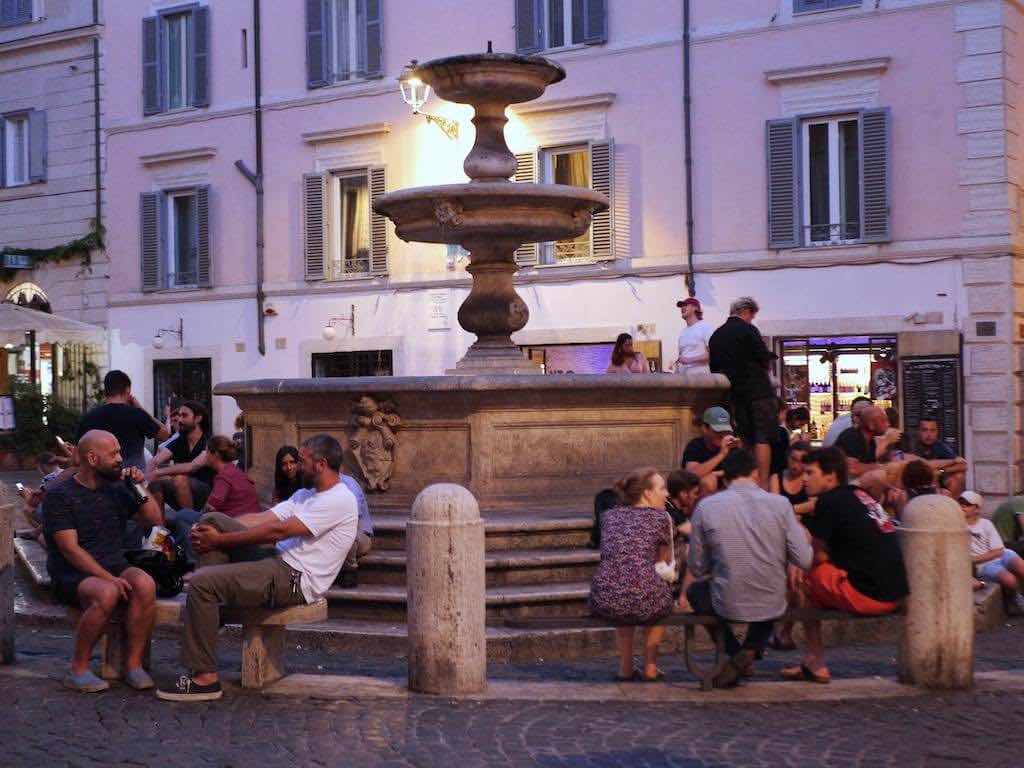
The quaint Monti neighborhood has become very popular among Rome’s citizens and tourists in the last two decades.
In there, you won’t find the crowds and the hustle of Trastevere, but only charming and casual restaurants, vintage shops, coffee bars, and wineries.
It is nice to walk in this neighborhood because it’s partially closed to the traffic (Via Urbana, Piazza degli Zingari).
Since it’s just a few minutes from the Colosseum, consider coming here to recover from a tiring day of sightseeing with dinner in a quiet, trendy area.
Monti is the best area to stay in Rome if you’re visiting for the first time.
16. Taste around at the Testaccio Market
After a massive renovation in 2012, the Testaccio Market has become one of Rome’s most welcoming places to buy food and sample street food.
Here, stalls sell local organic or D.O.P. (protected designation of origin) products like veggies, wines, cheeses, cold cuts, bread, pizza, and baked goods made with sourdough, fresh juices, and dishes.
The stores that overlook the covered market square also make fresh pasta dishes, second courses, sandwiches, and many types of street food.
The prices try to remain those of a market, so come here to find some cheap eats in Rome.
The Testaccio neighborhood is full of great trattorias and restaurants, and the new food market is just the icing on the cake.
Spend a few hours to please your sense of smell and taste at this place that should definitely be on your list of things to do in Rome.
Address: Via Aldo Manuzio, 66.
17. Unwind in Villa Pamphili Park
Rome isn’t just monuments, ruins, and museums. It is one of the world’s greenest cities, featuring numerous public parks and gardens.
Public parks in Rome were often properties of aristocratic families of the past who once owned villas and fields that were later transformed into public parks. This is the case of the beautiful Villa Pamphili.
The park is huge (183 hectares), and it is a pleasure to visit due to its pinewoods and splendid architecture. During your exploration, you will pass by a sumptuous mansion, fountains, a chapel, and a nymphaeum from the 17th Century.
In the park, you’ll also find the Vivi Bistrot, one of the best cafes in Rome, serving coffee, teas, and dishes made of organic products suitable for everyone, including vegans.
There is also a playground for small kids very close to the entrance gate located on Via Leone IV (Villa Pamphili Ovest).
18. Have a drink in the Pigneto neighborhood

Thanks to the creation of the pedestrian street (half of the Via del Pigneto), which gathers all kinds of pubs, wineries, and eateries, this area is the hipsters’ top choice for meeting people and spending the night in Rome.
There are cute cafes like the Necci dal 1926, vinyl and used books shops, and casual clubs with great live gigs like the Giove Live Music Club.
This is just a short introduction but gives you a taste of the general vibes of the Pigneto neighborhood.
Explore the area yourself, it’s perfect for you if you love drinking and meeting new people.
Nearest metro station: Pigneto.
19. Admire Bernini’s sculptures in the Borghese Gallery
Gian Lorenzo Bernini is one of the best-known Italian sculptors in the world.
Born in Naples, while still young, he followed his father, Pietro Bernini, a sculptor, to Rome.
When he was just twenty years old, Gian Lorenzo had a great opportunity to demonstrate his skill with stone: Cardinal Scipione Borghese, the favorite nephew of Pope Paul 5, commissioned him to create four groups of marble sculptures to be exhibited in the Borghese family’s residence in Rome.
Drawing from classical mythology and the Bible, Bernini created the Rape of Proserpine, the Apollo and Daphne, the David, and the group Enea, Anchises and Ascanius.
The characters are portrayed in their stories’ most dramatic and crucial moments.
You can admire all 4 of Bernini’s masterpieces at the Borghese Gallery, located in the heart of Borghese Gardens, holder of the best sculptures in Rome.
20. Taste the Trapizzino

The mouth-watering trapizzino is one of the newest street food invented in Rome.
The first trapizzino store opened in Rome in 2008, and in just 10 years, the creators managed to export it all over Italy and even to New York.
The trapizzino is a “corner” (or pocket) of fragrant “pizza bianca” (a soft and crispy flatbread) that can be filled with typical Roman, Italian, or international dishes such as:
Trapizzino with chicken cacciatora
- Trapizzino with zucchini and burrata cheese
- Trapizzino with parmigiana
- Trapizzino with ziginì
But there are many other fillings! This can’t be missed on your list of things to eat in Rome. You can find it here:
- Be.Re + Trapizzino | Via Vespasiano, 2
- Trapizzino Trastevere | Piazza Trilussa, 46
- Trapizzino Testaccio | Via Giovanni Branca, 88
21. See the Pope in St. Peter’s Square
Piazza San Pietro, which belongs to the Vatican State, is a huge square encircled by 284 marble columns. Did you know that the Vatican City is the world’s smallest country?
The piazza is considered the center of Catholicism.
You will see it with your own eyes when you visit on Sunday morning at 12, just in time to look at and hear the Pope celebrating the Angelus with hundreds of pilgrims.
There’s always an endless queue to enter the St. Peter’s Basilica and climb the dome, which bestows unique views of Rome.
TIP: If you want to exercise your legs with the 550 or so steps, be prepared to face a slow line, or either book the skip-the-line ticket Vatican City: Basilica, Dome Climb & Optional Crypts Tour
22. Admire Caravaggio paintings for free
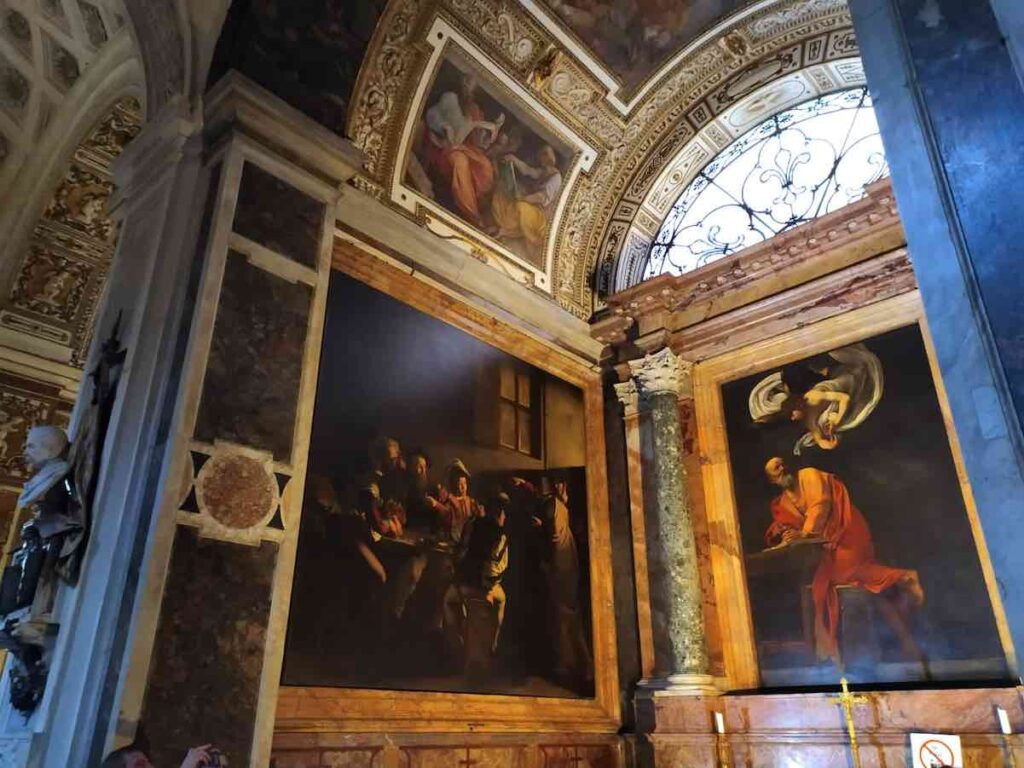
Rome is an extraordinary city also because it is an open-air museum, with many masterpieces of art and architecture to be admired simply by walking down the street.
In the case of the masterworks of Michelangelo Merisi called the Caravaggio, painter of the second half of the 16th Century, you can admire some of them in three churches in the center of Rome:
- Basilica of Santa Maria del Popolo
In the Cerasi Chapel are kept the “Conversion of St. Paul” and the “Crucifixion of St. Peter.”
- Church of San Luigi dei Francesi
In the Contarelli Chapel, you can admire three paintings: “Conversion of St. Matthew,” “St. Matthew and the Angel,” and “Martyrdom of St. Matthew.”
- Basilica of Sant Agostino
Go to these churches if you want to admire great paintings but lack the patience to visit a museum. This is one of the best free activities in Rome.
23. Visit the Aventino Hill

While many travelers explore the iconic sites, there’s a hidden gem that embodies the essence of this magnificent city—Aventino Hill.
Tucked away from the typical tourist routes, Aventino Hill offers a tranquil escape, a sanctuary where both locals and intrepid travelers come to unwind.
On the southern banks of the Tiber River, Aventino Hill boasts a collection of delightful experiences.
Going up the road from the Circus Maximus to the Aventine Hill, you will encounter the Municipal Rose Garden. If you travel in the middle of spring or summer, I recommend walking inside the garden, where thousands of vibrant blooms create an oasis of color and fragrance.
The hill is also home to one of Rome’s most beautiful public parks: the Orange Garden. Romans say this is the garden of lovers. If you visit Rome together with your sweetheart, you can’t fail to visit it. After enjoying the view from the large terrace, sit on one of the benches and… maybe exchange a promise of love!
It is not uncommon to have a musician performing here. The garden is filled with bitter orange plants in memory of a miraculous plant that according to legend, is still in the inner courtyard of the church of the adjoining Basilica of Santa Sabina.
The Basilica of Santa Sabina is one of the oldest buildings on the Aventine Hill. Enter to immerse yourself in the sparse and solemn early Christian architecture-it is one of the most beautiful churches in Rome.
Another church to visit is the Church of Santa Prisca, dedicated to the first female Christian martyr. The church is full of frescoes; visit it to fill your eyes with Baroque and Renaissance art. The frescoes in the apse by the Renaissance painter Passignano recount the life and martyrdom of the Roman maiden.
24. Stick your hand in the Mouth of Truth (if you dare)
A stone’s throw from the Aventine Hill is one of the strangest places in Rome. Or perhaps it would be better to say that the place is not strange, but one thing that locals do in that place is strange.
At the entrance to the Church of Santa Maria in Cosmedin you will find a long line, mostly of local travelers. Everyone is just waiting to stick their hand into the mouth of a large marble slab in the shape of a mask. This is the Mouth of Truth, the lid of a manhole cover from Roman times.
Since the Middle Ages, the legend had spread in Rome that this marble mask could detect lies. The defendant had to put his hand in his mouth and if he was a liar he would lose his hand…. Very often it was women judged to be cheating by their husbands who experienced that macabre magic.
It seems that today there is no danger, and especially children run to get their picture with their hand inside the mouth of the big mask.
Taking a photo next to this artifact is free of charge and you can do so during church opening hours. The Bocca della Verità is located in the outer portico of the Church of Santa Maria in Cosmedin, on Piazza Bocca della Verità.
If you are not interested in this marble mask, cross the street and admire two of the oldest temples in Rome.
25. Admire monuments in Piazza Bocca della Verità

In the picturesque Piazza Bocca della Verità, you’ll encounter a trio of remarkable monuments, each with its unique history.
The rectangular temple, likely dating back to the 4th century BC, stands as one of Rome’s oldest structures, dedicated to Portunus, the guardian of river ports.
Nearby, the Portus Tiberinus thrived during the construction of the cloaca Maxima, serving as Rome’s first commercial harbor. Byzantine frescoes adorn the temple’s interior, enhancing its historical allure.
On the opposite side of the square, you’ll find the circular Temple of Hercules Victor, constructed from Hellenic marble and adorned with 20 Corinthian columns. It shares a story of Rome’s ancient merchant culture.
A prosperous olive oil merchant built it in the 2nd century BC, and it once housed a magnificent bronze statue of Hercules Victor, now showcased in the Capitoline Museums. In the 12th century, this temple embarked on a new chapter as it was repurposed as a Christian church.
The Fountain of the Tritons, a creation by Francesco Moratti inspired by Bernini’s Fountain of the Triton in Piazza Barberini, graces the square with two kneeling tritons cradling a shell-shaped basin filled with water from the Acquedotto Felice.
As you continue your exploration, head towards Via Luigi Petroselli to discover the Arch of Janus. Despite its name’s origins in the 16th century, this monument, once known as the Arcus Divi Constantini, took shape in the 4th century AD, constructed by the sons of Emperor Constantine upon his passing.
Though time has taken its toll, you can still admire four statues on the keystones, believed to represent female deities, adding a touch of intrigue to this historic square.
26. Visit the Capitoline Museums
Visiting the Capitoline Museums is a chance to immerse yourself in the history of Rome, to see the city’s evolution, and to appreciate the artistry and creativity that have flourished here for millennia.
The exquisite collections on display encompass everything from classical sculptures to Renaissance paintings, each piece whispering tales of Rome’s glorious past. The sculptures collection is impressive and encompasses most of the most famous Roman statues and sculpture, such as:
Statue of Marcus Aurelius: The equestrian statue of the Roman Emperor Marcus Aurelius is a true marvel of ancient artistry. The emperor is depicted on horseback in a pose that exudes power and authority.
- She-Wolf of Rome (Lupa Capitolina): This iconic bronze statue is a symbol of the founding myth of Rome. It features a she-wolf nurturing the legendary twins, Romulus and Remus.
- Spinario (Boy with a Thorn): This bronze sculpture portrays a young boy removing a thorn from his foot. It’s a testament to the artistry and attention to detail in Roman sculpture.
- Colossal Head of Constantine: This enormous head of the Roman Emperor Constantine is an imposing sight, showcasing the artistic skills of the time and the significance of the emperor.
- Capitoline Venus (Venus Capitolina): This Roman-era statue is a beautiful portrayal of Venus, the goddess of love and beauty. It’s considered one of the most famous depictions of Venus in the world.
The museums also house an extensive array of ancient Roman inscriptions, a captivating window into daily life in the Eternal City.
But the allure of the Capitoline Museums goes beyond its impressive collection. The museums themselves are housed in splendid palaces, designed by none other than Michelangelo. The sweeping views from the museums’ terraces, overlooking the Roman Forum and the city’s historic heart, are simply breathtaking. It’s a setting that immerses you in the very essence of Rome.
Visiting the Capitoline Museums is a chance to immerse yourself in the story of Rome, to see the city’s evolution, and to appreciate the artistry and creativity that have flourished here for millennia.
You’ll find the Capitoline Museums on one corner of Piazza Venezia, on the top of the Capitoline Hill, in the Piazza del Campidoglio designed by Michelangelo.
27. Marvel at the vault of the Sistine Chapel inside Vatican Museums
Speaking of museums and art, this list of things to see in Rome cannot fail to include the Vatican Museums. The Vatican Museums are located within Vatican City, one of the smallest states in the world that is based right in the heart of Rome.
The Vatican is also the main residence of the Pope, the highest exponent of the Catholic religion. And it was a pope, Julius 2, who founded the Vatican Museums in the 16th century, finding a home for the papacy’s immense and extremely rich art collections. The museums opened to the public more than a century later, in 1771.
Are you ready to discover the treasures of the Vatican Museums? Then remember to book your ticket well in advance, at least a month, preferably two. The lines at the entrance are hundreds of meters long and you really risk not getting in because the rooms have reached maximum capacity.
TIPS:

You can book your ticket to the Vatican Museums here.

Avoid visiting museums on the first Sunday of the month. In fact, on that date, museums in

Rome are free to enter, so the lines get even longer.
The Vatican Museums boast an extensive collection of masterpieces from different periods and regions. Inside, you’ll find everything from ancient sculptures, Egyptian mummies, and classical artifacts to stunning Renaissance paintings and exquisite tapestries.
One of the crown jewels is the Sistine Chapel, where Michelangelo’s timeless frescoes, including the famous ‘Creation of Adam,’ adorn the ceiling.
28. Get spooked with a haunted tour

It would be naive to think that Rome’s history consists only of glorious episodes and that the city has been home only to artists, geniuses, and good people.
In the past of the Eternal City there are episodes and characters whose knowledge will give you chills.
I could describe some of them to you, but I don’t want to spoil the surprise. This is in fact the theme of a ghost tour of about an hour and a half that takes you through the places in Rome that have witnessed macabre events.
They talk about killings, about executioners, about innocent victims. All of this is part of the city’s history. The tour I recommend will talk to you in depth about the characters Rome wants to forget and their misdeeds; it will take you to the places where the events happened centuries ago.
I will stop here because by participating in the tour you will fully understand what it is all about .
For detailed info on the best haunted tour of Rome, go here.
29. Enjoy great live music in Rome

Another thing that gives me chills, apart from grisly tales, is live music. This time, I’m talking about pleasant chills.
Rome is a city that knows how to give great satisfaction to live music fans. The only thing you need is the desire to go out at night. So you should not exhaust all your energy by visiting the historical landmarks. Save something for an epic evening.
In the central Monti neighborhood, which borders Colosseum Square, there is a small venue that offers jazz concerts and jam sessions every night, the Charity Café Jazz & Blues Club. To enter you pay €10 (includes one drink). Get there early because there are only a few tables inside.
In the Esquilino district, near Termini Station, is Gatsby Café which offers a jazz concert program.
The most famous jazz club in Rome is the Alexanderplatz in the Prati district. If you like alternative music, rock, punk, or garage, I recommend checking out the live program at MONK Roma, Traffic Live Club, or Trenta Formiche Club.
On the other hand, you will find concerts by world-renowned artists at the Auditorium Parco della Musica.
30. Find a unique piece of clothing at a flea market
Here’s another of my favorite things to do in Rome: wander around vintage flea markets.
Rome is a perfect city for shopping, not just in boutiques and high-fashion stores. Here’s the info you’ve been looking for if you’re into vintage shopping.
The city’s most famous market is Porta Portese, held in Piazza di Porta Portese.
Every Sunday morning from 7 a.m. to 2 a.m., hundreds of stalls gather, selling clothing, accessories, housewares, furniture, and gifts—all second-hand.
Porta Portese is a market that attracts thousands of people, so watch your wallet and phone if you come here because pickpockets are lurking. There are also other exciting and smaller markets in Rome:
- Borghetto Flaminio Market, open on Sunday mornings | Piazza della Marina, 32
- The Ponte Milvio Antiques Market, open all day every Sunday | Via Capoprati
- Olympic Village Market, open on Friday mornings | Viale XVII Olimpiade, 7
- Monti Market, open all day on Saturday and Sunday | Via Leonina, 48
- The Monte Mario Market, open on Sunday mornings | Via Sebastiano Vinci
31. Join a food tour

I have already told you about some of the most delicious foods to taste in Rome, such as supplì, pasta carbonara, and pizza al taglio. However, I recognize that it is not easy to sample all the delicacies Rome has to offer in just a few days of travel. This is unfortunate, because one of the reasons to visit Rome is the food.
To get around the inconvenience of adding miles to your daily itinerary in search of the city’s best food, you could join a food tour.
Food tours in Rome consist of walks of about two hours in a foodie neighborhood of the city together with an experienced local guide who will lead you in tasting many different foods.
In addition to tasting them ( and they are usually some of the best in the city), you will also learn interesting facts about the foods such as local history and traditions.
Even though I am originally from Rome, I couldn’t resist trying one of these food tours, the one that takes you on a discovery of the Trastevere district through about 10 tastings among food and drinks.
I was pleasantly surprised and recommend it; it will help you find the best street food, pasta, and desserts in town.
You can take a look at the schedule and cost of this food tour in Trastevere here.
32. Spend a night in the Trastevere neighborhood
Even if you don’t participate in a food walking tour of the Trastevere neighborhood, I still recommend that you take an evening walk on your own. It’s worth it.
Trastevere’s fame precedes it, all the guidebooks talk about it, and even I can’t help myself. Trastevere is the neighborhood of osterias where you can taste typical Roman cuisine. Do you want to taste a perfectly cooked pasta carbonara or saltimbocca alla romana, the most succulent meat dish in Rome? In Trastevere, you will be able to do so. At the historic osteria Meo Patacca, while you tuck into a nice plate of pasta, you can enjoy listening to Roman Stornelli. These are songs in Roman dialect sung by locals strolling among the tables with guitars and accordion.
Trastevere is an excellent place to experience Roman nightlife for those visiting Rome for the first time.
The neighborhood comes alive at cocktail hour, around 6:30 PM. At that time, the locals arrive here and start drinking and eating. Many stop to chat in the neighborhood’s two main squares: Piazza Trilussa, near the romantic Ponte Sisto, and Piazza di Santa Maria in Trastevere.
If you are traveling as a couple, I recommend having an aperitif at the elegant Enoteca Ferrara.
Visit one of the two most popular pubs in Trastevere:
- Public Trastevere
- The Rox,
- Chakra Café
33. Admire Rome’s street art
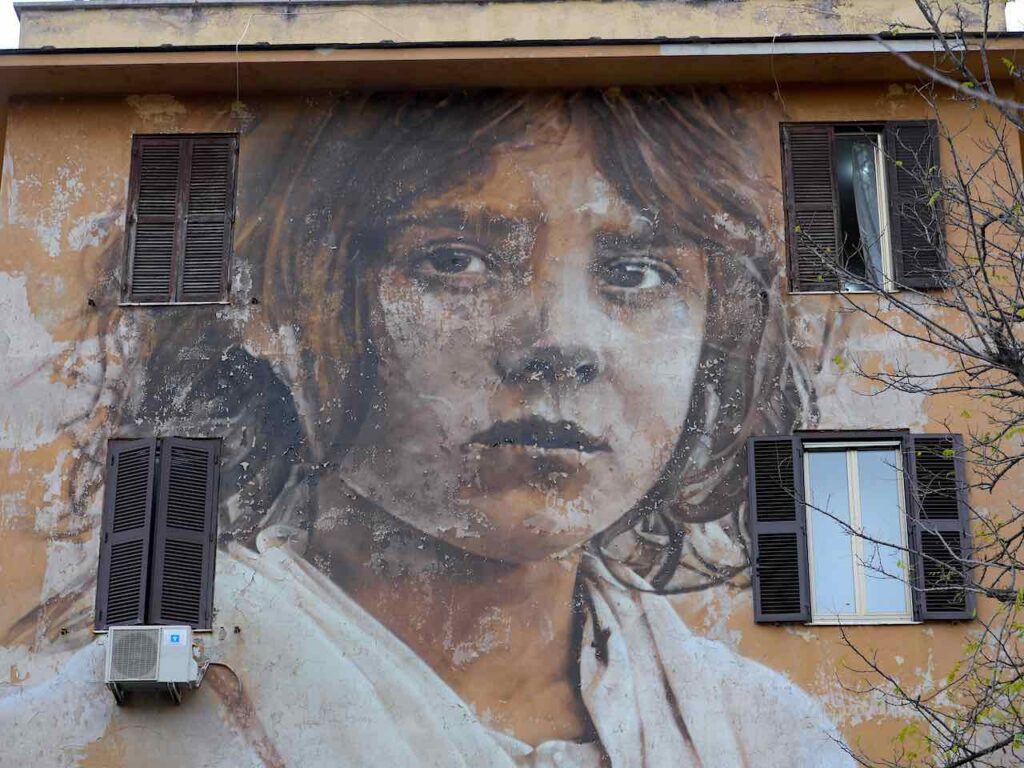
There are many opportunities to admire contemporary art in Rome. The coolest (and free) is murals street art. You’ll find murals on lots of buildings in Rome’s suburban neighborhoods.
One of the most remarkable street art endeavors in Rome to date is in the Tor Marancia neighborhood in south Rome. Spearheaded by a non-profit cultural foundation, this project has transformed a public housing block on Tor Marancia Street into an open-air museum.
Tor Marancia itself has a history dating back to the 1920s when the construction of the expansive Via Della Conciliazione led to the displacement of its residents, who relocated to modest stilt houses in an area humorously dubbed “Shanghai” by locals.
Over the decades, these humble stilt houses gave way to modern apartment blocks. Officially named the “Residential Museum of Tor Marancia” or “Big City Life,” this project made its striking debut in 2015, leaving an indelible mark on the neighborhood’s residents, who can rightly claim ownership of this unique museum.
The best part? It’s accessible to everyone at no cost, with an entrance from the street.
What sets this museum apart is the international caliber of the artists who participated in the project.
Famous street artists such as Vhils, Jaz, Gaia, Moneyless, Pantonio, Satone, Guido Val Helten, Matteo Basilé, Diamond, Albernero, Danilo Bucchi, Domenico Romeo, and Jerico.
This project even had the honor of being featured in the Venice Biennale, cementing its status as a world-class showcase of street art.
You can find this remarkable museum at Viale di Tor Marancia, 63
34. Discover Rome’s Past and Present in EUR
The EUR neighborhood, or Esposizione Universale di Roma, stands as a place of both historical significance and contemporary charm within the heart of Rome.
It came into being during the 1930s, during Mussolini’s rule, initially intended as a grand exhibition center for the 1942 World’s Fair. However, the fair was canceled due to World War II. This district beautifully intertwines a rich historical heritage with modern urban planning. As you explore the streets of EUR, you’ll encounter a mix of architectural styles, ranging from neoclassical monuments to functionalist structures.
EUR is home to some of Rome’s iconic landmarks, including the Palazzo della Civiltà Italiana, often called the “Square Colosseum” due to its unique architecture. The EUR Lake, an expansive park in the neighborhood, offers a peaceful retreat from the city’s daily bustle.
In this area, you can enjoy modern amenities and a range of dining options while witnessing the juxtaposition of history and innovation.
Among the highlights of Rome’s EUR district are the museums. You should visit at least two: the Museum of Roman Civilization and the Museum of Popular Arts and Traditions.
The former presents the urban and architectural evolution of Rome with miniature models of ancient buildings.
You must visit it if the remains of marble blocks and columns in the Roman Forum have left you a bit confused and bitter in the mouth.
The second, on the other hand, is a journey through the customs and traditions of Italian popular culture. The museum tour is long and will take several hours to visit.
35. Go off the beaten path in the Garbatella neighborhood
If you love Rome, you should explore some areas off the beaten path. Besides EUR, there are other neighborhoods worth visiting, less spectacular but more enchanting. My favorite is the Garbatella neighborhood.
Garbatella is renowned as one of the finest residential areas in Rome, nestled within the boundaries of Ostiense Street, attracting university students and becoming a hub for academic and creative pursuits. The district offers a delightful array of cafes, such as the Caffè Letterario and Romeow Cat Bistro, along with vintage music clubs and affordable dining establishments. It truly comes to life in the evenings, with a multitude of dining options along Porto Fluviale Street and Delle Conce Street, both of excellent quality and budget-friendly.
But what will impress you most about Garbatella is its architecture, that is unique in the cityscape.
The Garbatella District emerges as one of Rome’s most picturesque places, akin to a charming village immersed in the bustling city. It boasts an architectural and housing layout that is truly unique, fostering an intimate and communal atmosphere.
As a primarily residential area, it enjoys the luxury of escaping the urban traffic, even while maintaining excellent connections to the city center via public transportation.
Embark on a leisurely stroll along Via Domenico Chiodo, Largo Randaccio, Piazza Nicola Longobardi, Piazza Bonomelli, Piazza Montecroce, and Piazza Brin.
You’ll discover by the multitude of houses fashioned in the charming barocchetto style. It’s as if you’ve been transported to a tranquil village, where each house features its own garden, exuding a serene and bucolic ambiance.
The district’s beauty has not gone unnoticed, frequently serving as a backdrop in numerous Italian films.
36. Take a walk in Cinecittà Studios
When you’ve grown weary of the usual tourist-packed museums in Rome, here’s an off-the-beaten-path gem that’s well worth a visit. Cinecittà Studios, the largest film studio complex in Europe, offers an exciting experience for movie enthusiasts. It has served as the backdrop for numerous films set in Rome, making it an iconic part of cinematic history.
Initially constructed to bolster the fascist regime’s propaganda machine, Cinecittà later evolved into a hub for internationally acclaimed films. Famous for iconic movies like “Ben-Hur” and “La Dolce Vita,” it remains a symbol of Italian cinema.
Cinecittà boasts a rich history, and its sprawling sets have witnessed the creation of numerous cinematic masterpieces. One fascinating tidbit is that during World War II, the studio’s structures were camouflaged to appear as ruins, protecting them from Allied bombings. Cinecittà is where the legendary film director Federico Fellini shot many of his iconic movies, solidifying its place in cinematic folklore.
You can book tickets online by emailing the museum directly at visit@cinecitta.it. Tickets range from 10 to 15 euros and grant access to permanent and temporary exhibitions and film sets. Among Cinecittà’s main attractions is a stroll through meticulously reconstructed streets, each representing historical and international settings, immersing visitors in immersive and detail-rich atmospheres.
Take a tour of the production studios to witness the art of filmmaking and television series production. The exhibitions showcase the evolution of Italian cinema through costumes, sets, and authentic film production artifacts.
Admire clothing worn by legendary actors and actresses and props from iconic films. A visit to the Cinecittà Museum is a must, providing a deep dive into the history of Italian cinema with an extensive collection of photographs, playbills, posters, and cinematic memorabilia.
Between your explorations, savor a delightful coffee or some snacks at the various venues within Cinecittà, understanding the significance of a good coffee on a film set.
Conveniently located in the southeastern part of the city, reaching this cinematic wonderland is a breeze – just hop on subway line A and disembark at the Cinecittà stop.
37. Fill your suitcase with food souvenirs
The taste experience you’ll have in Rome will be so intense that you might get depressed at the thought of going back to your habits once you leave the city.
The sweetest way to make your culinary relationship with Rome a lasting one is to buy food to take back home. Foods such as cured meats, cheeses, wine, and cookies are easy to transport or ship.
What I recommend to foreign friends visiting Rome is to buy these foods in supermarkets, so you will have the quality that even locals choose at the most affordable prices.
If you don’t feel like going to a supermarket, there are also small delicatessens where you will find the products of the Roman countryside. One of them is Cacio Della Campagna Romana on Via dei Giubbonari, near Campo dei Fiori Square in the historic center.
38. Browse the layers of the city in the Basilica di San Clemente

After walking around the historic center of Rome for a while, you will find that the city is spread over different planes or layers, each belonging to a different historical period.
There is one building in Rome where you can go through these layers by taking a trip back in time: the Basilica di San Clemente.
At street level, you will see a religious building from the 12th century, with beautiful mosaics in the apse. Descending to the story below, you will discover the 4th-century early Christian basilica with ancient frescoes. Further down to the Roman-era level, you will find a cave dedicated to worshiping the god Mithras and the ancient walls of a mint.
You can reach the Basilica of San Clemente from the Colosseum by walking for about 5 minutes.
Note: Christian Catacombs
Those interested in religious art may be wondering where on this Rome bucket list I will put the Christian Catacombs.
I admit that I have no pleasure in visiting underground cemeteries; it gives me anxiety to walk through corridors with hundreds of burial niches.
Catacombs are underground cemeteries where early Christians buried their loved ones before the Christian religion was allowed (5th century.)
There are many in Rome that you can visit; it is a chance to admire early Christian painting. Here are the best Christian catacombs to visit in Rome.
- Catacombs of St. Priscilla, in the northeastern part of the city
- Catacombs of San Callisto, Domitilla, and San Sebastiano in the Appia Antica Archaeological Park.
39. Bike along the course of ancient aqueducts
One of the motivations behind your choice to visit Rome undoubtedly lies in the city’s consistently delightful weather throughout most of the year.
Rome boasts numerous public parks, some of which are expansive and adorned with historical landmarks. Among these, the Aqueduct Park stands out, situated in the southeastern part of the city, conveniently accessible via the Lucio Sestio Metro A stop.
For an optimal exploration of this park, I recommend renting a bicycle from FuoriDiRuota. By pedaling along the various pathways that wind through the remnants of seven impressive Roman-era aqueducts, you’ll be treated to awe-inspiring scenery.
The massive arches in the background are framed by colorful flower fields, making for a truly breathtaking experience.
A crucial note: To secure a bicycle rental, it’s essential to make prior arrangements by reaching out via email to fuoridiruota@gmail.com.
While Aqueduct Park primarily draws locals, if you’re looking to connect with fellow travelers, you’ll find Ancient Appian Way Park a better choice.
This park is not far from the city center and can be reached by taking the Metro B to the Garbatella stop and a short walk. Despite its proximity to the heart of Rome, Ancient Appian Way Park imparts a rural ambiance with open fields and grazing sheep.
Along the Ancient Appian Way, characterized by its broad cobblestone path, you’ll encounter the remnants of numerous aristocratic Roman villas.
Should you decide to explore the Appian Way by bicycle, I strongly recommend renting an e-bike, as pedaling on the ancient stone surface can be quite demanding.
You can arrange this at the Appia Antica Eco-bike Service Center, conveniently located at 58 Via Appia Antica.
40. Beat the cold in the thermal baths

Although Rome’s weather is clement year-round, there are several weeks of cold weather. Roman emperors warmed up at the Baths of Caracalla, a large thermal complex near the Aventine Hill. Today, you can only admire the impressive remains of those baths because they closed their doors in the 6th century.
But, contemporary Romans did not give up glorious thermal baths. To do so, they have to leave the city and travel to one of the many natural thermal baths near Rome.
Near the city of Viterbo, north of Rome, there are thermal springs of very hot water. To enjoy them, spend a day at the Terme dei Papi spa or Therma Oasi, which feature monumental pools. If you prefer free pools instead, head to Piscine Carletti.
East of Rome are the Acque Albule, near Tivoli, perfect for the in-between seasons as their waters are not extremely hot.
If, on the other hand, you can treat yourself to the Tuscan border, you will be able to admire some of the most unique thermal landscapes in the world: the Cascate del Mulino waterfalls in Saturnia and the White Whale in Bagni San Filippo.
42. Go see the sea

If you travel to Rome in the summer, it will be hard to resist the call of the beach. The city of Rome lies 30 km from the Tyrrhenian coast, where many beach towns await you.
Ostia Beach is part of the municipality of Rome and you can easily reach it by train from Porta San Paolo-Piramide. The train also stops at the ruins of Ostia Antica.
The disadvantage of swimming in Ostia is that the water is not exactly clean. I prefer to travel north and reach Santa Severa Beach, which has crystal clear water, especially in the morning. This beach is mostly frequented by locals, who especially like the part of the beach nicknamed “Castle Beach.” Here stands a Renaissance castle that also houses museums.
In Castle Beach, you can also rent a beach bed and umbrella to spend the day in complete relaxation. If I were you, I would also stop for lunch at the seafood restaurant L’Isola del Pescatore, located directly on the beach.
To reach Santa Severa Beach from Rome, take a train from Roma Termini bound for Santa Marinella and get off at Santa Severa Nord station.
43. Watch a soccer match at the Olympic Stadium
Soccer is the most watched sport in Italy. Rome is home to two teams, A.S. Roma and S.S. Lazio, which are also two of the strongest teams in Italy. Going to the Olympic Stadium to watch a match of one of these two teams is one of the most exciting cultural experiences to have in Rome. The days when the derbies between Roma and Lazio take place are when the fans are most passionate and organize “choreographies.”
The Stadio Olimpico can seat about 60k people indoors. To purchase tickets, check out the official websites of the Lazio and Roma teams.
The Olympic Stadium also hosts concerts by famous artists, especially in the summer.
44. Have fun with the whole family at the Borghese Gardens

Families with children are travelers who have the hardest time coming up with a Rome bucket list that fits their needs.
A highlight for those visiting Rome with kids should be the Borghese Gardens, a vast public park located right in the historic center.
You can spend half a day exploring the historic landmarks and the other half playing in Borghese Gardens.
Besides stand a blanket and picnic in the shade of a monumental pine tree on the verse lawn, there are plenty of activities for kids.
You can rent a rowboat and explore the pond, or rent bicycles or even a rickshaw.
To reach Borghese Gardens from other parts of Rome, take Metro A and get off at Flaminio-Piazza del Popolo.
45. Cruise Rome’s Streets with a Vespa Sidecar Adventure
There are many things to do in Rome, but travel time is short. If you’ve seen one of the most famous movies set in town, Roman Holiday, you’ve probably also dreamed of getting around Rome on a Vespa Scooter.
The good news is that you can. There is a tour that allows you to ride a Vespa in a sidecar, enjoying the view and leaving the tricky part, which is driving, in the hands of an experienced local.
This 3-hour adventure starts at the central Piazza di San Marco, adjacent to Piazza Venezia, and takes you to Rome’s most famous sites, including the Colosseum, Baths of Caracalla, and the intriguing Pyramid of Cestius. Ascend the picturesque Aventine Hill and take a moment to relax at the tranquil Orange Garden. You’ll also zip by the Circus Maximus before reaching the lively Trastevere neighborhood.
Here, you’ll take a break and savor a delicious gelato or a coffee. The tour culminates with a ride up Janiculum Hill, where you’ll be rewarded with breathtaking panoramic views of Rome.
Have a look at the availability of the Vespa Sidecar Tour here.
Wrap-up
Through this Rome bucket list, I have made you discover that you will not need a whole week to see Rome.
That is precisely the essence of the Eternal City. A crossroads of peoples, cultures, artistic styles. An overlapping of eras.
To enjoy your trip to Rome to the fullest, I recommend devoting each day to a different area of the city. And above all, to devote at least four full days to your trip.
Let me know in the comments how many things you’ve decided to do from this bucket list things to do in Rome.
9nL5fLXj_