
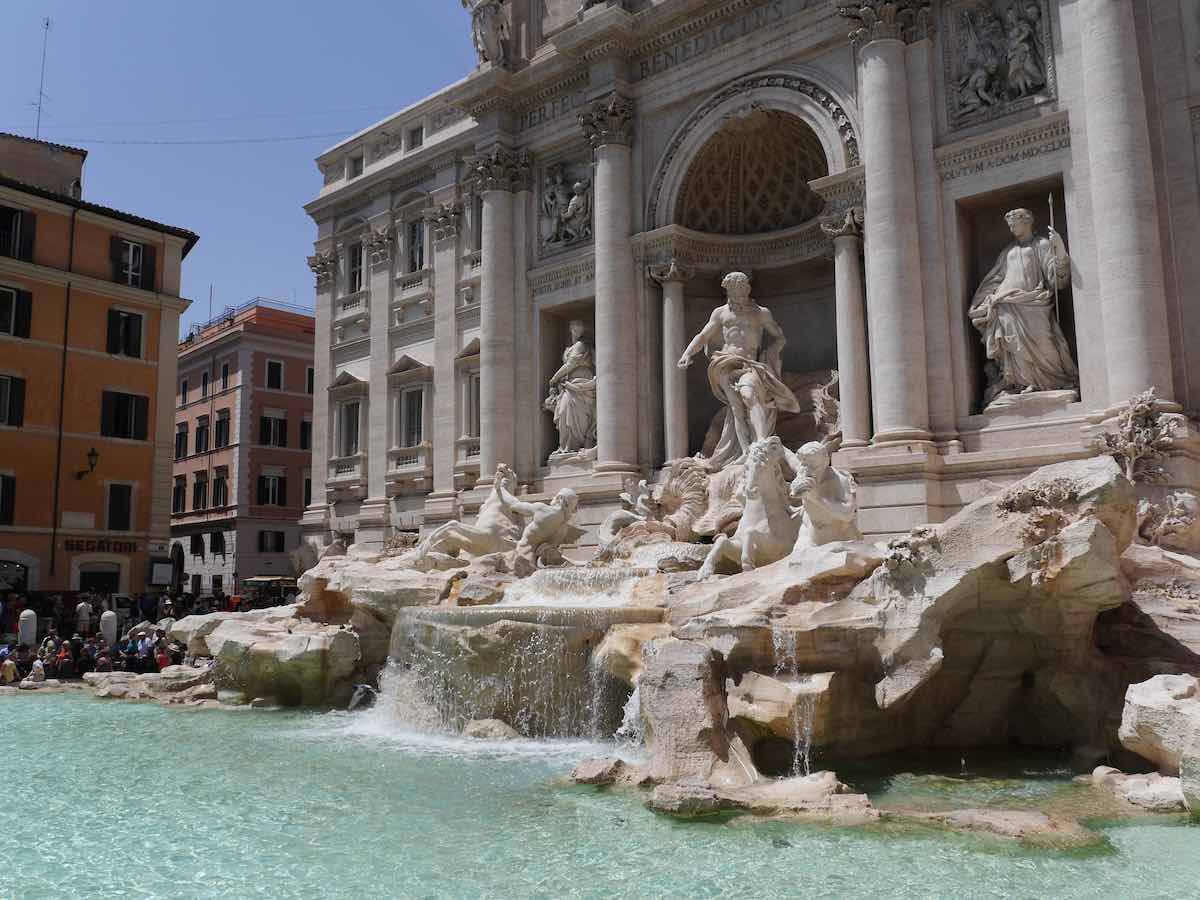
In this article, I reveal the most interesting facts about the Trevi Fountain, one of Rome’s most popular sites among travelers and locals alike.
The beauty of this fountain, its monumental size, and the sound of the water make this place so mesmerizing that I never tire of visiting it.
I go to the Trevi Fountain several times a week for my work. The atmosphere is filled with the cheerful chatter of the hundreds of people who visit at all hours of the day, taking photos and videos. It’s hard not to get caught up in the excitement.
I’ve gathered some intriguing tidbits that you’ll want to know before visiting the Trevi Fountain, like the movies filmed here, the legend of the coin toss, and what happens to those who dive into the fountain.
Facts you need to know about the Trevi Fountain
1. It took more than 1,700 years to build the fountain
The sculptural masterpiece we admire today dates back to 1762, the year the fountain’s renovation was completed. But to understand the hydraulic engineering marvel that supports it, we have to go back to 19 B.C.
At that time, Commander Agrippa, right-hand man to Emperor Augustus, ordered the construction of the Aqua Virgo aqueduct. This aqueduct, unique among ancient Roman aqueducts for still being in use today, collects water along the Via Collatina, 20 km east of Rome, and, after serving houses and other fountains in the historic center, it arrives at Piazza di Trevi.
It’s precisely in this square that Pope Urban VIII, in the 17th century, wanted to celebrate the healthy water of the Aqua Virgo with a grand fountain. He enlisted the help of Gian Lorenzo Bernini, the creator of some of Rome’s most beautiful sculptures.
In Roman and medieval times, the fountain was nothing more than an ordinary marble basin. Bernini died before he could renovate the fountain.
Pope Clement XII then commissioned architect Nicola Salvi. He also died before completing the work, which was then handed over to Giuseppe Pannini.
2. It’s famous thanks to a movie
Cinema has greatly contributed to making the Trevi Fountain known worldwide, so much so that everyone wants to see it as soon as they arrive in the city. Among the films shot in Rome that feature the fountain, the most famous is La Dolce Vita, with the scene of actors Anita Ekberg and Marcello Mastroianni bathing in the basin.
In Roman Holiday, Audrey Hepburn, in one scene, goes to get her hair cut at a hair salon overlooking Piazza di Trevi.
The fountain also appears in Woody Allen’s film To Rome with Love. Among Italian films, one of the most popular is Totò Truffa ‘62, where a local, played by the famous Neapolitan actor Totò, tries to sell the Trevi Fountain to an unsuspecting tourist.
One of my all-time favorite films that showcases the fountain is C’eravamo Tanto Amati with Stefania Sandrelli.
3. Throwing one, two, or three coins into the fountain brings luck
Once you’ve managed to make your way through the lines of travelers, you’ll reach the edge of the fountain and see everyone performing a strange ritual of tossing coins.
It’s interesting to know the origin of this custom. In ancient times, it was believed that water was home to various deities, so it was common practice to throw coins or precious objects into the water to win their favor.
In the 19th century, a German archaeologist working in Rome introduced this propitiatory gesture of throwing a coin into the fountain because he had fallen in love with the city and wanted to return.
Over time, this custom has been solidified and structured. Today, if you want to ensure good luck in returning to Rome, you must turn your back to the fountain, close your eyes, and toss a coin with your right hand over your left shoulder. It’s easier done than said.
But that’s not all. According to another tradition, if you throw two coins into the Trevi Fountain, you’ll find love, and if you throw three, you’ll get married. If that’s something you’re interested in…
This is one of the info that you could get from any half-day tour of Rome‘s highlights with a local guide. Anyway, don’t stress too much on how to toss the coins: it’s the intention and your desire to come back to Rome that matter!
4. The “glass” tradition
Once again, it’s the feeling of love that has given rise to yet another custom, popular at the beginning of the last century. This is the tradition of the glass. According to a belief, couples who are about to be separated for a long time, such as in the case of military service or an imminent trip, can strengthen their bond with a slightly magical trick.
The woman must give her partner water from the fountain to drink in a glass. Once he has drunk, the woman must throw the glass to the ground. This ensures that the couple will reunite. Quite an unusual thing to do in Rome, but why not try it?
5. It’s a gold mine
Now, for a moment, try to imagine the number of coins that end up at the bottom of the Trevi Fountain’s basin every day. Surely, they number in the thousands.
According to the news outlet Today.it, last year, the fountain received about 1.6 million euros, quite a sum.
The proceeds go to Caritas, a church organization with the mission of helping the underprivileged, the socially marginalized, and the needy.
Twice a week, the workers of the agency that supplies water to the city, Acea, empty the fountain, clean it, and collect all the coins. Even though access to one of Rome’s most famous monuments is free, it still manages to make money.

6. It’s strictly forbidden to touch the water
If you’ve visited the Trevi Fountain at least once, you’ve probably noticed that if a tourist tries to sit on the edge or touch the water, they’re immediately scolded with a whistle by the police or other nearby officials.
The fountain is monitored by live guards and 24-hour cameras. Recently, a woman sat on the edge and dipped her legs in the water. Meanwhile, a man climbed the central rock-like sculpture and dove headfirst into the water, swimming and then walking as he had seen in the famous film. Both excited travelers were fined €450 and immediately removed from the site.
If you want to play the part of an actor for a day, be aware of the consequences.
7. Many architects and artists contributed to its creation
When I give my tours in the historic center of Rome, I’m often asked who is the artist behind the Trevi Fountain. I then suggest we sit down and order a coffee. The story of the creation of this fountain took almost 2,000 years.
The last major renovation was in the 17th century, designed by architects Nicola Salvi and Giuseppe Pannini. The sculptural group is by Pietro Bracci.
8. It’s so large because it represents the ocean
Now it’s time to learn the story behind the fantastic travertine marble figures that populate the fountain. The giant more than six meters tall at the center, framed by the semicircular niche with two columns, is Oceanus, or Neptune, the god of the sea. Proudly, he strides on a chariot shaped like a shell, with his hand showing the grandeur of the sea, represented by the basin that holds the water.
Two winged horses pull the shell: one represents the stormy sea and the other the calm sea.
Behind the god, there are two niches with women representing the two qualities of the water brought here by the Aqua Virgo: abundance and healthiness.
9. The fountain’s water is legendary
Now I want to reveal something about why the water that flows from this fountain is also called Acqua Vergine and why the aqueduct that brings it here is called the Aqua Virgo.
Around 20 B.C., Commander Agrippa sent a delegation of soldiers to search for clean, drinkable water to bring to Rome. The soldiers searched east of Rome along the Via Collatina. When they had almost given up hope, they encountered a young girl who showed them where the spring was. That’s why it’s called “Virgin,” in memory of the girl thanks to whom the work on the 20 km-long aqueduct began, which is still in use today.
10. The fountain is built into the wall of a palace
After you’ve recovered from the wonder of gazing at the Trevi Fountain, look around. The square where the fountain is located is quite small, with the fountain occupying most of it.
To be precise, the fountain occupies an entire wall of the Poli Palace, which today houses the Central Institute for Graphics, which is also a museum.
The palace, which dates back to the Renaissance (15th century), is famous for having hosted an illustrious French college and for the Dante Hall, where concerts and receptions were held.
11. It’s one of the most visited works of art in Italy
If I still haven’t convinced you to add the Trevi Fountain to your Rome bucket list, know that it’s one of the most appreciated works of art in Italy and the entire world. The visit is free since the fountain overlooks a public square.
You’ll find hundreds of other travelers at any hour of the day or evening. The only exception might be early in the morning, before 7 a.m.