
The thought of “how to get around in Rome” isn’t just a concern for travelers, but also for locals and those like me who were born and have always lived here.
If you have friends who have already traveled to Rome and have shared their experiences, they probably told you these things:
- The city is bustling, full of cars and motorcycles everywhere barely obeying the traffic rules.
- Public transportation, like the roads, is crowded!
- The attractions are also quite far apart because the historical center is vast.
These reflections aren’t just whimsical thoughts but are indeed true. I confirm that getting around Rome isn’t very easy, and I advise you to prepare so you don’t feel overwhelmed once you arrive in the Eternal City. In this article, I want to help you: I’ll give you some tips that will help you organize your movements better.
Let’s get right to the point.
Most useful tips for getting around in Rome
1. You won’t walk all the time

One observation I often hear from those returning from a trip to Rome is: the best way to see Rome is on foot. When they make these statements, they are simplifying and only remembering part of the story, which is actually complex.
It’s true that walking in Rome is a unique experience. Indeed, you don’t just go from point A to point B to see exceptional monuments: the city is a continuous spread of historical testimonies and architectural treasures that seems endless.
And so you can walk and walk and walk… without ever getting bored. But then, will you have the energy to see everything on your list of things to see in Rome?
Time is limited, there are many things to see, and everything requires energy: communicating, waiting in lines at monuments, searching for a place to eat…
If you have a plan of action, an itinerary, you might need, besides very comfortable shoes, means of transport.
2. Walking Distances are a thing
To expand on the reflections from the paragraph you just read, I will give an example of distances that a traveler should consider (to which you must add the movement from and to your hotel):
- Distance from the Colosseum to the Trevi Fountain: 1.6 km
- Distance from the Colosseum to the Vatican Museums: 4.2 km
- Distance from the Colosseum to the Pantheon: 1.8 km
- Distance from the Colosseum to the Borghese Gallery: 3.3 km
- Distance from the Colosseum to Trastevere: 2.6 km
These are just a few of the places you’ll want to visit in Rome. Consider that there are also nice neighborhoods to explore, shopping streets, and countless hidden gems. Not to mention how large the museums are, inside which you must walk.
The historic center of Rome covers an area of about 20 square kilometers. You’ll only sit down for meal times (unless you decide to eat delicious street food on the go). Are you still convinced that you’ll only walk in Rome? 🙂
3. Metro isn’t the best

Having lived for about 30 years in the outskirts of Rome, I always used the metro to move towards the historic center. To be precise, I walked 1 km to catch a city train that took 20 minutes to reach the metro, and from there it was 5 stops to the center, totaling more than an hour of travel… Rome is a large metropolis.
Maybe you’ll stay in a hotel in the historic center, which will make getting around Rome easier. However, if you want to shorten the walks, you’ll rely on the metro.
Currently, the potential of the Rome metro is limited. There are only 3 metro lines, so when choosing where to stay in Rome, consider the presence of a metro stop that is easily reachable.
The bad news about the metro in Rome is primarily that the main 2 lines, which are located (more or less nearby) the famous monuments, intersect only at one point: Termini Station. This, in addition to being the meeting point of lines A and B of the metro, is also the central station of Rome, which is the capital of Italy. This means it is extremely crowded.
Also, I warn you that to change metro lines, you have to walk about 15 minutes through a crowd of people. During peak hours 8-9:30 AM, 1-2:30 PM, and 5-7 PM, the chaos is such that I often gave up on taking the metro to avoid making the switch. The switch must be made for instance to go from the Colosseum (line B) to the Vatican Museums (Line A) and the Spanish Steps (Line A).
4. Historic Landmarks along the metro lines
The good news is that you’ll find the Colosseum right as you exit the “Colosseo” metro station, standing before you in all its magnificence. But that’s about it. The Spanish Steps are a few steps from the “Spagna” metro stop, but to get out of the metro you have to walk about 10 minutes, so don’t rely on it if you have difficulty walking.
The entrance to the Vatican Museums is about 550 meters from the “Ottaviano” metro station. Other attractions such as the Pantheon and the Trevi Fountain are about 20 minutes’ walk from the metro.
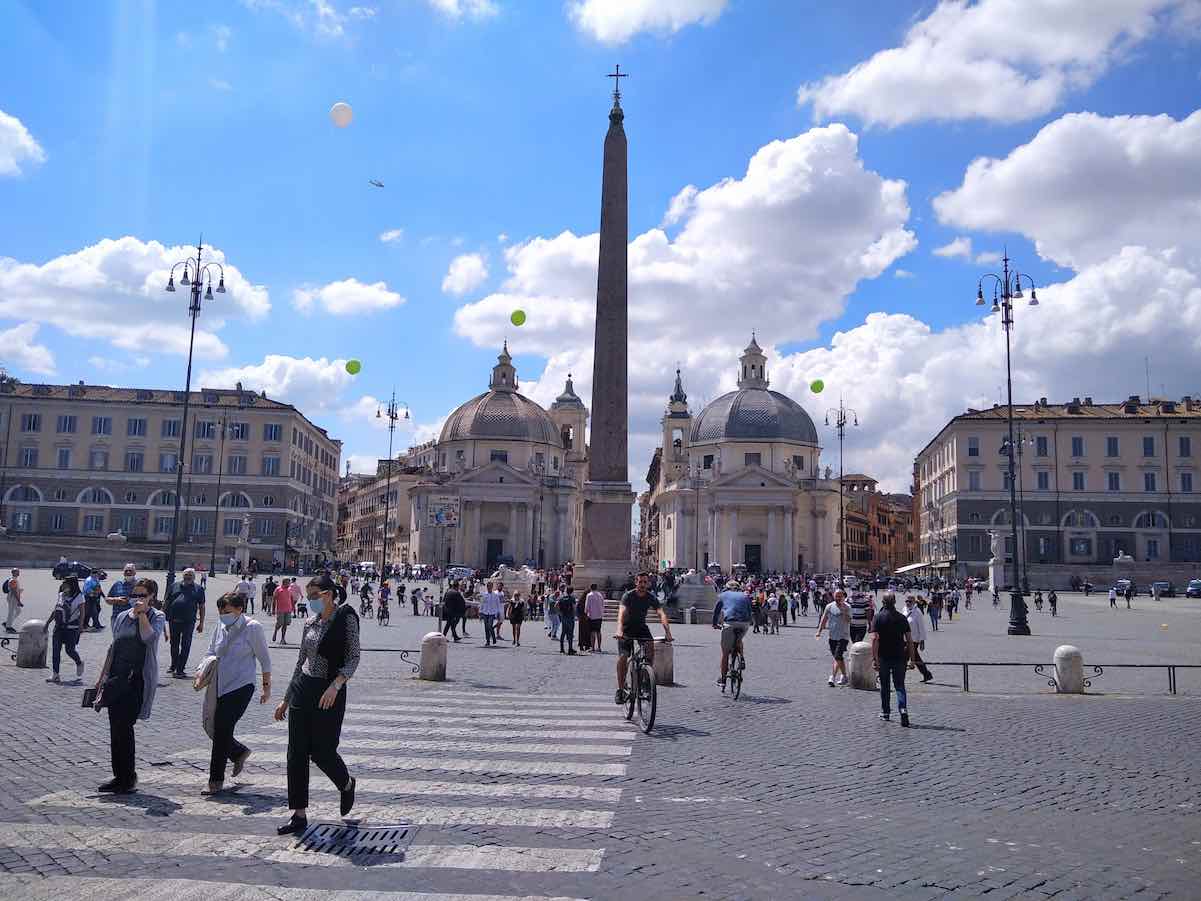
A place I adore and that is easily visited with the metro is the beautiful Piazza del Popolo: if you haven’t added it to your itinerary yet, you should, its treasures will surprise you.
5. Taking buses might help

At this point, if you want more concrete help to get around Rome with public transport, you have buses and trams. Bus lines decently cover the whole city, the buses are fairly new and have a reasonable number of seats, while those standing find themselves playing sardines, because the standing space is very scarce.
The easiest way to plan bus trips is to use an app like Google Maps or Moovit. I recommend you learn how to use and where to buy bus tickets in Rome because the fines are hefty and to avoid finding yourself uncomfortable and not knowing what to do, because the situation is peculiar and different from other cities.
It’s true that buses are slow because they travel on the same lanes as private cars, which are always numerous in the historic center, but I admit I prefer the bus to the metro. When the metro is crowded, I sometimes feel faint, especially in summer.
If I take the bus, I don’t have this problem. Buses that pass through the historic center are the target of pickpockets: be very careful.
Due to intense traffic, I advise you to take the bus ride earlier than the one you would usually take to arrive at a place at a certain time.
6. Trams are kind of useless for tourists
The tram is the public transport I prefer in my city. I find it much more elegant than the bus, less crowded, and more practical because it travels on preferential lanes.
However, the few tram lines that pass through Rome do not cover the usual tourist routes, so I don’t think they will be useful to most travelers.
I would like to point out that tram number 8 travels between Trastevere and Piazza Venezia, and so if you decide to stay in Trastevere (as many others do), you should use it to reach the historic center, the Colosseum, etc.
Meanwhile, tram 19 connects the suburban neighborhood of Centocelle to Piazza Risorgimento, which is a stone’s throw from the Vatican Museums and St. Peter’s Basilica: consider this option if you want to stay in one of the liveliest and youngest suburbs of Rome.
7. Taxis could help
Taking a taxi in Rome remains the only reliable and effective alternative for those who have difficulty walking. Taxis can travel to every part of the historic center and can drop you off at the entrance to attractions.
If you have little time but some money to spend and can’t cover stretches on foot, this is the best option. Booking a private driver could save you money.
To book a taxi in Rome with a phone call, call Radio Taxi at +39 063570, or use the APP Free Now.
8. Forget about driving in Rome
This is coming from someone who got her driver’s license in Rome, who drove here for 20 years, and who hates driving in this city. And anyway, everyone says it: driving in Rome is a bad idea if you’ve just arrived in town.
Even those born and raised here find it difficult and would prefer not to drive. It’s not just because of the traffic but mainly for cultural reasons. Roman drivers tend to be reckless, distracted, disrespectful of traffic rules, aggressive towards other drivers and even walkers.
What I always say is that Rome is a safe city but can become dangerous if you cross the street carelessly. There is a high rate of road accidents in this city. Finding parking is difficult.
The main reason I don’t like to drive in Rome is that the signage is insufficient, I can get lost even using a GPS, and it’s all too easy to take a wrong turn or drive in a taxi or bus lane, risking an accident or a fine. However, I’m sure you have no intention of driving in Rome.