
In this post, I’ll take you on a journey through Baroque art in Rome. Among its many eras, the Baroque period stands out for its opulence, creative fervor, and expressive intensity.
It’s certainly one of the elements that make Rome unique and enchanting. Therefore, I believe that one of the best ways to make a trip to Rome unforgettable is to get to know it through its Baroque masterpieces.
But let’s start from the beginning: the Baroque period flourished in Rome between the 16th and 18th centuries, characterized by a desire for grandeur, exuberance, and theatricality in art and architecture.
The popes of the time saw Baroque art as a powerful tool for communication and propaganda of the Catholic faith. Thus, the city was transformed into a stage of splendor, with sumptuous churches, spectacular fountains, and imposing squares.
I’ll start this artistic journey from St. Peter’s Basilica and move on to the magnificent Piazza Navona, the masterpieces of Caravaggio and Bernini, as well as other artworks and places off the beaten tourist path.
St. Peter’s Basilica

St. Peter’s Basilica is one of the most renowned manifestations of Baroque art in the world. It fully embodies the majesty of the Catholic Christian faith.
Its history dates back to antiquity when Emperor Constantine the Great decided to build a basilica over the traditional site of Saint Peter’s tomb, one of Jesus Christ’s twelve apostles.
The construction of the current basilica began in 1506 under Pope Julius II and lasted over a century with contributions from various prominent architects, including Bramante, Raphael, Antonio da Sangallo the Younger, Michelangelo, and Gian Lorenzo Bernini.
These Renaissance and Baroque masters left an indelible mark of their genius on the basilica, and uncovering their touches during a visit can yield incredible surprises.
The layout of the structure is a Latin cross, about 186 meters long and 114 meters wide. Entering for the first time, I was stunned by its size, which I hadn’t fully grasped from the outside.
The facade, created by Carlo Maderno in the 17th century, is decidedly imposing and, in a sense, very welcoming. In the center stands a large pediment, topped by a cross and a statue of Christ.
The white marble Corinthian columns frame the main entrance, while statues of the twelve apostles adorn the balustrade. Yes, these are the ones you’ve seen in Dan Brown’s film set in Rome “Angels and Demons” 😉.
One of the most impressive features of St. Peter’s Basilica is its dome, designed by Michelangelo. It dominates Rome’s entire skyline and offers a spectacular panoramic view of the city. Michelangelo managed to combine classical elegance with the structure’s grandeur, creating an architectural masterpiece that continues to inspire admiration even after nearly five centuries.

Let’s now move to another square whose fame and splendor have reached the world: Piazza Navona. This Baroque jewel, heart of the Parione area, represents an unparalleled celebration of 17th-century art and architecture.
Built on the foundations of an ancient stadium, this Baroque square was transformed into a grand scene by some of the greatest masters of the era, including Gian Lorenzo Bernini and Francesco Borromini.
At the center of the square stands the Fountain of the Four Rivers by Bernini. Four colossal allegorical figures, representing the rivers Nile, Danube, Ganges, and Rio de la Plata, emerge from the fountain, each with a different expression reflecting the diversity of the known world. I invite you to linger on the details of the statues’ facial expressions.
I’m always fascinated by the perfection with which each one embodies a thought or sensation. The scene is further enriched by naturalistic elements, animals, and plants, giving it an additional sense of dynamism.
Around the square, the Church of Sant’Agnese in Agone contributes to the Baroque atmosphere of the area. The convex facade of Sant’Agnese in Agone by Borromini, is a visual spectacle with elaborate decorations and sculptures revealed as you approach. Every time I pass by, I like to think of Piazza Navona as a fascinating example of how Baroque art can transform an urban space into a living theater of artistic expression.
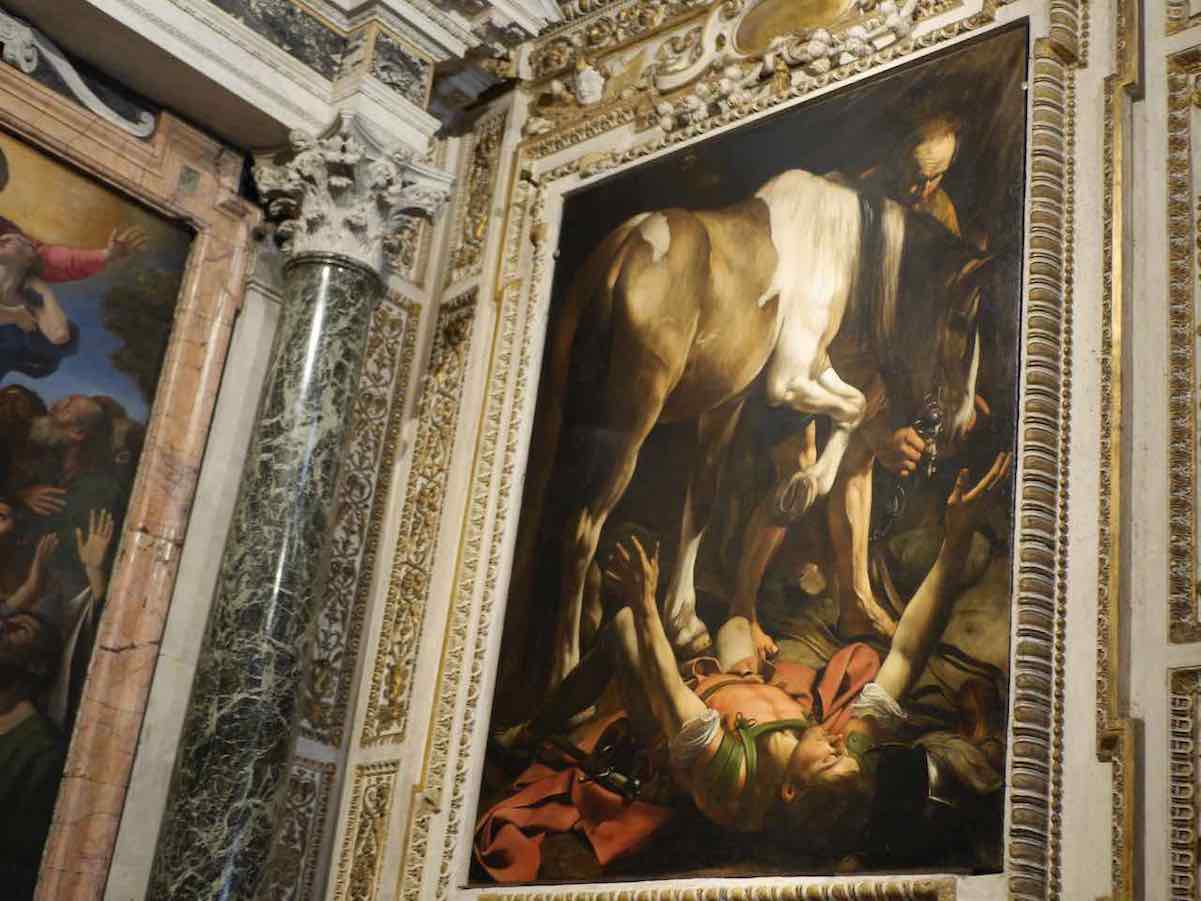
The most famous Italian painter in the world (if he isn’t already, I think he should be) is Michelangelo Merisi, whom we all call Caravaggio, named after the place of his birth. His works triumph in galleries and museums in major cities in Italy and around the world, but here in Rome, you can find some masterpieces simply by walking through the historic center.
Churches

In particular, there are three churches where you can admire Caravaggio’s paintings and enter freely. These are Santa Maria del Popolo, San Luigi dei Francesi, and the Basilica of Sant’Agostino. The artist who introduced conceptually revolutionary innovations in religious figurative art and the use of light lived many years in Rome, where his popularity reached its peak and, unfortunately, its depths.
The film “Caravaggio’s Shadow” deals with these events and the immensity of this character from a human and philosophical point of view, and I recommend watching it before visiting the eternal city.
Palazzo Barberini
Between 1627 and 1633, Carlo Maderno, Gian Lorenzo Bernini, and Francesco Borromini joined their wonderful minds to create another Baroque gem in Rome: Palazzo Barberini. It is located on Via delle Quattro Fontane, and today, along with Palazzo Corsini, forms part of the National Galleries of Ancient Art.
Inside, you’ll find Baroque masterpieces like few other places in the world: Caravaggio, Raphael, and Titian are just a few of the artists whose works you’ll encounter. If you’ve never been, I highly recommend visiting. It’s a must-see stop to make your Roman experience fully immersive.
But let’s get back to Palazzo Barberini. The main facade, by Carlo Maderno, is an example of Baroque classicism, characterized by a play of columns, balconies, and windows that harmonize in perfect balance.
At the center of the facade, the large coat of arms of the Barberini family testifies to the power and influence of this dynasty in the art and politics of the time.
In the center of the palace, the main hal by Gian Lorenzo Bernini, is another clear example of Baroque grandeur. The ceiling frescoed by Pietro da Cortona, titled “The Triumph of Divine Providence,” is an extraordinary composition of colors and allegories.
Another peculiarity of Palazzo Barberini is the helicoidal staircase by Francesco Borromini. Climbing it will make you feel like a true pasha, even if just for a moment. It is a double staircase, unique of its kind, winding with grace and harmony, adding an element of movement and dynamism within the palace.
Ponte Sant’Angelo
The Tiber River features several ancient bridges along its course, but one, in particular, stands out for its history, beauty, and unmistakable touch of Baroque art: Ponte Sant’Angelo. Originally the bridge’s name was Pons Aelius, commissioned by Emperor Hadrian between 134 and 139 AD as part of a personal mausoleum.
The highlight of Ponte Sant’Angelo is ten angelic sculptures adorning the bridge’s parapet that are among the Italy’s most stunning sculptures. The commissioner was Pope Urban VIII and the authors are the best Baroque artists of the time, including Bernini, Antonio Raggi, and Lorenzo Ottoni. The sculptures represent the stages of Christ’s Passion and, in my opinion, create an atmosphere that goes beyond the sacred, bordering on meditative, for the entire length of the bridge.
As with Bernini’s Fountain of the Four Rivers, each statue has open wings and intense, almost dramatic expressions: a distinctive feature of Baroque art. The light playing on the sculptures at different times of the day contributes to creating a sense of movement and life, emphasizing their personification.
Ponte Sant’Angelo is located right in front of Castel Sant’Angelo, a mausoleum fortress later converted into a papal stronghold. The combination of the bridge and the castle offers a fascinating mix of military and civilian architecture, uniting two important aspects of Rome’s history.
I believe that anyone who has had the pleasure of visiting Rome can confirm that it is one of the city’s most suggestive places.
Borghese Gallery
For all sculpture art enthusiasts and beyond, I recommend visiting the Borghese Gallery, which is absolutely a must-visit during your first trip to Rome. It houses the art collection of the noble Borghese family, originally from Siena, primarily assembled by Cardinal Scipione Borghese between the 16th and 17th centuries.
The collection is housed within the palace in the heart of the Borghese Gardens, an estate that belonged to this family, just steps away from Rome’s historic center.
Here among the highlights are the marble sculptures by Gian Lorenzo Bernini, such as the Rape of Proserpina and Apollo and Daphne, characterized by their realism, movement, and pathos.
You can access the Borghese Gallery with a ticket that must be booked in advance.
Church of Sant’Ivo alla Sapienza
The University La Sapienza complex in Rome hosts the Church of Sant’Ivo alla Sapienza, a true Baroque masterpiece designed by the genius Francesco Borromini in the 17th century.
Its captivating and unique facade immediately draws attention, but the interior holds the most extraordinary surprises.
The dome, with its spiral shape reaching towards the sky and its pinecone-shaped lantern, is one of the building’s distinctive features, symbolizing Borromini’s boundless creativity.
Inside, the intricate architecture and breathtaking frescoes create an atmosphere of extraordinary beauty and spirituality.
Although this church is less known compared to other famous Baroque churches in Rome, its uniqueness and splendor make it a must-see for those looking to explore Rome’s hidden wonders.
A visit to this Baroque gem is a journey into the artistic mastery and architectural innovation of the 17th century.
Wrap-up
Here are my recommendations for Baroque art enthusiasts visiting Rome. If you have the opportunity to delve deeper, you will discover that Rome’s Baroque period produced numerous masterpieces of architecture, sculpture, and painting.
These extend beyond the places I mentioned in this post. If you don’t have much time to explore these wonders, then at least dedicate yourself to Caravaggio’s paintings, the sculptures in the Borghese Gallery, and the magnificent Piazza Navona.