
Christmas season is one of my favorite times to be in Rome. It usually isn’t too cold, and I get by with a coat and a hat. There are far fewer tourists than usual. Locals bustle around the shops of the historic center in a lighter mood than usual. Rome’s streets, already beautiful in their own right, compete to see which one has the most beautiful decorations. There are also several Christmas markets, both inside and outside the historic center.
In Rome, the Christmas season runs from December 8, the Feast of the Immaculate Conception, to January 6, Epiphany.
The city has its own traditions and customs when it comes to Christmas. I’ll tell you about all of this in this article to show you that it’s worth spending Christmas in Rome, my city.
Rome at Christmas
Christmas is the most important holiday for this city. As you well know, it celebrates the birth of Jesus Christ, and Rome, after all, is the capital of Catholic Christianity.
Nowadays, the meaning this holiday has taken on is a little different, since the locals, rather than going to Mass, prefer to buy gifts and get ready for the biggest feast of the year.
And this brings us to the topic of food.
Restaurants in Christmas Rome
Of the thousands of restaurants serving Rome’s historic center, many will be open on Christmas Eve and Christmas Day. Tourism is the engine that keeps this city working, and Roman restaurant owners don’t go on vacation right during the holidays. So you’ll find restaurants open, but for Christmas lunch I recommend booking: there’s often a set menu.
You’ll also have the chance to taste winter and Christmas dishes, like puntarelle. On Christmas Eve, tradition calls for a meatless menu, with fish and veggies, while on Christmas Day people eat cappelletti in broth and abbacchio (roast lamb). Typical Roman sweets include torrone, pangiallo (a semi-sweet bread with dried grapes and nuts) and panpepato (sweet bread with pepper.)
Shopping and Supermarkets
In the days before Christmas, take the opportunity to stroll through the city’s department stores.
As a rule, shops, supermarkets, and malls stay open at least until 4 p.m. on Christmas Eve, to allow for last-minute shopping before the holiday, and so also for the last sales. On Christmas Day the shops are closed, but you can head to the Christmas markets.
Christmas Markets
The oldest and most historic market is the one in Piazza Navona, the square of the city’s Baroque art, one of the most beautiful squares in the world. Traditionally it’s the Befana fair, and it lasts until January 6.
The Befana is a figure from Italian folklore: a little old woman dressed in rags who, riding a broomstick on the night between January 5 and 6, brings sweets to good children and coal to naughty ones. Here you’ll find the carousel and the stands with sweets.
If you’re interested in handicraft stands, I recommend these locations:
- Piazza Mazzini Market in the Prati neighborhood
- Auditorium Parco della Musica Market
- Ethica Christmas Village at the Città dell’Altra Economia in the Testaccio neighborhood (closed December 25 and January 1)
- Christmas Market in the Cinecittà neighborhood
Decorations
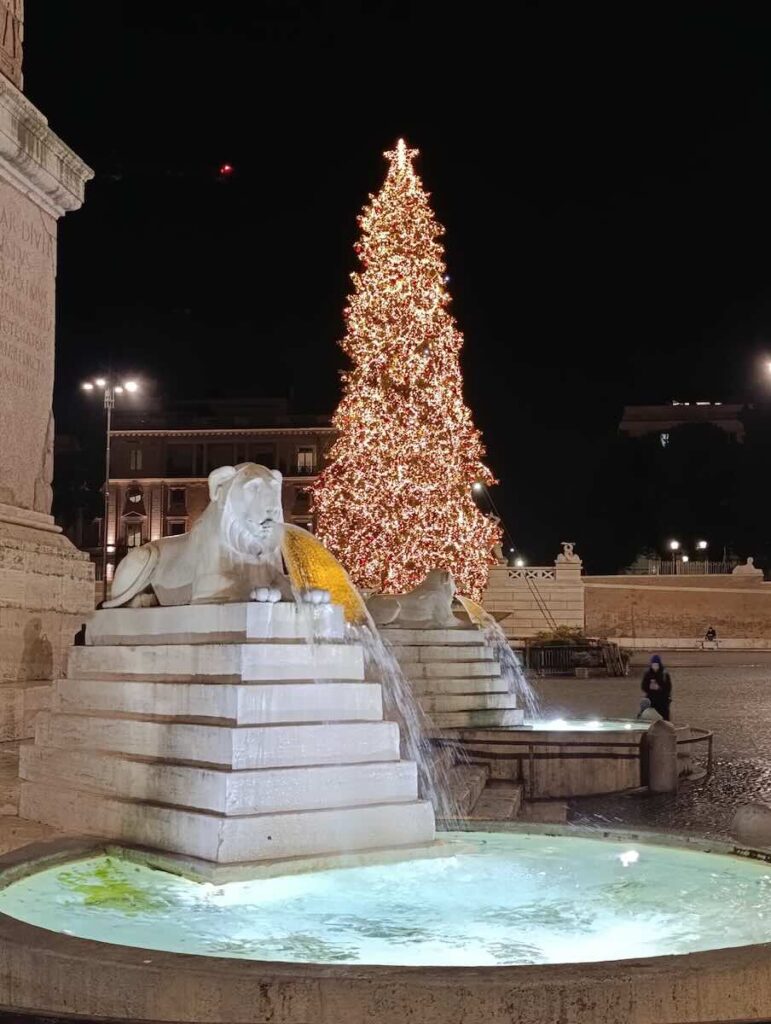
The most striking decorations are the ones put up by shopkeepers in the shopping streets of the historic center, especially those around Piazza di Spagna. I recommend taking a walk along Via del Corso and Via del Babuino. Both streets lead to Piazza del Popolo, where you’ll find a big Christmas tree.
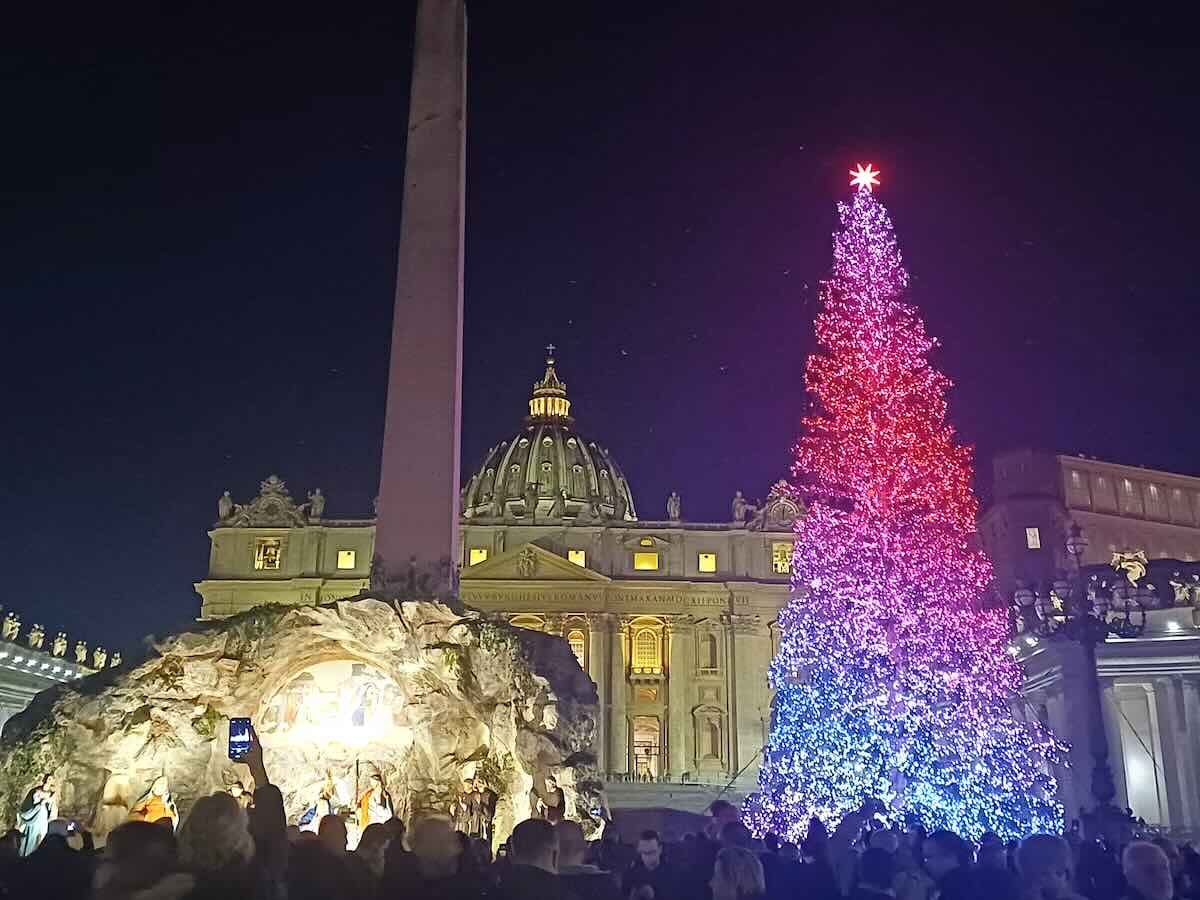
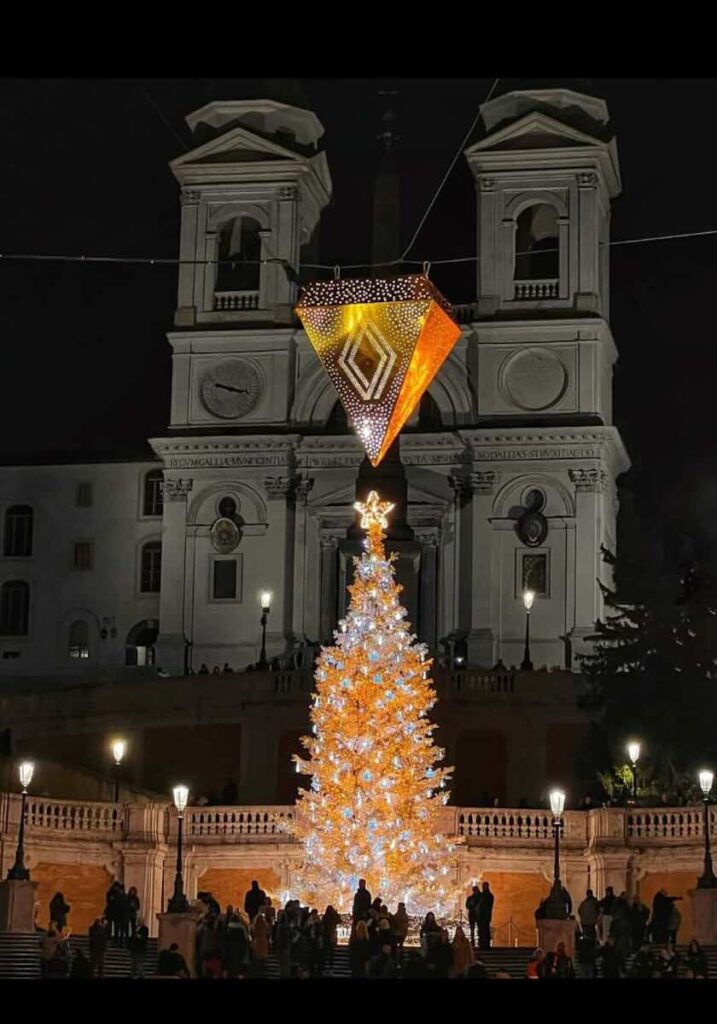
There are decorated Christmas trees on the Spanish Steps and in St. Peter’s Square too, where a large Nativity scene is also set up.
Churches at Christmas
The holiday season is the perfect time to visit Rome’s churches. Almost all of them set up a Nativity scene, and as you walk through the historic center it’s easy to stumble upon a Christmas choir filling the naves with music.
Some churches deserve a special visit. The Basilica of Santa Maria Maggiore holds the relic of the Holy Crib, believed to be a fragment of Jesus’ manger, and the Nativity scene sculpted by Arnolfo di Cambio, the oldest one known.
In the church of Santa Maria in Aracoeli, at the top of the staircase next to the Capitoline Hill, people venerate the Santo Bambino (Holy Child), much loved by Romans.
At Santi Cosma e Damiano, by the Imperial Forums, there is instead a large 18th-century Neapolitan Nativity scene that can be seen all year round.
Not far from the Pantheon, the church of Sant’Ignazio di Loyola also sets up its Nativity scene, and it’s the perfect chance to admire the famous vault frescoed by Andrea Pozzo and its fake dome, a masterpiece of perspective illusion. Step inside, sit down for a few minutes, and let yourself be surprised: it’s one of the most authentic ways to experience Christmas in Rome.
Christmas at the Vatican
The most awaited moment is the Christmas Night Mass, which the Pope celebrates on the evening of December 24 in St. Peter’s Basilica. It isn’t exactly at midnight: last year Pope Leo XIV celebrated it at 10 p.m. Tickets are free and must be requested well in advance. If you can’t get in, you can follow it on the big screens in St. Peter’s Square.
On the morning of the 25th, the Pope also celebrates Christmas Day Mass, and at noon he appears on the central loggia of the Basilica for his Christmas message and the “Urbi et Orbi” blessing.
Last year he also offered Christmas greetings in 10 languages.
A tip: arrive well ahead of time, because the security checks take a while.
Why Visit Rome at Christmas
In conclusion, Christmas is one of the best times to discover Rome. The lit-up streets, the Nativity scenes in the churches, the markets, and the Christmas choirs give the city a warm, intimate atmosphere, far from the summer crowds.
And if your trip stretches until Epiphany, the Befana is waiting for you in Piazza Navona. Rome is beautiful in every season, but at Christmas it has something special.