
Why Visit the Etruscan Museum of Villa Giulia in Rome?
My blog about Rome wouldn’t be complete without an in-depth look at the Etruscan Museum of Villa Giulia.
If you’re a regular reader, you already know how passionate I am about the Etruscans, the civilization that ruled central and northern Italy before the Romans.
The Etruscans had a huge influence on Roman culture, and some of Rome’s legendary kings were Etruscan. The most important Etruscan museum in the world sits just outside Rome’s historic center.
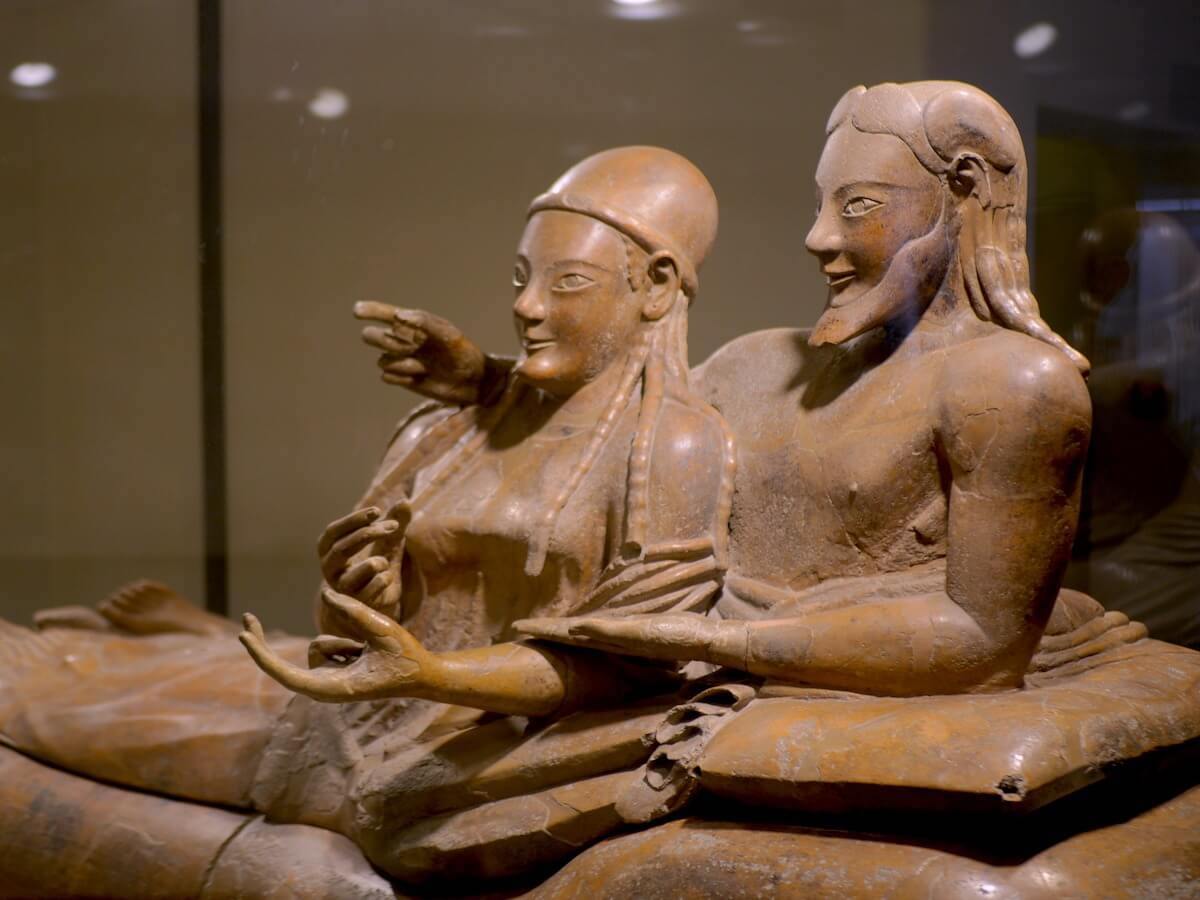
Inside, you’ll find masterpieces you’ve probably seen in art history books, like the smiling couple of the Sarcophagus of the Spouses and the striding Apollo of Veio.
And the setting is part of the experience. The collection fills a Renaissance villa built for a pope, with frescoed halls, quiet courtyards, and an elegant sunken nymphaeum. It’s one of Rome’s great hidden gems, and it’s rarely crowded.
A pope’s country retreat: the history of Villa Giulia
And the setting is part of the experience. The collection fills a Renaissance villa built for a pope, with frescoed halls, quiet courtyards, and an elegant sunken nymphaeum. Villa Giulia’s museum, is rarely crowded (except on the first Sunday of every month, when admission to state museums is free.)
The villa takes its name from Pope Julius III, who had it built in the middle of the 15th Century. At the time, the site lay in the countryside outside Rome’s walls. The pope wanted a place for leisure and culture, modeled on the suburban villas of ancient Rome.
Some of the greatest artists of the day worked on it, like Giorgio Vasari and Bartolomeo Ammannati. Ammannati created the nymphaeum, a “theater of water” on three levels, fed by the ancient Aqua Virgo aqueduct.
After Rome became part of the Kingdom of Italy, the villa passed to the state. In 1889 it became the home of a new museum, first devoted to pre-Roman antiquities and especially to the Faliscans, the people who lived north of Rome around today’s Mazzano Romano and Calcata. Its founder, archaeologist Felice Barnabei, soon turned it into the great Etruscan museum we know today.
In the garden, don’t miss the life-size reconstruction of the Temple of Alatri, built in 1889–1890 to show what an Etrusco-Italic temple of the 3rd–2nd century BC looked like.
Where it is: Piazzale di Villa Giulia 9, at the northern edge of Villa Borghese park (see below for how to get there).
How the collection is arranged
The museum is organized topographically: instead of grouping objects by type or date, it takes you city by city. Almost everything comes from Southern Etruria, the land between the Tiber River and the Tyrrhenian Sea that is now northern Lazio. So as you walk through the rooms, you’re really traveling across the ancient Etruscan world, each room telling the story of one site through its tombs and sanctuaries.
Here’s what you’ll find, more or less in order:
- Vulci: rich tomb groups, fine bronzes, and the stone Centaur of Vulci (6th century BC). Since 2026 this is also where the François Tomb paintings are displayed.
- Bisenzio, on Lake Bolsena: early Iron Age finds, including a small bronze ceremonial cart.
- Cerveteri (ancient Caere) and its port Pyrgi: the Sarcophagus of the Spouses, the Pyrgi Tablets, and the temple reliefs.
- Veii: the terracotta statues from the Portonaccio sanctuary, with the Apollo.
- The Faliscan and Capenate territory, north of Rome: finds from Narce and from Falerii (today’s Civita Castellana), including the Apollo of Lo Scasato.
The museum also displays private collections, above all the Castellani collection of ancient and 19th-century jewelry, and Greek vases imported into Etruria.
The masterpieces you can’t miss
Sarcophagus of the Spouses (Cerveteri, 530–520 BC)
This is the museum’s icon. A husband and wife recline side by side on a banquet couch, smiling, as if about to share a cup of wine. The bed is actually the lid of the sarcophagus, where the couple’s remains were placed.
In 1881, the sarcophagus was found in the Banditaccia necropolis at Cerveteri, smashed into about 400 pieces.
It’s made of terracotta. Look at the details: the “archaic smile,” the eyes that were once inlaid in black and white, the woman’s pointed cap and her shoes with upturned toes. The hands once held objects that are now lost, perhaps perfumed oil, garlands, or a cup.
The scene maybe tells us something about Etruscan society. Unlike Greek women, Etruscan women joined banquets as equals of their husbands?..
The Pyrgi Tablets (Pyrgi, about 500 BC)
These three thin sheets of gold were found in 1964 in Santa Severa, the ancient port of Cerveteri. Two are written in Etruscan and one in Phoenician. They record how Thefarie Velianas, the Etruscan ruler of Cerveteri, dedicated a temple to the goddess Uni, the Etruscan counterpart of the Phoenician Astarte.
This bilingual text is a precious key: comparing the two languages helped scholars understand Etruscan, which we can read but still only partly understand.
The Pyrgi high relief: the Seven against Thebes (470–460 BC)
From the same sanctuary area excavated near Santa Severa Beach, comes one of the masterpieces of Etruscan sculpture. This terracotta high relief covered the end of the main roof beam at the back of Leucothea, and it shows the most dramatic moments of the Greek myth of the Seven against Thebes.
The relief was made in the very years when Aeschylus staged his tragedy Seven against Thebes in Athens. Nearby you’ll also see the beautiful head of Goddess Leucothea from the temple’s later front pediment (340–330 BC).
Apollo of Veii (510–500 BC)

This life-size terracotta god, about 1.8 meters (6 feet) tall, once stood on the ridge of the roof of the Portonaccio temple at Veio, in a sanctuary dedicated to Minerva. He was part of a group with Heracles, Latona, and Hermes: Apollo and Heracles were fighting over a sacred deer. In May 1916, the statue was found broken into pieces in a votive deposit.
It’s the finest example of the school of Vulca, the only Etruscan artist whose name we know. Vulca was called to Rome around 580 BC to decorate the Temple of Jupiter, today inside the Capitoline Museums.
Apollo of “Lo Scasato” (late 4th–early 3rd century BC)
We jump forward almost two centuries to Falerii, the main town of the Faliscans (today’s Civita Castellana). This terracotta bust comes from the pediment of the temple at Lo Scasato, excavated in the late 1880s.
Only the head and torso survive, but they’re unforgettable: the tilted head, the dreamy gaze, and the thick, wavy hair. They recall the portraits of Alexander the Great by the Greek sculptor Lysippus, and they show how quickly the new Hellenistic style reached central Italy.
The gold of Narce (7th century BC)
Narce was a Faliscan town in the Treja Valley, between today’s Calcata and Mazzano Romano. Its tombs were excavated in the 1890s, just as the museum was being founded, and they yielded refined gold jewelry from the 7th century BC. In that age, the Etruscan and Faliscan elites showed off their wealth with luxury goods inspired by Eastern models.
The François Tomb (Vulci, 340–320 BC)
This painted tomb was discovered on May 1, 1857, by the archaeologist Alessandro François in a necropolis in Vulci on the of Prince Alessandro Torlonia. In 1863, the frescoes were detached from the walls and moved to Villa Albani in Rome, where they stayed in the private Torlonia collection for over 150 years.
In 2026 the Italian state bought them for €15 million, and since then they’ve been on permanent display at Villa Giulia.
The tomb belonged to one of Vulci’s leading families. Its paintings set Greek myths, such as the sacrifice of the Trojan prisoners by Achilles, beside Etruscan legends.
Heroes from Vulci fight their enemies, including a Tarquinius from Rome, an echo of the real wars between Etruscans and Romans in the 4th century BC. The new display follows the layout of the tomb’s main chamber, so you get a sense of the original space.
The Tomb of the Funeral Bed (Tarquinia, about 480–460 BC)
Tarquinia is famous for its painted tombs, and Villa Giulia preserves the frescoes detached from one of them, the Tomb of the Funeral Bed (Tomba del Letto Funebre). Seeing them up close in Rome is a great preview, or reminder, of a visit to the Monterozzi necropolis in Tarquinia itself.
How to get to Villa Giulia by public transport
Villa Giulia is just outside the historic center, north of Piazza del Popolo, but it’s easy to reach by public transport.
Read my article on buying bus tickets in Rome if you haven’t yet.
- By tram (the easiest option): trams 3 and 19 run along Viale delle Belle Arti and stop right by the museum; the tram 19 stop is even called “Museo Etrusco Villa Giulia.” Tram 2 leaves from Piazzale Flaminio, just outside Piazza del Popolo, and runs up Via Flaminia; get off after a few stops and walk a few minutes to the museum.
- By metro: take Line A to Flaminio. From there it’s about a 14-minute walk, or you can hop on tram 2 right outside the station.
- On foot: if you’re already exploring Villa Borghese or Piazza del Popolo, the walk through the park is a pleasant way to get there.
What to see ner the National Etruscan Museum
Tip: You can easily combine your visit with the National Gallery of Modern and Contemporary Art, a few minutes away along Viale delle Belle Arti, or with Galleria Borghese, a pleasant walk across the park.