As a local who writes mostly for travelers from abroad, I feel a little self-conscious trying to describe the emotions I felt visiting the Capitoline Museums. Word has it that Rome’s most important museum is a different one. Well, with this post I’d like to change your mind. Or, at the very least, share with you that the Capitoline Museums, where I’m about to take you, have always been, and always will be, the museum closest to the hearts of Rome’s locals. What’s more, it’s a museum like no other in the world. Did you know that the “Capitolini,” as we modern-day Romans call them, are the oldest public museum in the world?
Now let’s get straight to the heart of this post about one of my favorite cultural spots in Rome, my hometown!
A Guide to Visiting the Capitoline Museums in Rome
A Location Like No Other
You simply can’t talk about the Capitoline Museums without mentioning their location, which is a story in itself. The museums are spread across the three main buildings standing on the Capitoline Hill, one of the seven historic hills on which the ancient Romans built their city. And that’s not all… In ancient times, this hill was home to Rome’s most important archaic temple, dedicated to Jupiter, Juno, and Minerva, the three greatest gods of the Romans. Later on, I’ll tell you more about the ruins of this temple, which are part of the museum’s exhibits and an absolute must-see.
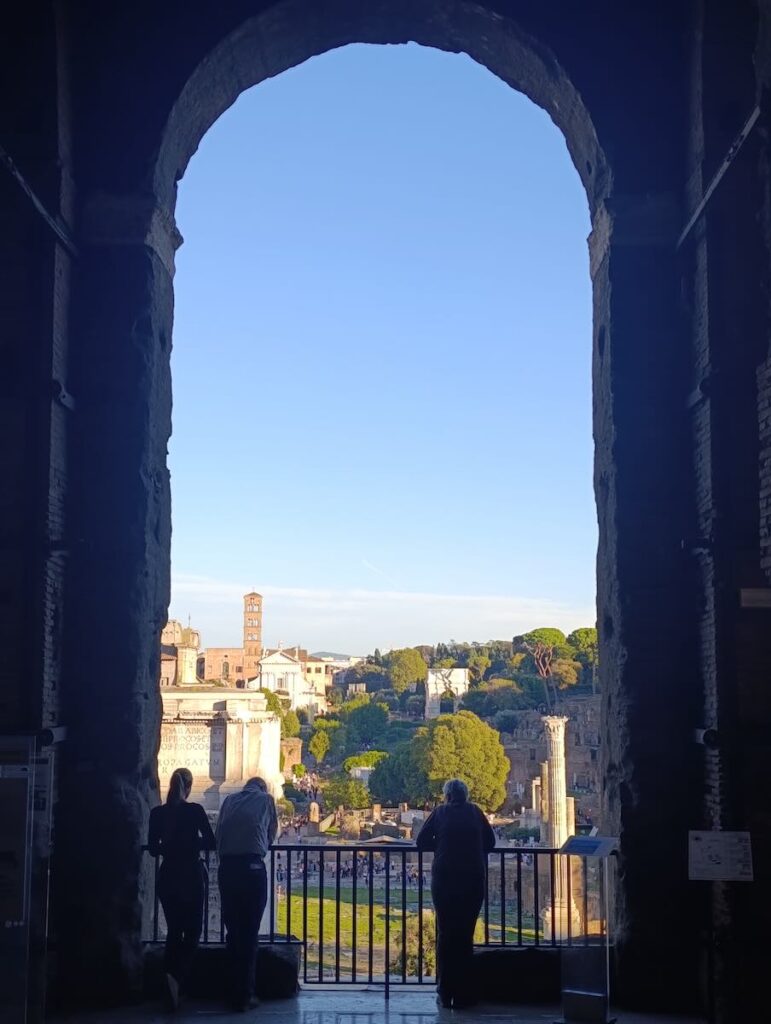
In short, we’re right next to the Roman Forum, and the museums offer a unique, privileged view over it, which is also part of the museum tour.
A Brief History: The World’s First Public Museum
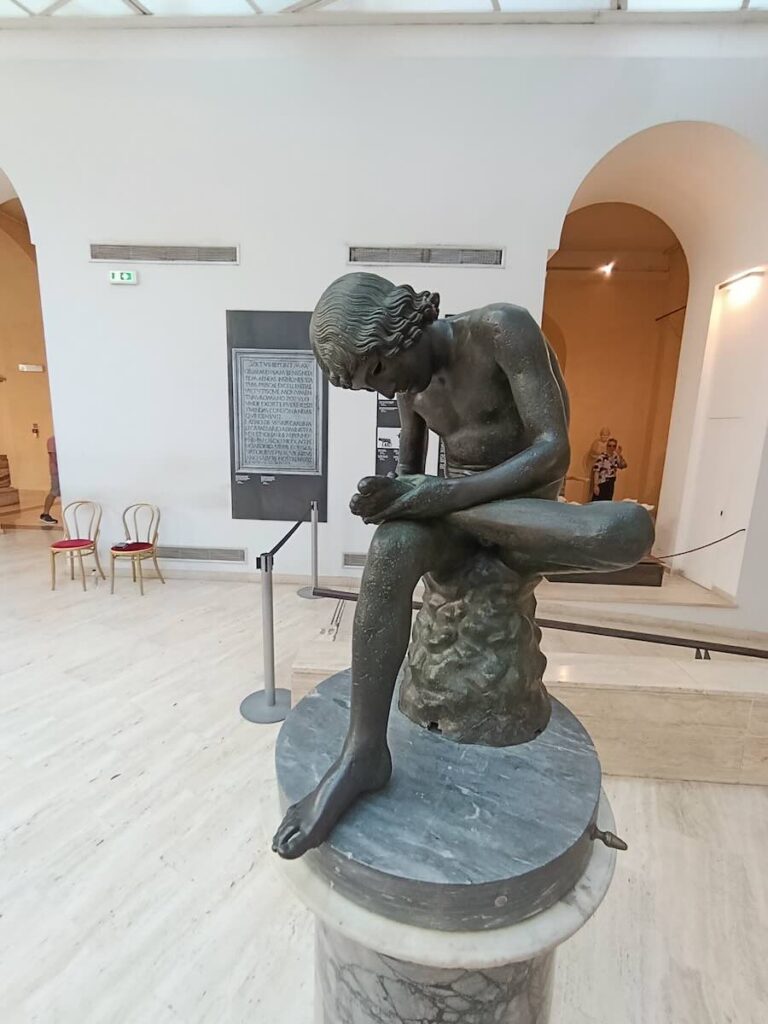
It all began in 1471, when Pope Sixtus IV decided to give a group of ancient bronze statues, kept until then at the Lateran, back to the people of Rome. Among them were some of the city’s most beloved symbols: the She-Wolf, the Spinario (the boy pulling a thorn from his foot), and the colossal bronze head of Emperor Constantine. The gesture carried a powerful message: these treasures didn’t belong to the pope, they belonged to the Romans.
At first, the statues were displayed on the façade and in the courtyard of Palazzo dei Conservatori, and the collection kept growing with finds from excavations all over the city. In the second half of the 16th century, Pope Pius V, a strict reformer who didn’t want ancient statues of gods and heroes decorating the papal palaces, sent a large group of sculptures to the Capitoline. Once Palazzo Nuovo was built across the square in the mid-1600s, the collection finally had room to breathe.
The museum officially opened its doors to the public in 1734, under Pope Clement XII, after he acquired Cardinal Albani’s collection of statues and portraits. A few years later, Pope Benedict XIV founded the Pinacoteca, the picture gallery, bringing in two major private collections. So when we Romans say the “Capitolini” are the oldest public museum in the world, we really mean it: a museum built on the idea that art and history belong to everyone, long before the Louvre or the British Museum existed.
One-of-a-Kind Architecture: Michelangelo’s Masterpiece on the Hill
Before you even step inside, take a moment to enjoy Piazza del Campidoglio, because the square itself is a work of art. Its current look was designed by none other than Michelangelo in the mid-16th century, after Pope Paul III had the bronze equestrian statue of Marcus Aurelius moved here from the Lateran in 1538.
Michelangelo made the emperor on horseback the heart of the whole composition, placing him at the center of an oval space decorated with a star-shaped pattern. Here’s a fun fact: the square was paved right away, but that beautiful star design was only completed in 1940, almost four hundred years later! The square has a trapezoidal shape, and the two museum buildings, Palazzo dei Conservatori and Palazzo Nuovo, mirror each other perfectly, angling slightly outward to frame Palazzo Senatorio and draw your eye straight to it. Palazzo Senatorio, at the back, is still Rome’s City Hall today.
To get there, you’ll walk up the cordonata, the wide, gently sloping ramp that leads up to the square. It did something truly revolutionary: it turned the hill around. In ancient times, the Capitoline Hill faced the Roman Forum; from then on, it faced the modern city. At the top, the two colossal marble statues of the Dioscuri, the twin semi-gods Castor and Pollux, have been welcoming visitors since 1583.
The Highlights: Masterpieces You Can’t Miss
The collections are huge, so here are the pieces I’d never let you skip, in the order you’ll meet them along the way:
- The colossal Constantine. Start in the courtyard of Palazzo dei Conservatori, with the huge marble fragments of the emperor’s statue (yes, including the famous foot and hand). You’ll find the giant bronze head, hand, and globe later on, indoors.
- The imperial reliefs on the grand staircase. Don’t rush up the stairs! The landings are lined with huge marble panels that once decorated public monuments in ancient Rome. Three of them celebrate Marcus Aurelius: you can see him showing mercy to defeated barbarians, riding in triumph, and offering a sacrifice in front of the Temple of Jupiter, the very temple whose remains you’ll see later in the museum. The Hadrian panels come from an arch on Via del Corso that was torn down in 1662 to widen the street. My favorite is the apotheosis of Sabina, Hadrian’s wife, carried up to the heavens by a winged figure while the emperor watches from his seat.
- The tigers of Junius Bassus. At the top of the staircase, on either side of the entrance to the Pinacoteca, two panels face each other, each showing a tiger attacking a calf. They look like mosaics, but they’re actually opus sectile: pieces of colored marble cut and fitted together like a puzzle. They date to the 4th century AD and come from a lavish hall on the Esquiline Hill. Look at the tiger’s stripes and the calf’s terrified eyes: it’s hard to believe it’s all stone.
- The Hall of the Horatii and Curiatii. This is the grandest room in the palace, and it has hosted major moments of modern history too: the Treaty of Rome, which created the European Economic Community, was signed right here in 1957. The walls are covered with frescoes by the Cavalier d’Arpino, painted over several decades, telling the legendary beginnings of Rome: the she-wolf finding Romulus and Remus, the Rape of the Sabine Women, and the duel that gives the room its name, where three Roman brothers, the Horatii, fought three brothers from the rival city of Alba Longa, the Curiatii, to decide a whole war. Watching over the room are two papal statues: Urban VIII in marble by Bernini and Innocent X in bronze by Algardi.
- The Capitoline Brutus. One of the most famous bronzes in the collection: a stern, intense portrait traditionally identified with Lucius Junius Brutus, the legendary founder of the Roman Republic.
- The Fasti Capitolini. In the Hall of the She-Wolf, once called the Hall of the Ancient Fasti, the back wall holds marble fragments carved in the age of Augustus, listing Rome’s consuls and the generals who celebrated a triumph, year after year. They were found in the Roman Forum in 1547 and arranged on the wall following a design by Michelangelo himself. Think of them as Rome’s official history book, written in stone: many of the names you studied in school are right there.
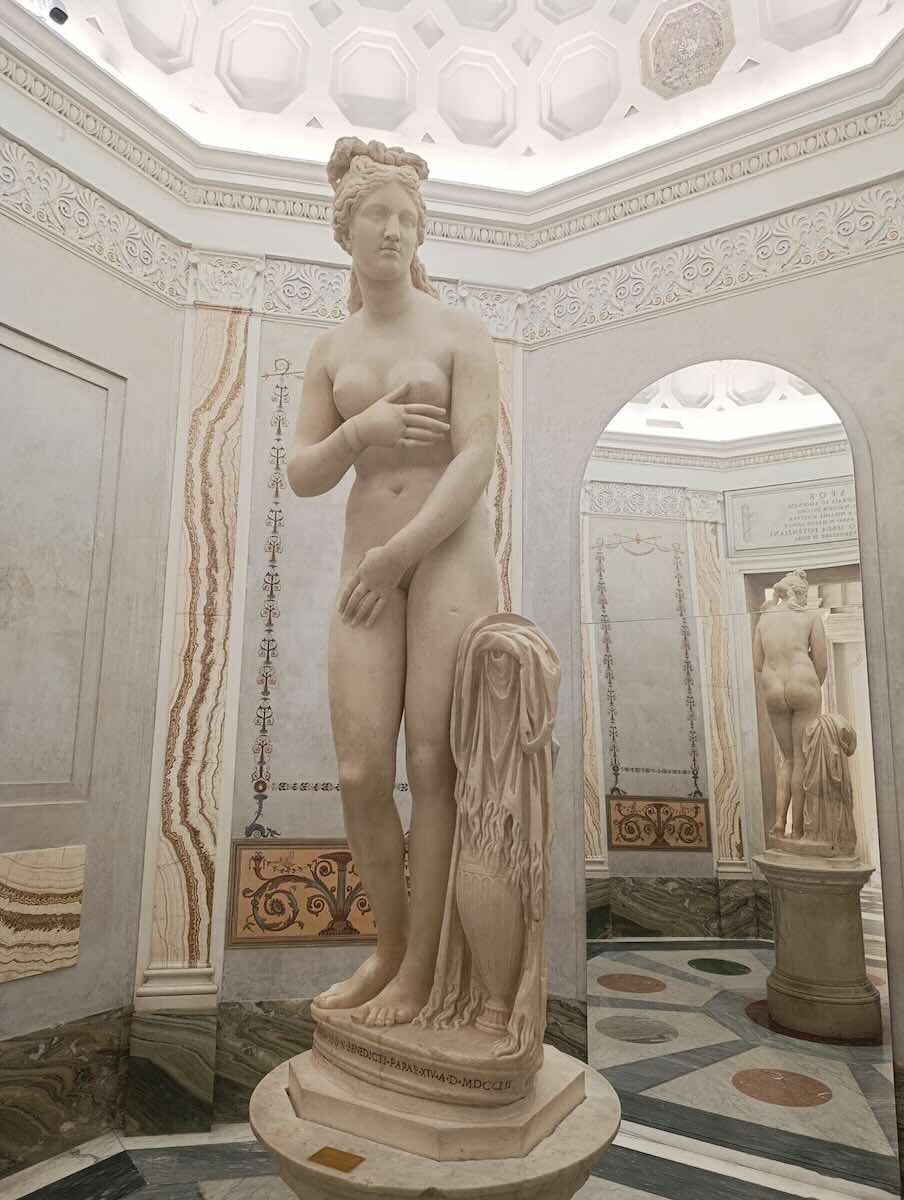
- The Esquiline Venus. One of my favorite pieces in the whole museum. The goddess stands completely nude, tying up her hair with a ribbon, and she has a detail you won’t find on any other statue of Venus: she’s wearing sandals! Look closely at the vase beside her, too: there’s a cobra coiled around it, a hint of Egyptian influence that has kept scholars guessing about who she really is.
- Commodus as Hercules. Remember Marcus Aurelius on horseback? This is his son, the emperor Commodus, and he clearly had a high opinion of himself. He chose to be portrayed as the mythical hero Hercules, complete with lion skin, club, and the golden apples of the Hesperides. The marble is so well preserved that it still looks freshly carved. And here’s the best part: it was found together with the Esquiline Venus, in the same underground room.
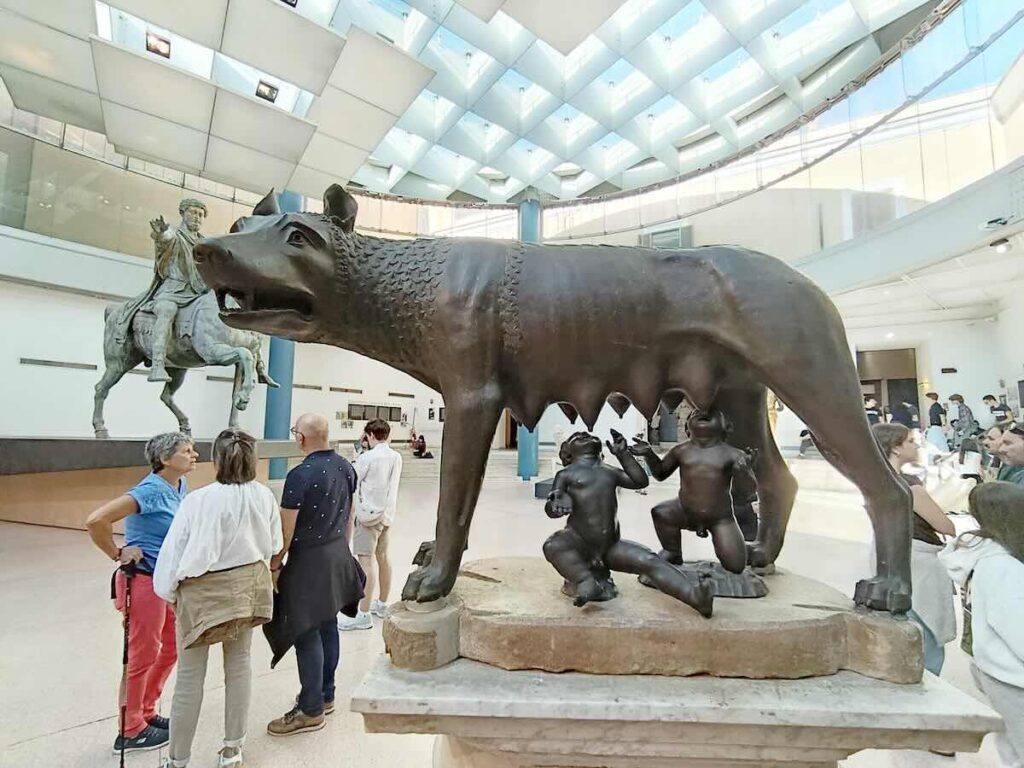
- The Capitoline She-Wolf. The symbol of Rome itself. The bronze wolf is ancient, while the twins Romulus and Remus nursing beneath her were added during the Renaissance.
- The Spinario. A boy sitting on a rock, pulling a thorn from his foot: one of the most tender and beloved bronzes in the collection, and part of the original donation of 1471.
- The equestrian statue of Marcus Aurelius. The one in the square is a copy: the original gilded bronze is inside, in a spectacular glass-covered hall. It’s the only ancient bronze equestrian statue that has survived almost intact, probably because for centuries people believed it portrayed Constantine, the first Christian emperor.
- The Temple of Jupiter. Remember the temple I mentioned earlier? Its massive foundations are right inside the museum, and standing next to them really gives you a sense of how monumental it must have been. As you walk around the foundations, you’ll also discover the remains of the temple’s terracotta decoration, said to be the work of the Etruscan master Vulca. We’ll meet him again at the National Etruscan Museum of Villa Giulia.
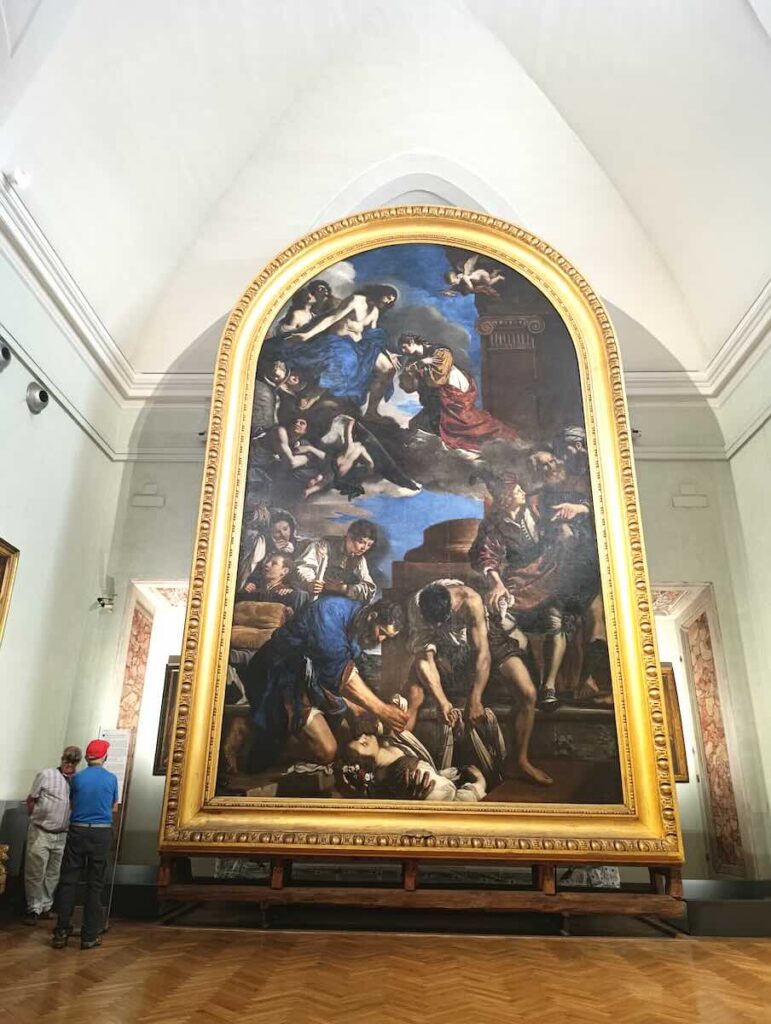
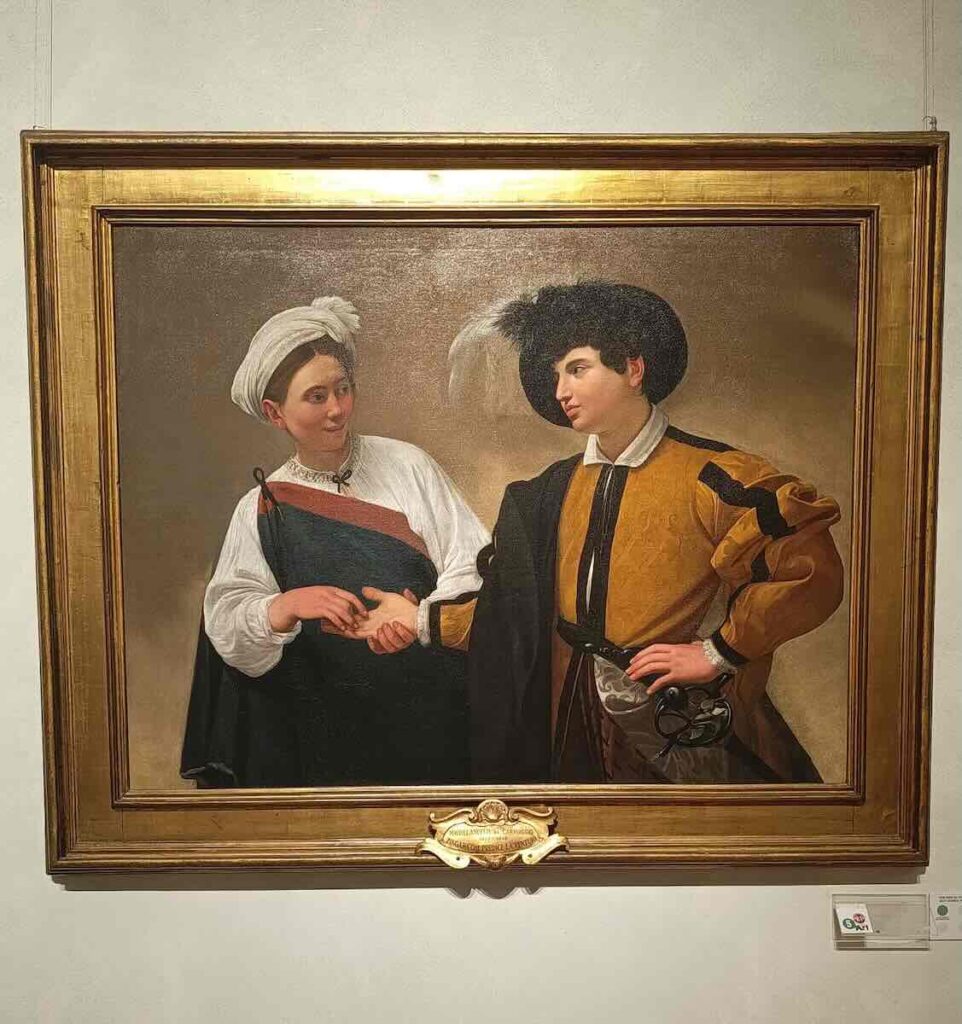
- The Pinacoteca. Art lovers, this is for you: two paintings by Caravaggio, Saint John the Baptist and The Fortune Teller, plus Guercino’s enormous Burial of Saint Petronilla.
- The Tabularium and the view of the Forum. Save this for last. The underground gallery connecting the two museum buildings leads you into the Tabularium, the ancient building that held Rome’s state archives, with arched windows overlooking the Roman Forum. It’s one of the most breathtaking views in the whole city, and you get it all to yourself.
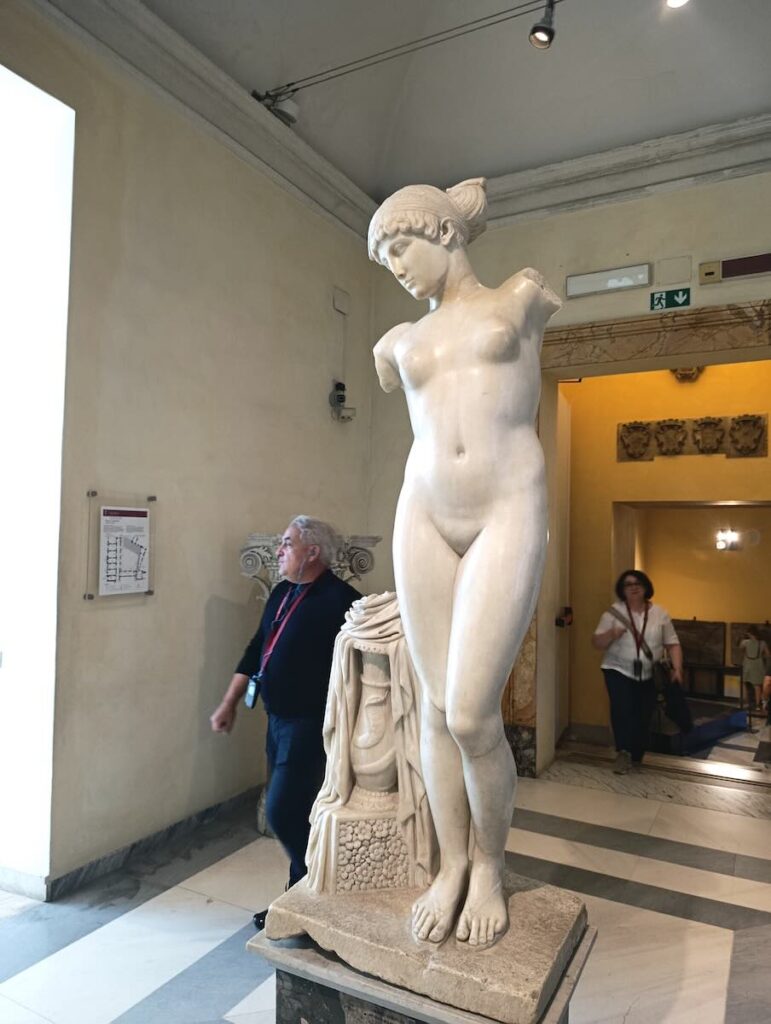
- Even if you’re feeling tired by now, don’t give up: you can’t leave without visiting Palazzo Nuovo and its extraordinary sculptures, such as the Capitoline Venus, the Dying Gaul, and the Marforio fountain.
Practical Tips for Your Visit
- Accessibility: The museum is wheelchair and stroller accessible.
- Opening hours: Every day, 9:30 am to 7:30 pm. Last entry is one hour before closing. On December 24 and 31 the museum closes at 2 pm, and it’s closed on May 1 and December 25.
- Tickets: A standard adult ticket for non-residents costs €15 when no special exhibitions are on, and a bit more when they are. EU citizens aged 6 to 25 and over 65 get a reduced price, and children under 6 enter for free. I recommend buying online in advance (there’s a €1 booking fee) to skip the line at the ticket office.
- Free entry: On the first Sunday of every month, entry to Rome’s city museums, including the Capitolini, is free for everyone. Expect crowds!
- Combo ticket: If you love archaeology, the Capitolini Card (valid 7 days) also includes the Centrale Montemartini, where ancient statues are displayed among the machinery of an old power plant. A true hidden gem.
- Audio and video guides: Available at the ticket office (€4 for the audio guide, €6 for the video guide). The museum also has a free app.
- How long to stay: Plan at least 2.5 to 3 hours. Honestly, you could easily spend half a day here.
- Getting there: The museum is a short walk from Piazza Venezia, in the very heart of the city. The closest metro stop is Colosseo (Line B), about 15 minutes away on foot.