

Are you looking for ideas for the best weekend trips from Rome, Italy? You have landed in the right place. The author of this post about weekend getaways from Rome was born and raised in Rome and spends every spare moment exploring the city’s surroundings and nearby regions.
Rome’s location, right in the center of Italy, sets itself up perfectly as a base for further discovery, whether you travel by car or train.
In this blog, you will find inspiration for discovering other cities rich in art and history, such as Florence and Naples, as well as enchanting landscapes such as Bracciano Lake and the Umbrian hills.
I have also included many destinations off the usual tourist routes, interesting and authentic regions such as Val d’Orcia and Tuscia.
These weekend trips from Rome will satisfy your desire to explore in all seasons.
I will reveal the most beautiful seaside destinations near Rome and also where to find the best thermal baths.
Take it from here to start planning your Rome weekend breaks.
Best weekend trips from Rome Italy in Spring
1. Florence
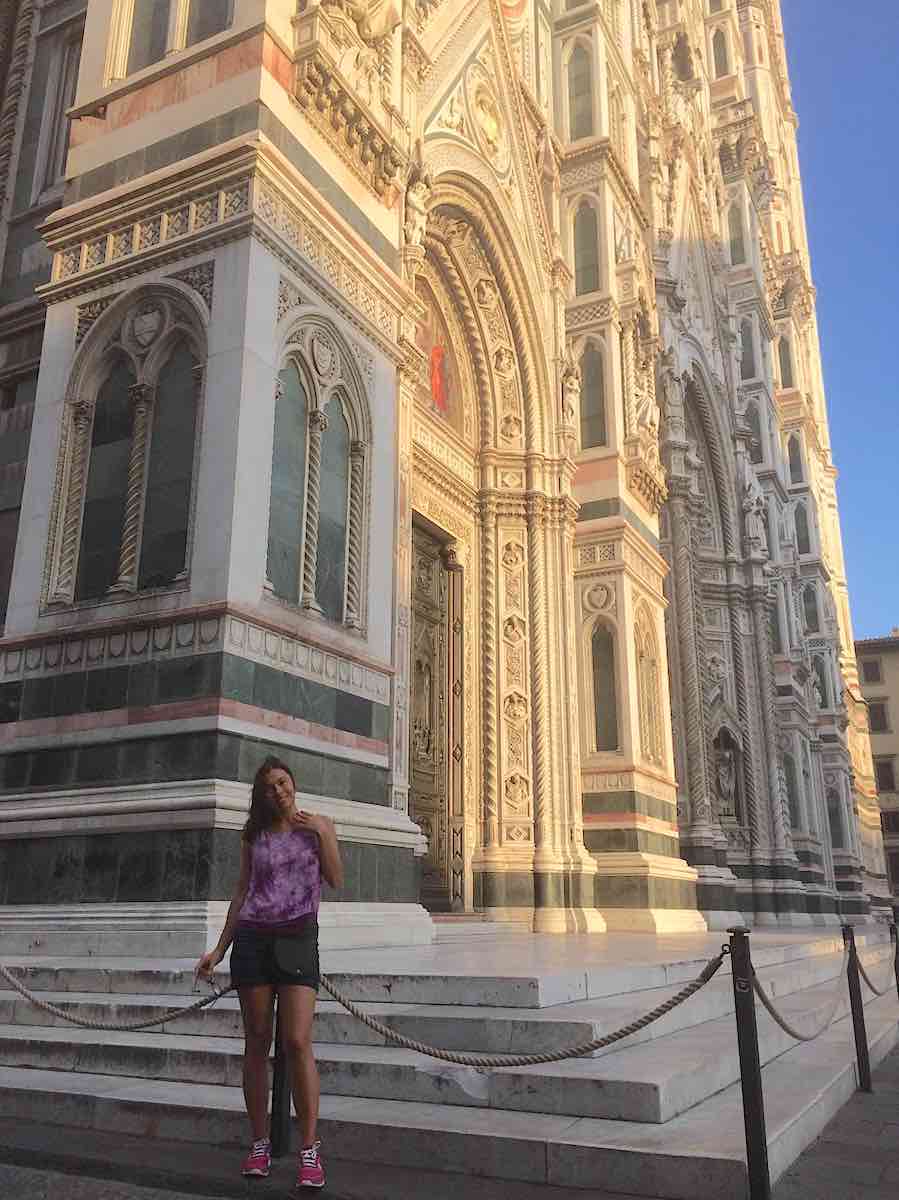
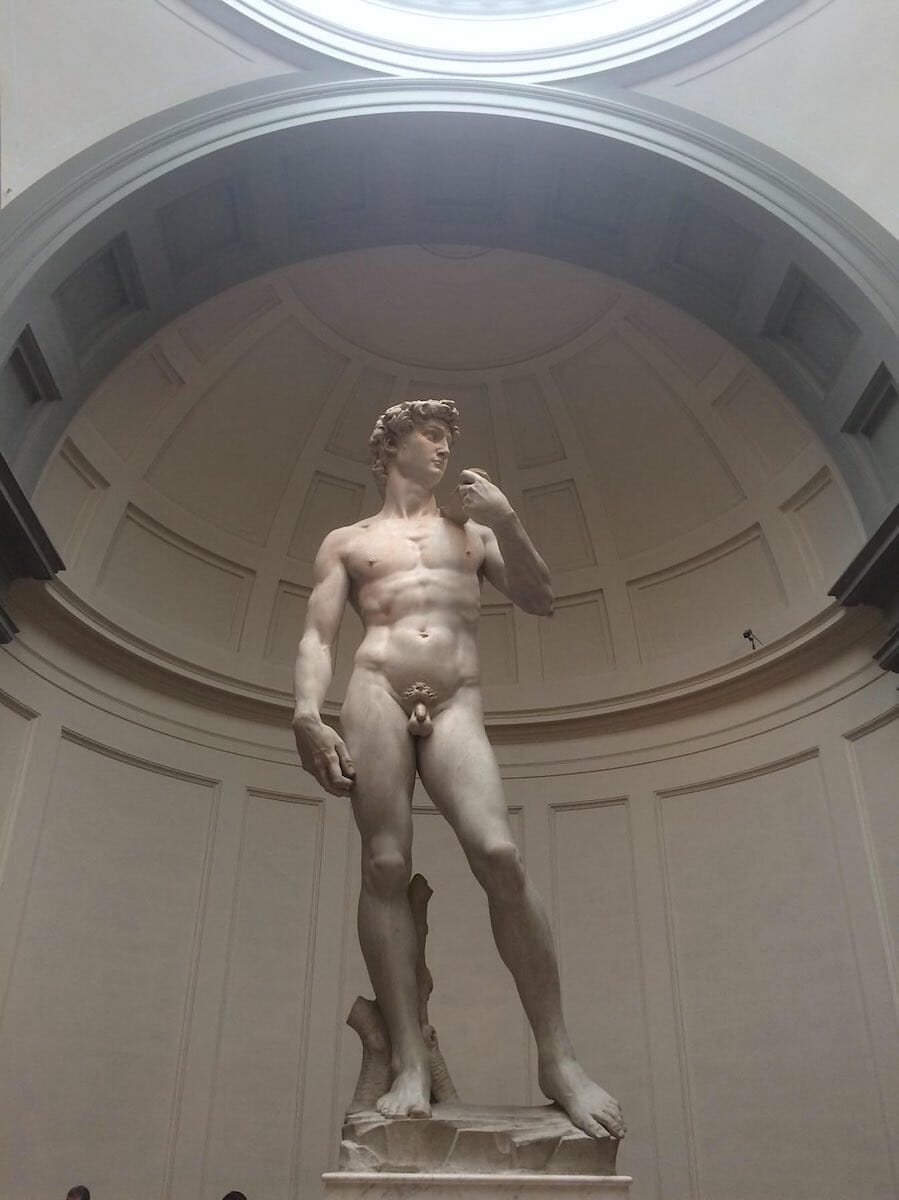
Florence, the cradle of the Italian Renaissance, will be a true paradise for lovers of art, culture, and architectural beauty.
Renaissance architecture sought the most harmonious forms that created well-being for the people who lived within. You will feel this harmonic symphony while walking through the city streets.
The perfect way to recover from the traffic and noise of Rome!
During your weekend trip from Rome, admire the grandeur of the Florence Cathedral, Santa Maria del Fiore, with its impressive dome designed by Brunelleschi, and visit the Uffizi Gallery, which houses an extraordinary collection of masterpieces such as Botticelli’s “The Birth of Venus.”
Don’t forget to stroll along the Ponte Vecchio. The bridge, centuries ago, used to host butcher shops. In the 16th century, the Medici family, who ruled Florence, moved those shops elsewhere. The bridge then became a passageway for nobles heading from the Palazzo Pitti residence to the Uffizi Gallery, where they had their “offices.” Piazza della Signoria is also magnificent, with the Palazzo Vecchio overlooking it.
Florence is also famous for its refined cuisine: not only the Florentine steak but also the vegetables and wines from the Tuscan countryside. Two simple yet exquisite dishes are pappa al pomodoro and ribollita soup.
If you’re vegetarian, I recommend having lunch at the bistro “5 e 5” in Piazza della Passera, where they prepare dishes made with vegetables from their own garden.
I also recommend grabbing a coffee or sitting down to eat at the beautiful café “Ditta Artigianale Caffé.”
From Florence, you can also embark on a short tour of the Chianti countryside to admire the landscapes of vineyards and olive groves. In the village of “Sant’Andrea in Percussina,” besides the idyllic scenery, you can visit an incredible historical landmark. It is the Renaissance palace where Niccolò Machiavelli, one of the greatest Italian philosophers, lived. In addition to walking through the rooms and kitchens, you can also see the cellars, where there are centuries-old barrels.
Now, there is also a bistro that offers modern dishes and wines in one of the most beautiful settings in the Italian countryside.
Where to stay: AM Collection Florence, just a stone's throw away from the Duomo. Check their rooms here!
2. Calcata
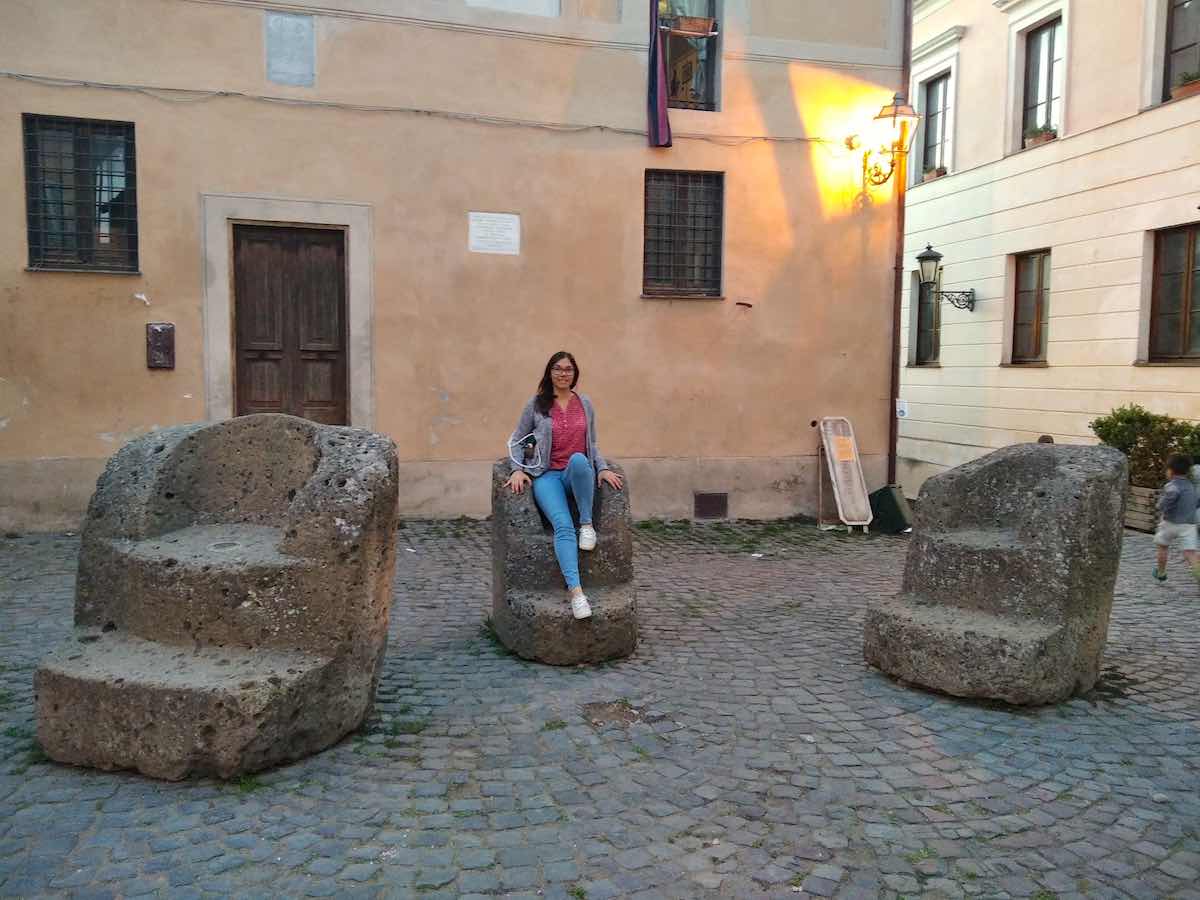

For an easy weekend getaway from Rome, just 50 km north of the city, you’ll find the village of Calcata Vecchia. This hamlet perched on a flat tufa cliff in the southern part of Tuscia has exerted a special charm on Romans for over 50 years. Myself included.
In fact, I allow myself to visit the “village of artists near Rome” at least a couple of times every month, as I live nearby.
Calcata exudes a unique atmosphere that sets it apart from other small villages in Italy.
Since the 1960s, the farmers who inhabited this ancient medieval town were invited by the government to relocate to another hill opposite Calcata Vecchia, in brand-new houses. The reason was that research had discovered that the cliff where the village still stands today was on the verge of collapse. Nothing could be further from the truth, as Calcata Vecchia is still standing, more vibrant than ever.
Abandoned by the locals, this picturesque village of stone houses has been repopulated over time by a rich and diverse community of Italian and international artists.
Here, they have always felt free to create art, far from the constraints of industrialized cities. And above all, they are inspired by the powerful and lush nature that surrounds them.
The village is nestled in the center of a lush valley full of forests, the Treja Valley, which you can explore with walks starting from Calcata Vecchia.
The first thing to see is undoubtedly the historic center, accessed through a scenic gateway that leads you through thick medieval defensive walls. Then you find yourself in the small piazza, where artists and travelers gather to chat and, during aperitif hour, to sing. Explore the narrow streets with artists’ workshops and breathtaking views of the valley. You can even hear the flowing of the river.
In the evening, treat yourself to a dinner of local dishes at one of the restaurants in the historic center, such as Gatto Nero or Osteria “Ai Tre Monti.”
Another delicacy you should not miss is the cookies baked in the wood-fired oven by Carmen, an “artist of sweets”. Next to the little piazza, look for the sign “Dolci per i dolci” (Sweets for the Sweets) and enter the bakery without delay. Try the blueberry and lemon cream tart. Then choose the cookies that inspire you most. My favorites are the coffee ones and the chocolate-cornflake ones.
TIP:
If you love walking in nature, you absolutely must visit the most important museum in Calcata. Opera Bosco, Museum of Art in Nature, has been hosting contemporary art installations made entirely from materials found in the forest since the early 1990s: branches, leaves, stones, and sculpted rocks.
This brilliant and revolutionary idea of creating a truly ecological museum was conceived by a Belgian artist and a Venetian artist. Every Sunday morning, the museum offers a two-hour guided tour through the path of 50 natural installations.
For more information, send a message to the Opera Bosco page here.
Where to stay in Calcata Vecchia: Casa sulla rupe, a house carved into the rock, with a terrace overlooking

the valley. Have a look at it here.
3. The “Cities of Tufa” in Southern Tuscany

It’s quite easy to reach Tuscany from Rome. And it’s worth it! With about a two-hour drive, you can reach Pitigliano, one of the most beautiful villages in Tuscany. This part of Tuscany is just off the beaten path.
Here, the travel experience focuses on excellent cuisine, wine tasting, and exploring ancient villages.
The towns of Pitigliano, Sovana, and Sorano are part of the Archaeological Park of the Cities of Tufa, an area of great historical interest.
These medieval towns are built on ancient Etruscan settlements. Taking walks in the surrounding woods, you’ll discover Etruscan tombs carved into the tufa rock. The Tomb of the Siren and the Tomb of Ildebranda are spectacular.
If you don’t feel like walking, concentrate on the ancient historic centers of the towns. Pitigliano has hosted one of Europe’s oldest Jewish quarters since the 16th century, and there is also a synagogue.
From the heart of the historic center, Piazza della Repubblica, you can admire the Fountain of the Seven Spouts and the arches of the ancient aqueduct. Overlooking the square is the Renaissance Palazzo Orsini, which houses the Archaeological Museum and the Museum of Sacred Art.
Take a stroll along Via Roma, a characteristic alley with food and souvenir shops, artist workshops, antique shops, and vintage shops.
Via Roma leads you to the Cathedral of Saints Peter and Paul, which has a charming facade. Sit at one of the restaurants near the cathedral to immerse yourself in the atmosphere of this ancient town. They are all excellent options:
- Locanda del Ceccottino
- Trattoria la chiave del Paradiso
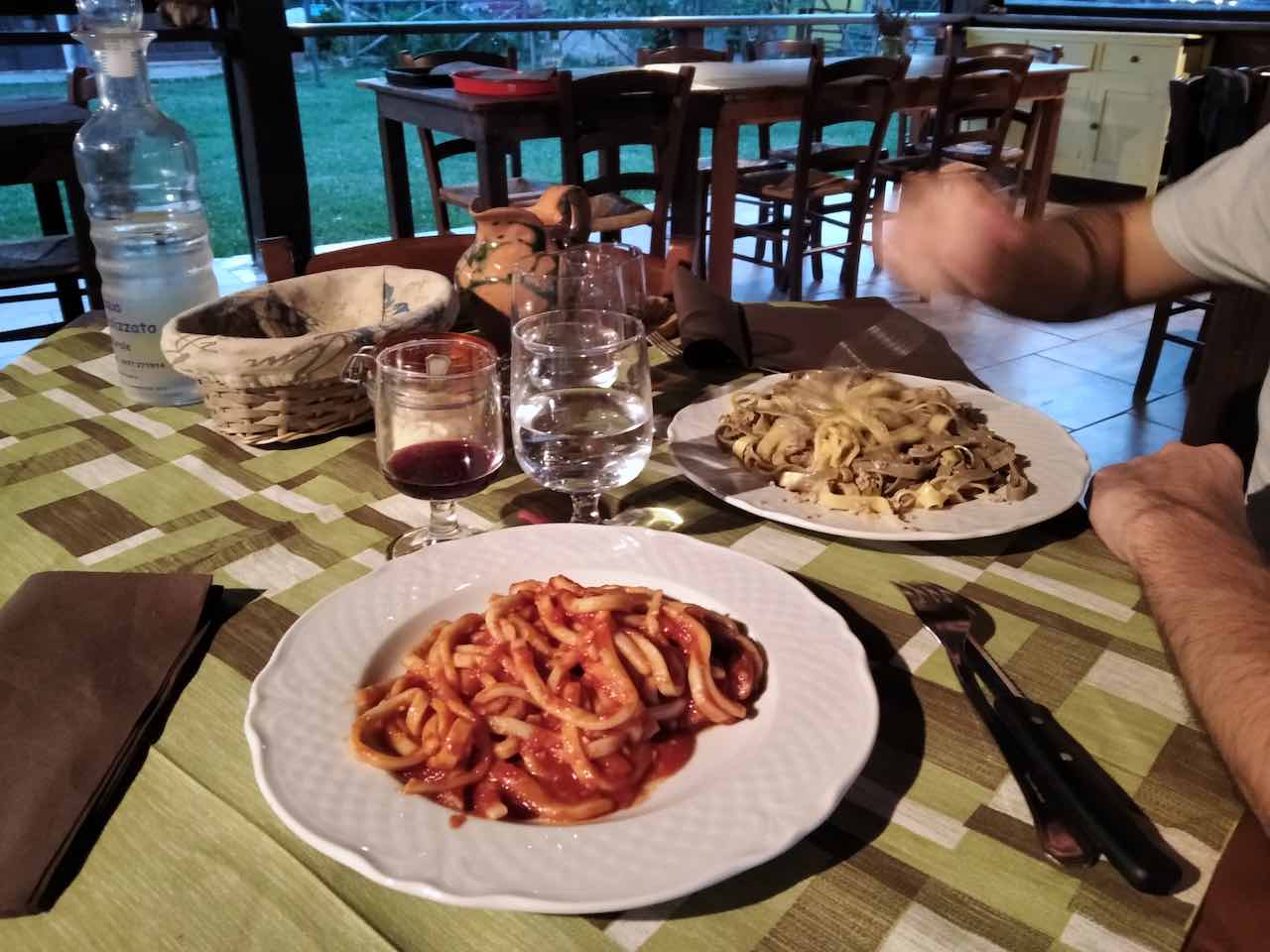
The quality of the cuisine is guaranteed; you are in Tuscany. Taste the typical local first course, Pici all’agliata, accompanied by Pitigliano wine.
I know this region very well as I live in northern Lazio and can reach it with a short car trip.
When I come here, I prefer to eat at a farmhouse. For example, Agriturismo Aia del Tufo, near Sovana, offers food produced either by themselves or by nearby farms.
Indulge in mixed appetizers, homemade pasta (both pici and pappardelle), meat dishes, and desserts.
Southern Tuscany in fact is so rich in beautiful nature and cultural heritage that you’ll need to do at least three weekend trips from Rome to see most of it. Think also about the Saturnia hotspring and the Maremma Coast.
Where to stay in southern Tuscany: If you're traveling with family, I recommend staying at Agriturismo Aia  del Tufo, where your kids can observe many animals. Have a look at the latest rates here.

If you're a couple, the choice falls on romantic B&B Poggio Ba. Check it here.
4. Val d’Orcia, Tuscany


A weekend is enough time to get lost among the rolling hills and villages of Val D’Orcia and fall in love with them.
Ideally, you should travel by your own car from Rome, driving along the Via Cassia in the direction of Siena, keeping your camera handy at all times.
Along the way, stop to photograph the famous Val d’Orcia cypresses at coordinates 43°03’45.6″N 11°33’31.86″E and the monumental tree “Quercia delle Checche.”
When we talk about Val d’Orcia we mean the countryside south of Siena with the towns of Pienza, Montalcino, Castiglione d’Orcia, Radicofani, and San Quirico d’Orcia.
The region is part of the UNESCO World Heritage Site. This area preserves the conception of the Renaissance landscape (14th and 15th centuries). The architecture of the towns is realized with harmonious proportions communicating a sense of beauty to those who pass through them.
Pienza is also known as the “ideal city“. Man, for the philosophy of the Renaissance, must be at the center of the cosmos, and for man’s well-being, it is necessary to conceive a harmonious relationship with the surrounding nature.
This philosophy reflects also in the agricultural landscapes that surround the towns of Val d’Orcia.
The historic centers of the villages are absolutely worth visiting. Start with Pienza and San Quirico d’Orcia, which are home to viewpoints with breathtaking views of the countryside.
Taste the typical products of the region: Brunello di Montalcino wine, extra virgin olive oil, pecorino cheese, and the typical homemade pasta “pici” at a restaurant such as “La Buca delle Fate” in Pienza.
If you visit this part of Tuscany during the cold months, take a small detour west to Mount Amiata. At the village Bagni San Filippo you will find one of the most scenic and warmest natural hot springs near Rome, the “White Whale” or Fosso Bianco.
5. Civita di Bagnoregio and Orvieto, Umbria


To go from Rome to the hilltop town of Orvieto in Umbria, pass through Tuscia and make a stop at the fairy-tale village of Civita di Bagnoregio.
This village is also perched on a tufa cliff like other villages in Tuscia, but the scenery here is even more spectacular. The cliff features two alternating colors that take on pink and golden hues at sunset time.
The village is accessed only by a 300-meter-long scenic bridge that you can only cross on foot. About 10 inhabitants live permanently in the old town.
Explore the narrow streets lined with medieval houses and the church on the main square. Look for viewpoints that open your gaze to the Valley of the Ravines, which presents a wild, lunar landscape. In case you love hiking, there are trails that take you to explore the valley.
Take time to have lunch at a small restaurant like Alma Civita. As in other parts of Tuscia, here in Civita, you’ll have excellent homemade pasta, desserts, and meat courses. Look at me in the photo, I’m about to dive in that Tiramisù. I had lunch at the restaurant Alma Civita, which I loved.
There isn’t too much to see in Civita (actually Civita di Bagnoregio isn’t worth a trip on its own), so I suggest you match it with the stunning Orvieto.
Orvieto dates back to the late 10th century B.C. by Etruscan communities on the tufa cliff on which it still stands today.
A day in Orvieto will enchant you: the majestic Duomo di Orvieto is one of the most beautiful cathedrals in Italy. Its facade will leave you in awe. The St. Patrick’s Well dating back to 1500, is a monumental well that you can visit that will take you dozens of meters underground. It is the place where the saint himself took refuge.
6. Spello, Foligno and Rasiglia in Umbria
Spello is a charming medieval town famous for its picturesque alleyways and beautiful geranium blooms.
The best time to visit is during the Infiorata festival. This festival happens every year during the week after Pentecost, usually towards the end of spring. On this occasion, locals try their hand at the most elaborate image creations on the streets, using tiny sheets of colored paper and flour.
Getting lost in Spello’s narrow streets will allow you to discover medieval frescoes, pretty squares and breathtaking panoramic views. Visit the Church of Santa Maria Maggiore to admire its fine frescoes by Pinturicchio and visit the Museo Civico to learn about the city’s history and art.
Foligno is a city rich in history and culture. Explore the historic center, admire the majestic Cathedral of San Feliciano, and visit the Trinci Palace, which houses a rich collection of artwork. Stroll the bustling streets of Foligno, discovering stores, cafes, and restaurants, and soak up the authentic atmosphere of Umbria.
Rasiglia is a unique village, known as “the village of springs.” Explore its charming narrow streets and admire the many fountains that characterize the village. You can take a walk along the surrounding nature trails, enjoying the scenic beauty and the cool waters of the streams. Rasiglia offers an authentic experience away from the tourist crowds, allowing you to relax and immerse yourself in nature.
These places are worth visiting because they offer an authentic experience of Umbria, with their thousand-year history, striking architecture, precious art, and natural beauty. You will experience the sweetness of living at a slow pace, savoring traditional Umbrian cuisine, and meeting the welcoming hospitality of the locals.
These locations will offer you an immersion in the culture and beauty of this Italian region, leaving you with unforgettable memories.
Best weekend getaways from Rome in summer
7. Lake Bracciano
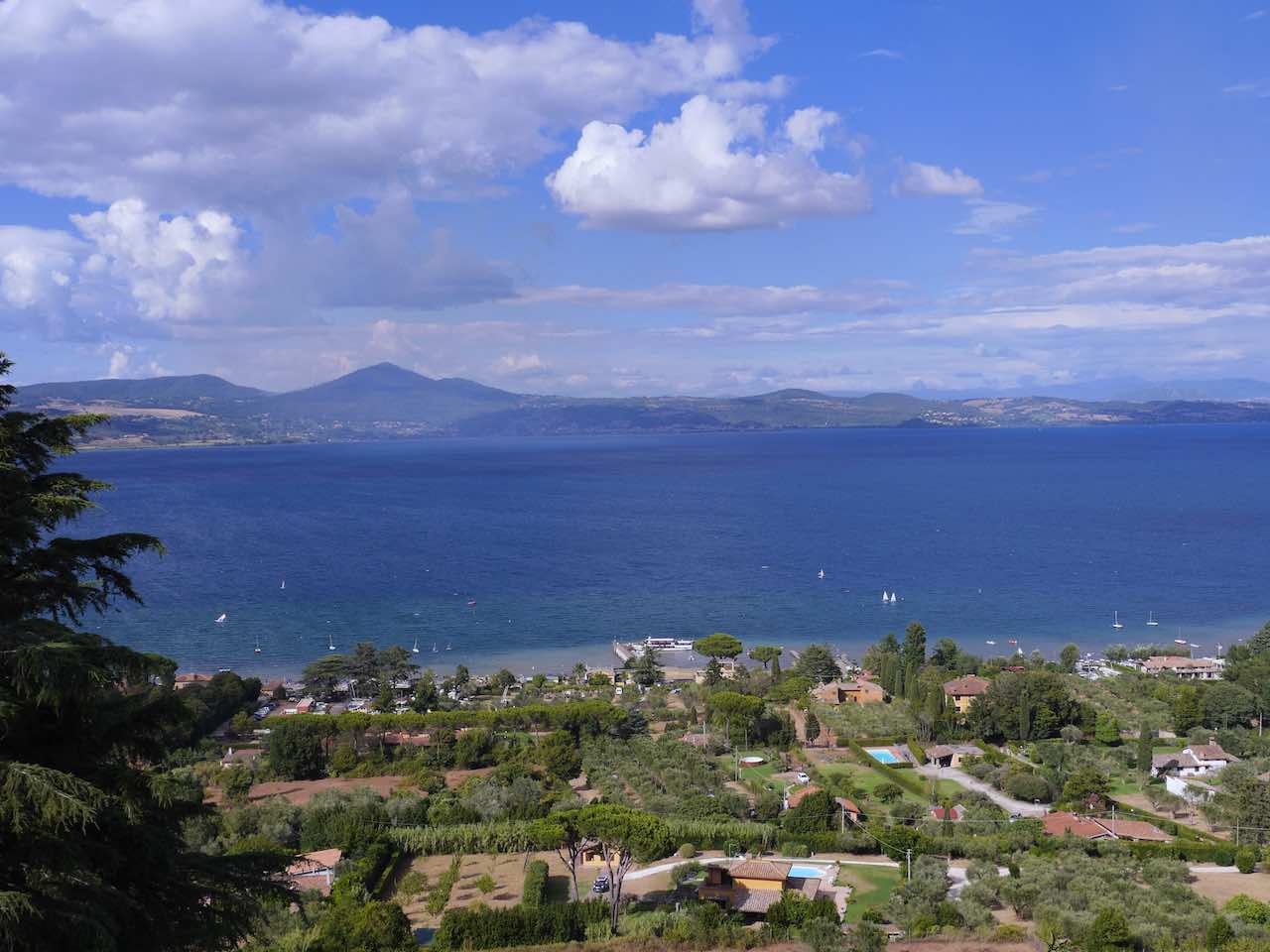
One of the hidden gems near Rome is the charming Lake Bracciano, a perfect destination for a two-day trip. Located just 35 kilometers north of Rome, Lake Bracciano offers a peaceful atmosphere and natural beauty that make it an ideal place to escape the city’s hustle and bustle.
Its crystal-clear waters and hills rich in forests provide an enchanting experience.
If you find yourself in this area during the summer, you’ll fully appreciate the gifts that nature has to offer. Swimming in this lake is an absolute pleasure. The picturesque towns that overlook the lake have easily accessible beaches, both public and with beach clubs. My favorite is the beach of Trevignano Romano, which you can reach by walking along the beautiful lakeside promenade. Restaurants and cafes also line the promenade. A must-try is the gelato from Bar Sandro, as well as the pizzas or seafood dishes from Caratello.
One of your weekend days should start with a breakfast outing. The best options? The Forno Franchini Bakery, makes the best pizza al taglio (pizza by the slice) of Lake Bracciano, as well as sandwiches with cheese and prosciutto. Their cookies, like the typical “brutti ma buoni” made with hazelnuts, are also mouthwatering.
Then there’s the café in the main piazza, “Caffetteria Ermete,” which will delight you with cappuccinos, pastries, and cakes.
The main historical attraction around Lake Bracciano is the Orsini-Odescalchi Castle, also known as the Bracciano Castle. This ancient castle overlooking the lake, dating back to the 15th century, offers a unique opportunity to immerse yourself in medieval history and architecture. The castle’s exterior and interior are excellently preserved. You can explore its towers, richly decorated halls, and well-maintained gardens, which often host weddings.
Nature lovers will find pleasure in numerous outdoor activities. There are scenic trails that surround the lake, such as the one along Via San Bernardino del Malpasso that leads to the paragliding field.
For watersports enthusiasts, the lake offers opportunities to enjoy sailing, windsurfing, and rowing. You can rent a kayak to explore its tranquil waters or a wing foil if the waters are choppy. The best thing to do here is of course to swim in the lake.
For refined palates, Lake Bracciano offers a local cuisine rich in authentic flavors. Restaurants along its shores serve dishes made with fresh fish caught right from the lake, accompanied by fine local wines. One typical dish is fried “lattarino” fish, which I recommend trying at the bistro “La Locanda” in Trevignano Romano.
In conclusion, Lake Bracciano is an Italian lake that deserves to be discovered. With its combination of history, enchanting landscapes, and recreational activities, it makes an ideal two-day getaway from Rome, providing a rejuvenating break from urban life.
Where to stay:

The most romantic and relaxing place is Hotel Villa Clementina in Bracciano. Check it out here.

If you're traveling on foot, I highly recommend Hotel Malì in Trevignano Romano. Have a look at the rooms here.
8. Abruzzo

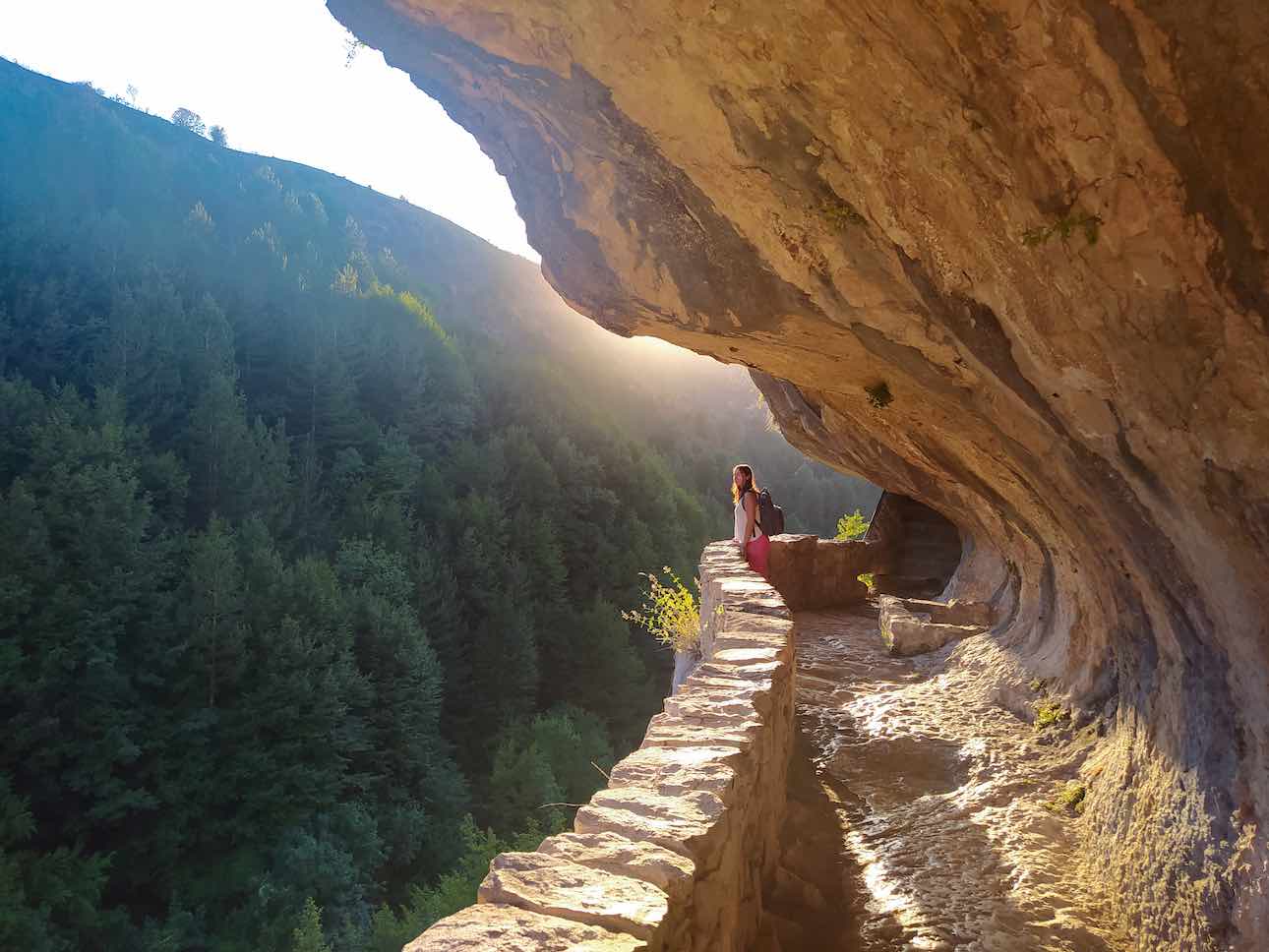
If you’re looking for an authentic nature experience, you can’t miss the enchanting region of Abruzzo. Abruzzo is one of the most underrated Italian regions by foreign travelers and is home to three national parks, as well as 150 kilometers of coastline.
One of the richest and less explored areas is the Majella National Park, a true oasis of wild beauty. This park hosts an extraordinary variety of flora and fauna, along with spectacular mountain landscapes. You can take panoramic hikes along the trails that lead to mountain hermitages, such as the Hermitage of San Bartolomeo and Santo Spirito. You can walk in the lush Orfento River Valley or reach the summit of Mount Amaro through the gorges of Fara San Martino.
A constant will undoubtedly be good, inexpensive, and abundant food. Food is certainly one of the reasons that locals travel to Abruzzo. Among the typical dishes are arrosticini (skewered lamb) and sheep cheese. One restaurant we loved is Osteria del Belvedere in Roccamorice.
After enjoying the mountain atmosphere, head towards the Abruzzo coast and discover the wonder of the Trabocchi Coast.
“Trabocchi” are ancient wooden fishing platforms built above the sea, a peculiar feature of the Abruzzo coastline.
You can stroll along the coast from Ortona to Vasto and admire the Trabocchi, which seem to float on the turquoise sea. Some Trabocchi have been transformed into restaurants where you can enjoy delicious dishes made with freshly caught fish.
Delicious fish dishes like spaghetti alla chitarra can be found for a reasonable price in the town of Marina di San Vito Chietino in Trattoria di Mare La Piazzetta.
Where to stay in Abruzzo: C'era una volta podere San Giovanni near the coastal municipality of

Fossacesia Marina.
9. Tarquinia, Lazio


Another off-the-beaten-path destination for a weekend trip from Rome is the charming coastal town of Tarquinia.
Located along the Tyrrhenian coast, this fascinating town is a true archaeological gem and a peaceful oasis. Tarquinia is famous for its extraordinary Etruscan sites, declared UNESCO World Heritage sites. You can visit the ancient necropolises and admire the incredible painted tombs dating back to the Etruscan era, a unique testament to the rich history of this region.
You can rent a bicycle and ride along the bike path that runs alongside the beach, admiring the spectacular scenery along the way.
Water sports enthusiasts will find numerous opportunities in Tarquinia to practice surfing, windsurfing, and kitesurfing. If you’re traveling with family, there are other fun activities in Tarquinia. For example, visit the adventure park in the pine forest of Riva dei Tarquini. The park has 10 courses for children of all ages, starting from 2 years old.
During your visit to Tarquinia, don’t miss the opportunity to indulge your taste buds with the local cuisine. The city’s restaurants and trattorias offer traditional dishes based on fresh fish, such as the famous spaghetti alle vongole (spaghetti with clams). For seafood specialties, head to the beachfront restaurant Tamurè Mediterraneo. For meat dishes, cured meats, and cheeses, I recommend the Osteria Therra.
Tarquinia is a city near Rome off the beaten path, and you could venture even further.
With a short car trip from Tarquinia, you can reach the Giardino dei Tarocchi (Tarot Garden), an artistic park just across the border with Tuscany. The park was created by the Franco-American artist Nikki de Saint Phalle, who designed it with a team of artists and opened it in the 1990s. The park features 22 colorful monumental sculptures representing the major arcana of the Tarot cards. A stroll through the park will delight both adults and children.
10. Argentario Peninsula, Tuscany

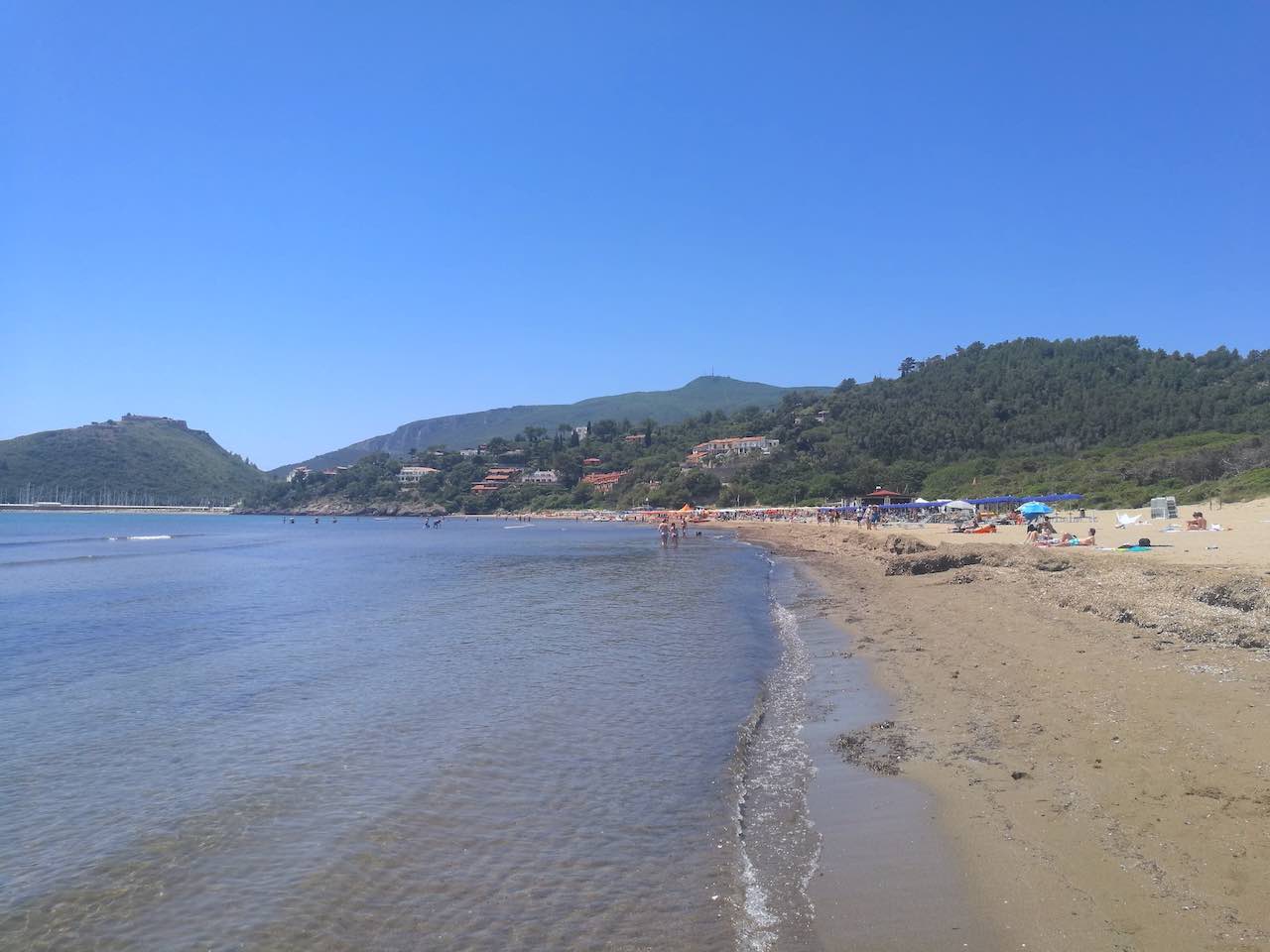
Traveling along the western side of Tuscany, we move south and reach the Argentario promontory, surrounded by a crystal-clear and fairly deep sea.
The main towns in the area are Orbetello, Porto Santo Stefano, and Porto Ercole, with the latest being the smallest and most quaint.
The coves are the real pearls of these seaside destinations that can be enjoyed all year round thanks to the mild temperatures. Lovers of sandy beaches will prefer the long white Feniglia Beach with its dense pine forest, one of the most beautiful beaches north of Rome. During a walk in this forest, it is not uncommon to spot wildlife including friendly deer.
Several ferries leave daily from Porto Santo Stefano to Isola Del Giglio, a destination not to be missed if you love colorful villages and lunches or dinners of freshly caught fish.
Argentario is, as mentioned before, a promontory, so it isn’t only suitable for those who love swimming and beach life, but also perfect for those who enjoy hiking or mountain biking.
For an excursion with a unique and unforgettable view, the routes arriving or departing from Punta Ala are best.
Getting to Argentario from Roma Termini takes less than two hours, and the cost of the ticket is really cheap. The station where it is recommended to get off is Orbetello – Monte Argentario, and then from there move to the various villages by public transportation, which is very efficient both in winter and summer. If you prefer to be autonomous and use a car, the time is about the same (approx. two hours) via the E80.
11. Lake Bolsena
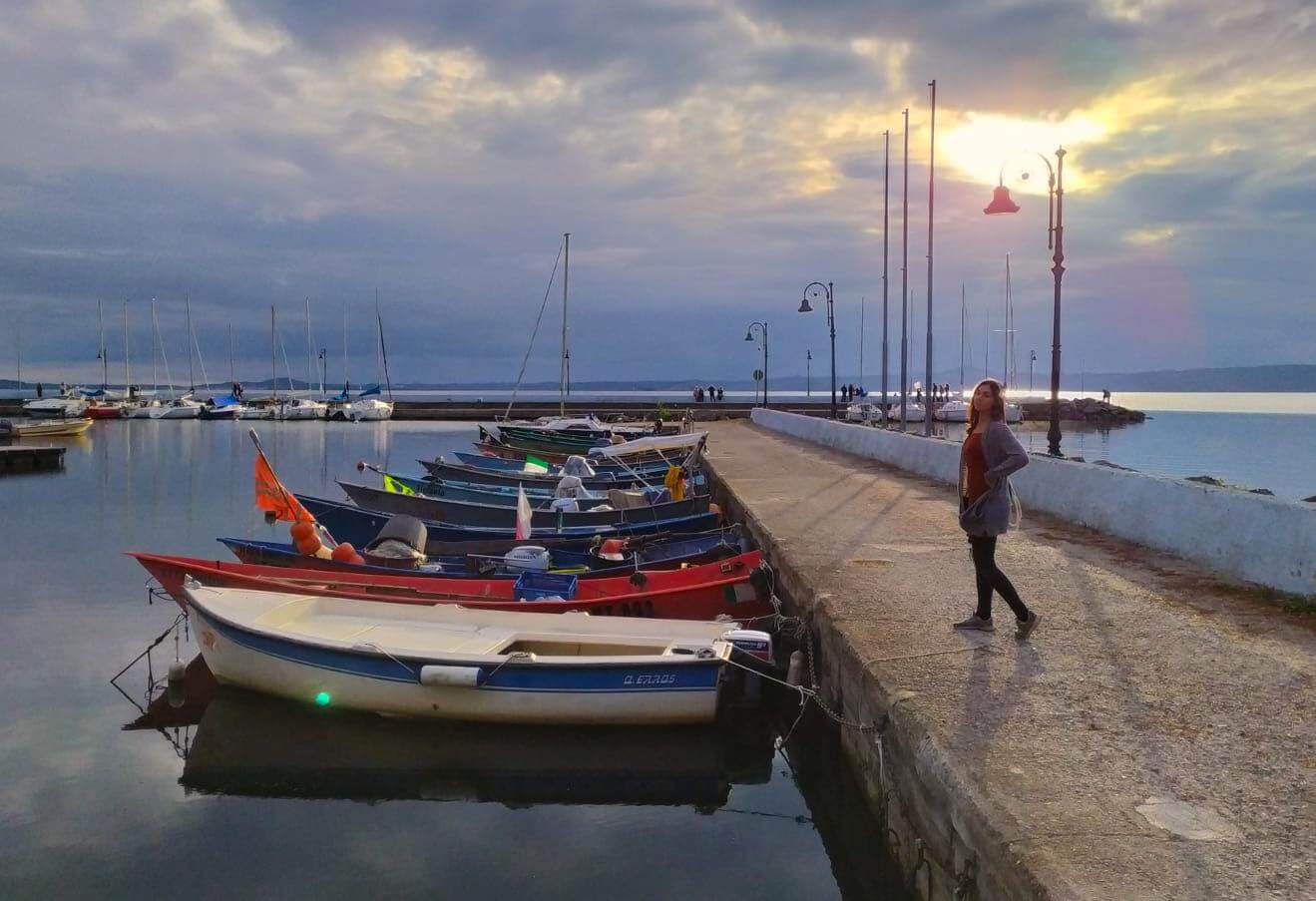
About an hour’s drive north of Rome lies a region that is a hidden gem of central Italy: the Tuscia region. Not to be confused with neighboring Tuscany, this place is completely off the tourist radar. It is called Tuscia because a couple of millennia ago, these lands were strongly influenced by the Etruscan civilization. You’ll find traces of these ancient and advanced people throughout the territory.
Tuscia is one of the most enchanting countryside areas near Rome, and Lake Bolsena is its most precious jewel.
This lake is of volcanic origin and is the largest in Europe. Swimming in the lake during the summer is recommended.
The scenery is tranquil beyond measure, and you can spend hours admiring the two islets in the middle of the lake: Isola Martana and Isola Bisentina. History and legends envelop these two islands.
It is possible to visit Isola Bisentina, which belonged to the wealthy Farnese family, by making a reservation via email at info@isolabisentina.org.
On the island, you can explore paths through the woods, Renaissance churches, and mysterious remains from ancient times.
The beauty of the lake also extends to its shores. The town of Bolsena is worth a visit. Its historic center is built on a hill, and medieval architecture is magnificently preserved, offering a journey back in time. The Bolsena Castle is one of the most interesting castles near Rome, housing an Etruscan museum. You can stroll along its walls to enjoy the view of the lake.
The town of Marta extends right along the lake’s shore, it was a fishermen’s village until the half of the last century.
At the restaurant Il Pirata in Marta, you’ll have some of the best food in the area, including fresh catch.
The village of Capodimonte, located on the promontory overlooking the lake, is also worth a visit. It boasts the best views of the lake.
Where to stay: The Casa Clemy lake-view apartment in Capodimonte. Check their latest rates here.
12. Ponza Island


If you’re looking for a hidden paradise just a short distance from Rome, the Island of Ponza is the perfect destination for a two-day trip. This jewel of the Pontine Archipelago offers a unique combination of natural beauty, crystal-clear waters, and a relaxed atmosphere.
Start your adventure by exploring the marvelous beaches and coves of Ponza.
You can spend your days on beaches like Chiaia di Luna, a bay framed by high cliffs, or Frontone, a pebble beach with transparent waters ideal for snorkeling. Take advantage of the numerous boat rentals and embark on an unforgettable boat excursion along the coast, discovering sea caves and islets.
TIP:
Renting a motorboat or a rubber boat is the only satisfactory way to visit the island’s many coves.
During your visit to Ponza Island, don’t miss the opportunity to explore the small town of Ponza, with its characteristic colorful houses and picturesque alleys. Take a stroll along the promenade and enjoy a romantic dinner in restaurants that offer specialties based on locally caught fresh fish. Savor the island’s typical dishes, such as fish soup or linguine with seafood, accompanied by a glass of local white wine. A great place to savor the local cuisine is Ristorante Punta Incenso da Anna.
If you’re passionate about underwater adventures, Ponza also offers incredible opportunities for snorkeling and diving. The island’s transparent waters are rich in marine life, corals, and ancient shipwrecks. Rent the equipment and dive into the depths of the sea to discover a fascinating underwater world.
Don’t forget to set aside some time to explore the other islands of the Pontine Archipelago as well. Ponza is the ideal starting point to visit nearby islands such as Zannone, Palmarola, and Ventotene, or to take an unforgettable boat trip around the entire archipelago.
There is plenty of stunning places to see on and around Ponza Island. This part of the Tyrrhenian see will bless you with some of the best long weekend trips from Rome in summer.
Where to stay in Ponza: Villa Ersilia.
13. Cilento Coast

Some of the best weekend trips from Rome can be arranged in Campania.
One of Lazio’s neighboring regions, it offers an endless variety of experiences to enjoy. The beaches and hamlets of the Cilento Coast, for example, will be able to amaze you with the boundless nature that still dominates the area.
Beaches alternate between rocky and sandy and small coves that can only be reached by sea. The crystal-clear blue that distinguishes the waters of Cilento won the Legambiente “Most Beautiful Beach in Italy” award for the Cala Bianca Beach, near the town of Marina di Camerota.
The stunning medieval village of Castellabate looks out over the Cilento Sea from 289 mt above sea level. This small town is in fact perched on a promontory, full of narrow streets and alleys that are home to artisans’ stores and restaurants where you can let the traditional delicacies captivate you (absolutely try the local mozzarella!). A path of stairs will take you to the top of the village, where you can enjoy priceless views.
You can get to Cilento via trains and buses from the capital, with stops at Vallo Lucania-Castel, and from there you can then use the public buses that will take you to the various villages or beaches. Having a variety of villages and sites to visit the car is also a good option, passing through the Salerno Reggio Calabria highway will take about a 3-hour drive.
14. Lake Albano and Castelli Romani
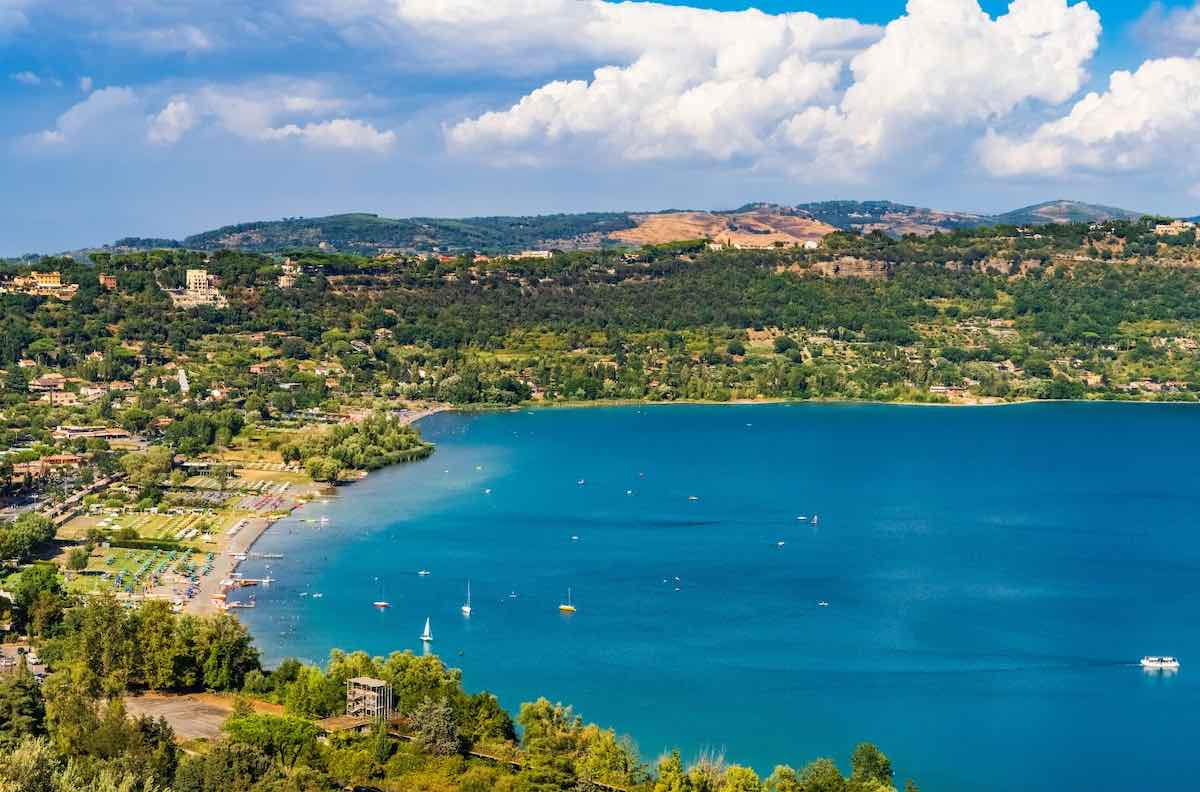
Lake Albano is one of the most beautiful lakes near Rome. If you want to discover Italy off the beaten path, add this lake and the villages that surround it to your list.
With a whole weekend to spare, you can take a stroll around the old towns that stand on the slopes of the Albani Hills, also known as the “Castelli Romani.”
The towns of Albano Laziale, Nemi, Castel Gandolfo, Frascati, and Rocca Priora are well worth a visit.
Castel Gandolfo can be the starting point for exploring the region. You can reach it in 40 minutes by train from Roma Termini. If you purchase a train ticket marked “Castel Gandolfo Ville Pontificie,” it also includes the cost of the Schiaffini bus that takes you to the entrance of the popes’ summer residences and their gardens.
From the historic center of Castel Gandolfo, you can also set off on a walking tour of Lake Albano. The loop route of about 10 km is very easy because it is almost all flat.
The lake is surrounded by forests and it will be pleasant to visit it in spring, autumn or even summer for a nice swim. There are ancient ruins to visit as well, like the Roman Villa of Domitianus.
Adding to the charm is the fact that it is the mouth of an ancient volcanic crater and seems to be the place where the legendary Aeneas founded Albalonga, from which Romulus and Remus moved to found Rome.
Best weekend trips from Rome in Fall
15. Bologna
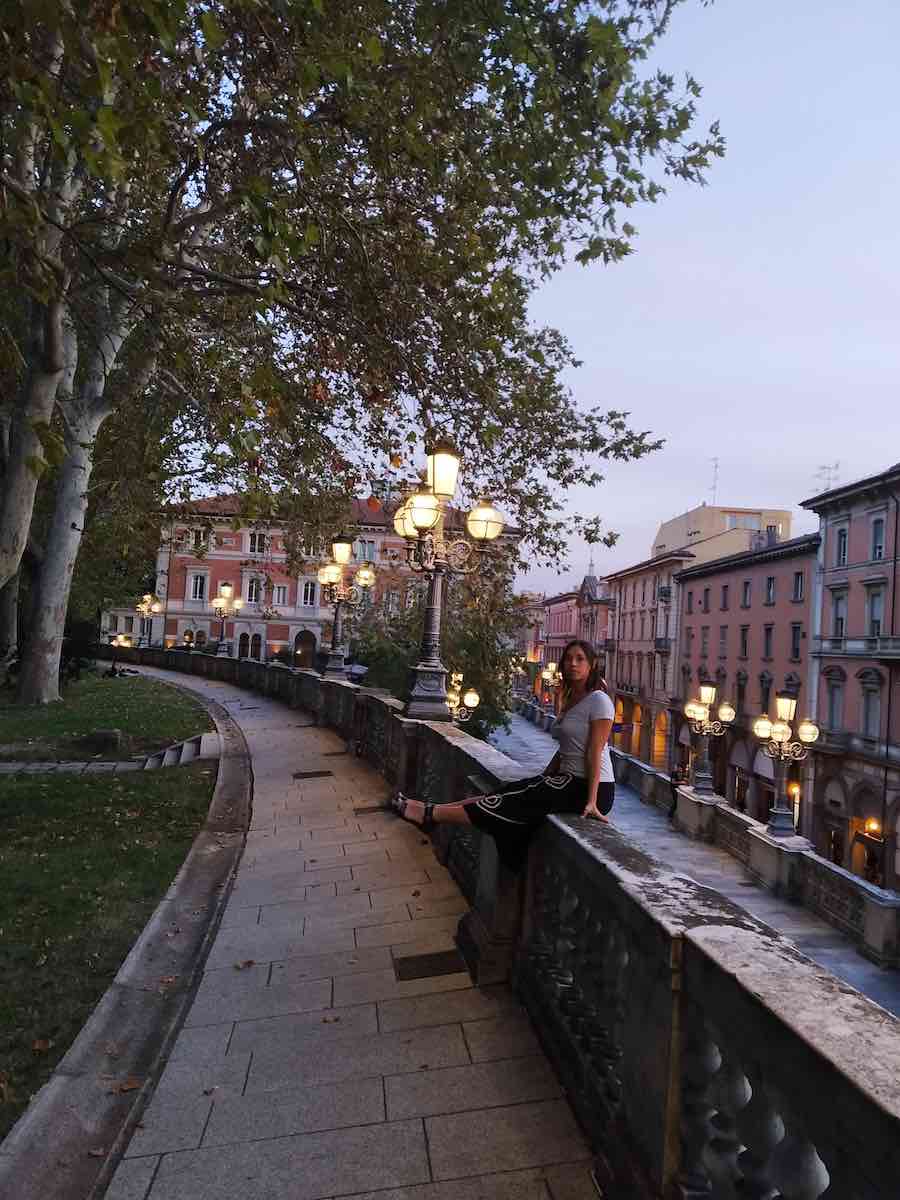

Bologna, known as “La Grassa” (The Fat One), is a city that boasts a rich culinary tradition but also offers splendid historical and cultural attractions.
Italians who travel here from the rest of Italy do so primarily to delight their taste buds and immerse themselves in the youthful, student-friendly, and vibrant atmosphere of the city. In Bologna, you can savor the typical dishes of Emilia Romagna, which have made Italian cuisine known worldwide:
- Tortellini
- Tagliatelle with ragù
- Parmigiana
- Lasagna
- Prosciutto di Parma
- Parmigiano cheese
You can taste all these wonders at the “Sfoglia Rina” restaurant.
Take a walk through the historic center. Admire the two medieval towers of Asinelli and Garisenda, which dominate the cityscape, the ancient porticoes that envelop the streets, and the bustling squares. Visit the famous Piazza Maggiore, with its imposing Palazzo Comunale, the Basilica of San Petronio, and the Fountain of Neptune.
Don’t forget to conclude your visit with a glass of red wine from the region, such as the famous Lambrusco.
Bologna is the perfect destination to enjoy a long weekend in Italy in both fall and spring.
Where to stay in Bologna: Hotel San Donato, in the historic center. Check their latest rates here
16.Viterbo
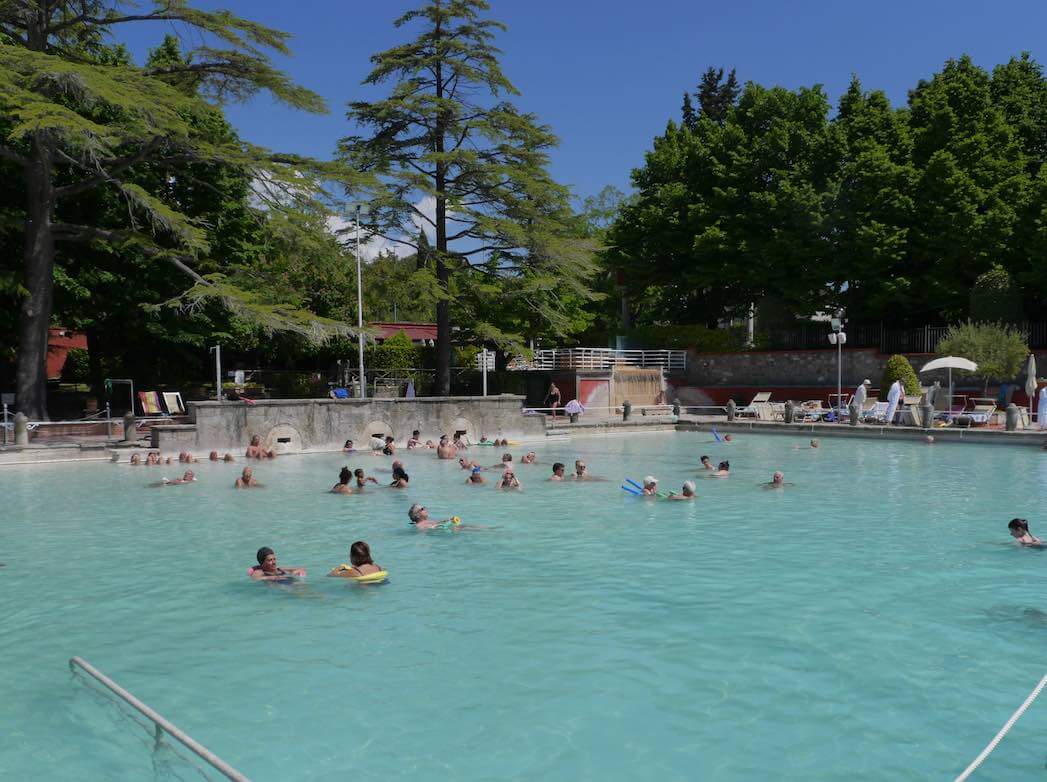

One of the hidden gems of Lazio and definitely one of the best weekend getaways from Rome is the city of Viterbo.
Located in the heart of Tuscia, this medieval city will captivate you with its history and architecture, taking you back to the Middle Ages.
It was during that era, precisely in the 13th century, that Viterbo hosted the papacy for about 60 years. It is from that time that the elegant Palazzo dei Papi dates back, with its neo-Gothic style, overlooking Piazza San Lorenzo. Together with the Cathedral of San Lorenzo, the palace is the monument from which your stroll in the San Pellegrino Neighborhood should start.
This area, with its medieval architecture, features cobblestone streets lined with buildings made of pepper stone, the dark stone on which the city is built. You’ll enjoy discovering small piazzas adorned with sculpted fountains, and the alleys that open up to the majestic Piazza del Plebiscito. There you will find the Palazzo del Comune and the Palazzo dei Priori. From there, Via Roma also starts, with its boutiques and clothing and souvenir shops.
Romans who spend a weekend in Viterbo do so primarily to relax.
In the surroundings of Viterbo, there are several thermal baths where you can immerse yourself in hot healing waters. Start with the monumental pool of Terme dei Papi and then treat yourself to a dip in the exclusive pool of Hotel Salus Terme. If you enjoy free thermal baths, there are Piscine Carletti and Bullicame Spring.
After spending the day soaking in thermal waters, replenish yourself with the excellent and affordable cuisine of Viterbo. The pizza from Restaurant-pizzeria Il Labirinto is the best in town, while you can find typical local dishes at the trattoria “I tre Re.”
Where to stay in Viterbo: B&B Medieval House in the historic center or Hotel Salus Terme (adults only).
17. Pisa and Pistoia

Tuscany borders Latium to the northwest and should be on every Italy bucket list.
In addition to the better-known and splendid Florence, also Pisa and Pistoia are worth exploring. You can visit both cities in 2 days. I recommend you stay in Pistoia, a hidden gem located only 70 km away from Pisa. In this way, you’ll save on accommodation costs.
Let’s explore Pisa first. In addition to its distinctive 56-meter-tall leaning tower, visit the other monuments in the Cathedral Square, also known locally as the Piazza dei Miracoli because of the uniqueness of the buildings therein: the Baptistery, the Cathedral, and the Old Cemetery.
In particular, delve into the Baptistery, which every day becomes a stage for nonprofessional singers who challenge its particular acoustics. A day will be more than enough to visit the historic center of Pisa. With just a few hours in Pisa, you will see some of Italy’s most famous historical landmarks.
Pistoia is a gorgeous, lesser-known city in northern Tuscany. Every corner of it is characterized by unique architecture, but for a different and engaging experience visit the underground part of the city. With more than 650 meters of tunnels, the Pistoia underground museum guides you to discover the history and people who have passed through the area since the 12th century.
Reaching Pisa or Pistoia from Rome is very easy and it is recommended to do so by train so that you don’t have to find parking (often paid or otherwise occupied). From Roma Termini you’ll reach Pisa in about 3 hours by regional train, Freccia Bianca, or Italo. If from Pisa then, you want to reach Pistoia, a convenient regional train will take you there at a very low price and with only an hour’s journey.
18. Pompeii and Herculaneum
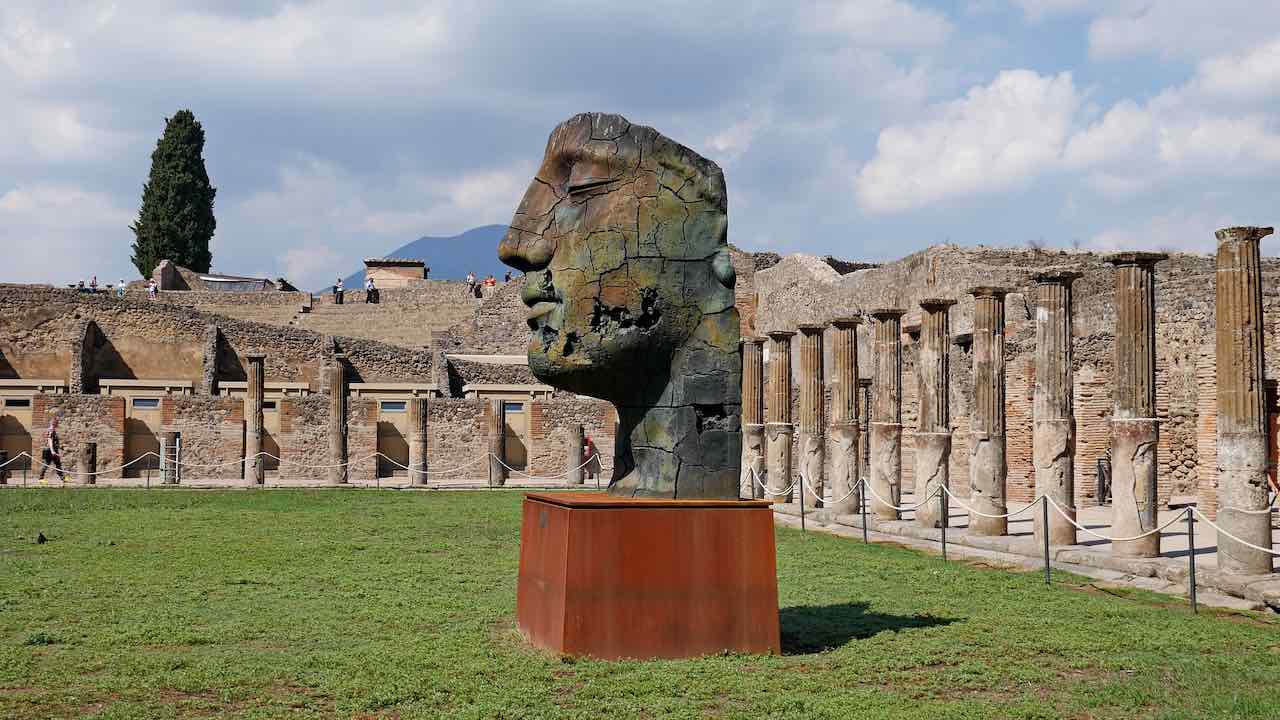
If you’re passionate about archaeology and want to immerse yourself in the history of ancient Rome, a two-day itinerary to Pompeii and Herculaneum is an unmissable experience during a trip from Rome.
TIP:
These important archaeological sites are located near Naples, but from experience, I recommend visiting Naples and Pompeii on separate trips. A weekend is not enough to see both places, especially if you also want to visit Herculaneum.
Start your adventure by exploring the ruins of Pompeii, one of the best-preserved Roman cities in the world. As you walk along the ancient streets, you can admire the frescoes, buildings, and paved roads, getting an authentic snapshot of daily life in ancient Rome. Don’t miss the famous site of the Teatro Grande, the Roman Forum, and the Villa of the Mysteries, with their incredible archaeological details that unfold like a window into the past.
Next, head to Herculaneum, another ancient city buried by the eruption of Mount Vesuvius in 79 AD.
This archaeological site offers a different perspective compared to Pompeii. You can admire the well-preserved buildings, mosaics, and artworks that testify to the wealth and elegance of the ancient Roman city.
Herculaneum is also famous for its villas, including the Villa of the Papyri, which houses a rich collection of artwork and a library.
During your visit to Pompeii and Herculaneum, you can also enjoy the local culinary delights. Sip an authentic Italian espresso in a traditional café and delight your taste buds with local cuisine. Savor dishes made with fresh seafood, such as “fritto misto” or “linguine alle vongole,” accompanied by a glass of local wine, such as Lacryma Christi del Vesuvio.
Additionally, you may dedicate some time to visit the Vesuvius National Park, which surrounds these ancient cities. You can hike on the slopes of the volcano and enjoy breathtaking views of the Bay of Naples and the surrounding countryside.
In summary, a two-day itinerary to Pompeii and Herculaneum is a unique immersion into Roman history. Explore the well-preserved ruins, admire the frescoes and mosaics, and savor the local cuisine. Don’t forget to dedicate time to visit the Vesuvius National Park to complete your experience in this extraordinary region.
TIP 2:
Visiting the ruins in summer can be quite exhausting. You’ll need to walk for many hours to see everything, and you won’t want to do it in the scorching heat that characterizes the region during the summer months. Even though you’ll be by the sea, it’s better to visit Pompeii and Herculaneum during the milder or cooler seasons.
19. Cinque Terre

Italy is famous, among many other aspects, for its beautiful beaches. The small and wild ones in the northwestern part of the peninsula are not to be underestimated.
To get away from the city for a while, think of a walk by the sea and in colorful villages standing among rocks, maritime pines, and flowers. Yes, you got it right, you are heading to Liguria, more specifically to Cinque Terre.
This place of fishing hamlets and coastal vineyards takes its name from the five villages that characterize it: Monterosso al Mare, Vernazza, Corniglia, Manarola, and Riomaggiore.
In each town, you find irresistible coves and beaches, but if you prefer to go at a quieter time, not in high season, there are many excursions to do, more or less challenging.
Among the most impressive we recommend visiting the village of Monesteroli, which can be reached either by sea or via a long stone staircase. From Campiglia, take trail 4b, and after a walk through the vineyards, you’ll reach the first of more than 1,000 steps of a staircase overlooking the deep blue sea. This is truly one of northern Italy’s hidden gems.
To get to Cinque Terre from Rome it is advisable to use the train. Reach the train station in La Spezia (in just under 4 hours) and then get a two-day ticket for the “Cinque Terre Express“, a regional train line connecting all the villages of interest in the area.
20. Amalfi Coast

Another corner of paradise in Campania, the Amalfi Coast, can be definitely visited with a weekend trip from Rome.
With its white beaches and its picturesque villages, it certainly knows how to offer unforgettable weekend getaways from Rome to anyone.
Among the most beautiful beaches on the Amalfi Coast, those in the small town of Positano are absolutely worth visiting. In addition to the lidos where the friendly and welcoming service will make you feel truly on vacation, the more adventurous traveler can go in search of two hidden and less frequented beaches: Torre di Clavel and Remmese Beach.
Reachable by sea and land, both beaches will amaze you with boundless nature and marine wildlife.
The Amalfi Coast is brimming with colorful little towns and villages full of life. Vietri earns a place among the most picturesque and characteristic, with its narrow alleys decorated with colorful ceramics and the scent of restaurants that rush to delight your palate with fish-based traditional dishes.
Vietri ceramics have origins to be traced back to the 17th century, and traditional methods of creation and firing are still retained today. The artisan workshops around the city are a great way to admire the colorful works that are produced, as well as the murals created from tiles of infinite shades of color and with typical depictions of the area.
Reaching the Amalfi Coast from Rome is easy by train. With only two hours, a Trenitalia Freccia Argento train will get you to Vietri sul Mare, where you can then move by transport to the various beaches and hamlets.
It is very inadvisable to use a car, because of the heavy traffic (especially in the morning) and the narrow roads that run all along the coast, suitable only for experienced drivers in the area.
Great weekend trips from Rome in winter
21. Naples
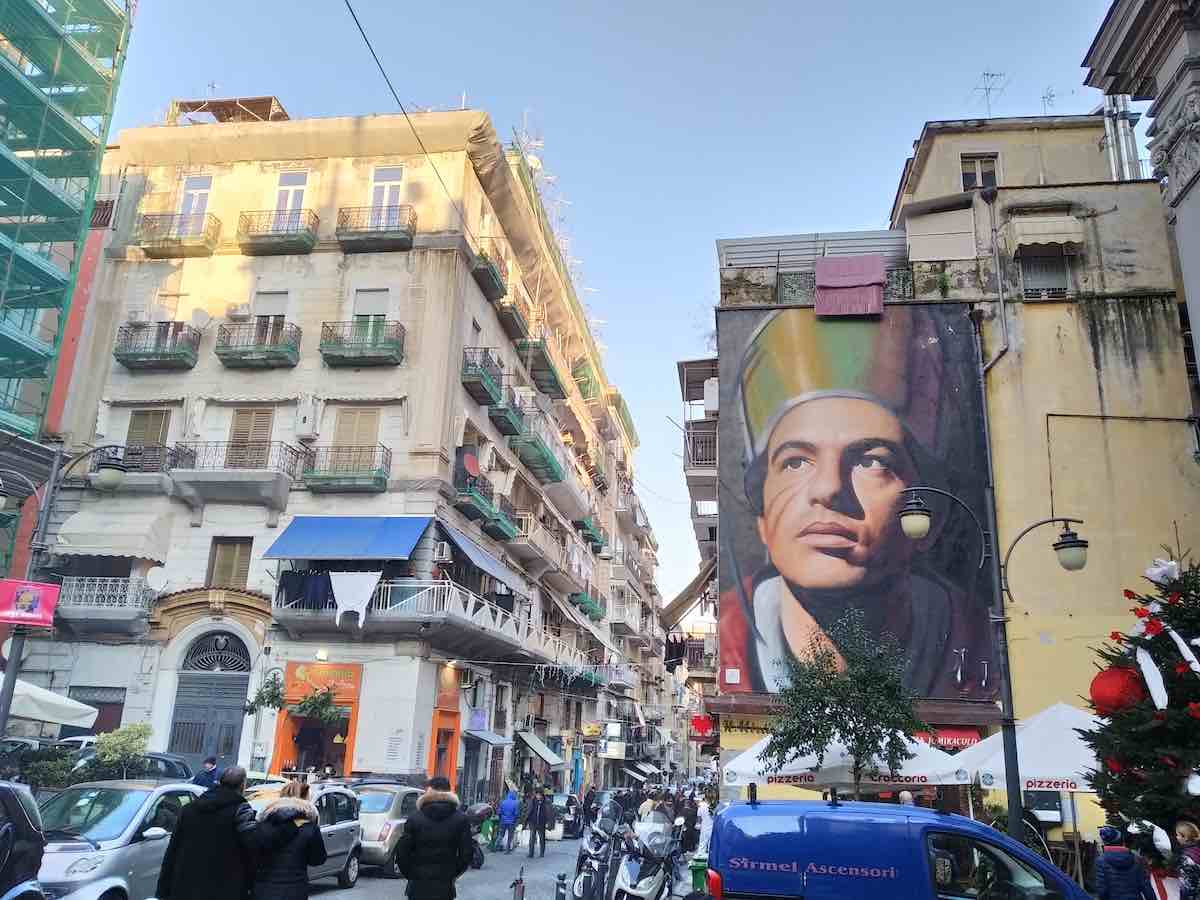
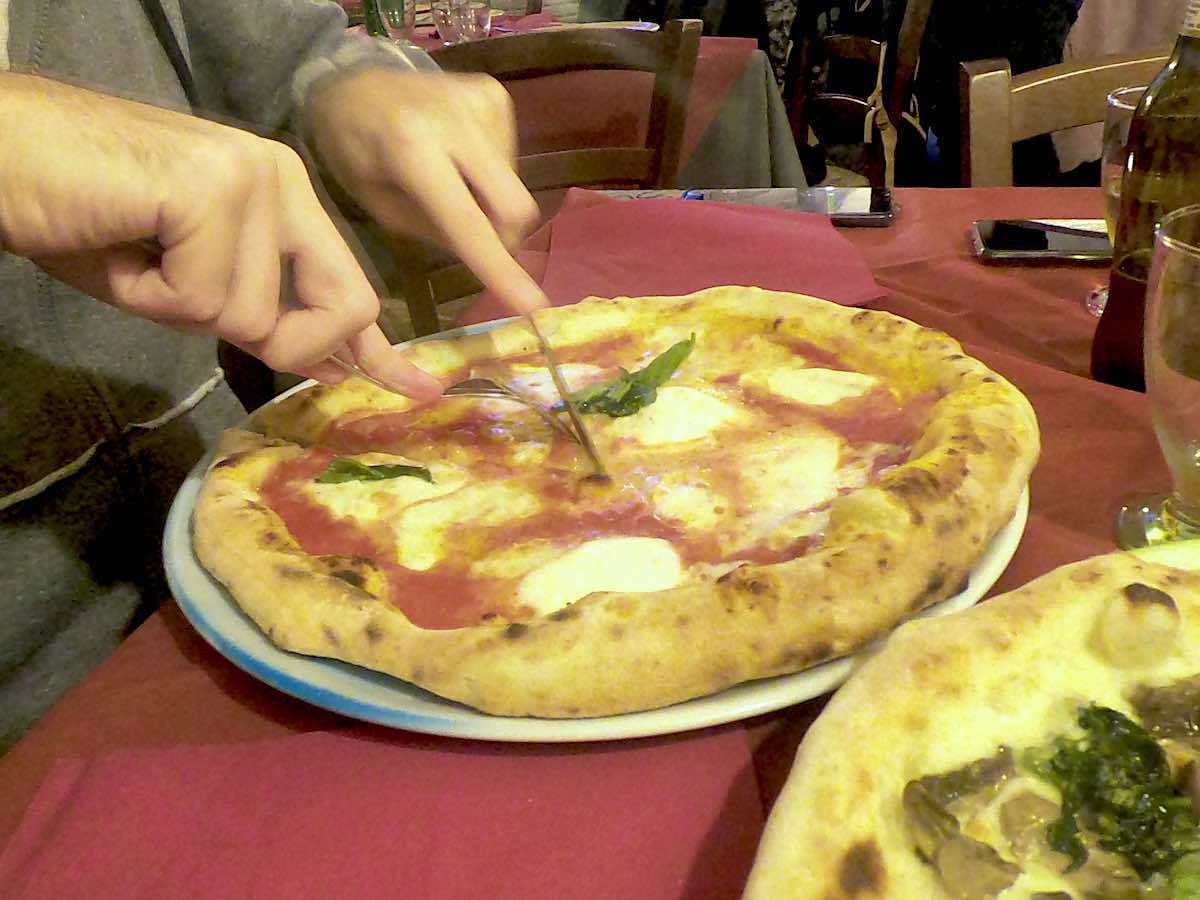
A two-day trip from Rome to Naples is an experience that will immerse you in the vibrant culture of southern Italy. The city offers a unique mix of history, art, and, of course, delicious gastronomy.
We Romans go to Naples when we want to feel a different vibe. Naples is the hometown of famous Italian musicians, poets, philosophers, and fantastic pizza makers.
The people here are warm and fervently creative, and it’s no coincidence that the city is located near the Vesuvius volcano.
You can start your Neapolitan adventure with a breakfast of coffee and sfogliatelle, typical pastries filled with ricotta.
It is said that the coffee in Naples is the best in Italy. Until the 1970s, it was common for Romans to go to Naples just to have a coffee and then return.
But the food that makes it worth visiting Naples is Neapolitan pizza, a UNESCO heritage.
In Naples, you will eat the most delicious pizza in Italy, marveling at how affordable pizza is here.
Key places to taste Neapolitan pizza are Pizzeria da Michele (featured in the movie Eat Pray Love) and Gino e Toto Sorbillo.
The historic center of Naples is a UNESCO World Heritage site as well.
Visit the National Archaeological Museum, which houses a vast collection of Roman and Pompeian artifacts.
Then head to the heart of the city to admire the magnificence of the Naples Cathedral and the treasure of San Gennaro.
Take a stroll through “Spaccanapoli” and Via San Gregorio Armeno with its artisanal nativity scene workshops.
Castel dell’Ovo, overlooking the sea, is the stage for one of the most beautiful fireworks displays in Italy on December 31st.
You should also see the splendid interiors of the Royal Palace, overlooking Piazza del Plebiscito.
You will need at least two days to explore the city’s most important historical monuments and enjoy its unique vibe that will charm you. If you’re looking for the best destinations for weekend trips from Rome during Christmas, look no further, Naples is the way.
Where to stay in Naples: There are so many things to see that I recommend staying right in the historic

center. The location of Reginella Duomo Apartment is perfect. Have a look at the rates here!
22. Assisi and Perugia, Umbria


About 90 km east of Orvieto is Assisi. Here, too, historic art takes the spotlight. In the Basilica named after the famous Saint Francis of Assisi, there are frescoes dating from the 1200s that have been attributed to Giotto, among many others. The hill town of Assisi is a fairy-tale village with its pink and white stone houses.
This city, a UNESCO World Heritage Site, also has a distant history, to be found in ancient Corinthian times. Witnesses are the remains in the town, such as the Temple of Minerva with its six columns.
Here, too, the “underground” version of the town can amaze you with the remains of the Roman forum and two Roman houses still rich with precious details.
It only takes a few hours to visit Assisi. The rest of the day, devote it to Perugia, the capital of Umbria.
For art lovers, the National Gallery of Umbria houses a vast collection of Renaissance and medieval artwork. Perugia is also famous for its chocolate, so be sure to sample the delicious local chocolates. Explore the ancient medieval streets, such as Corso Vannucci, with its quaint stores and cozy cafes. Enjoy breathtaking panoramic views from the Rocca Paolina and discover the fascinating system of underground arches. Perugia is a vibrant city with cultural events and festivals year-round, such as the Umbria Jazz Festival.
A trip to Assisi and Perugia is an opportunity to immerse yourself in Umbrian culture and discover the charm of this enchanting city.
These places are at their best during the Christmas period. Actually, Assisi is one of the best Christmas towns in Italy. The reasons for this primacy include cozy taverns, wonderful churches to visit (St. Francis and St. Clare), and Christmas lights.
23. Anagni and Fontana Liri, southern Lazio
If you are after an authentic Lazio experience I recommend exploring Anagni, a charming city south of Rome, and the picturesque village of Fontana Liri.
Begin your itinerary by immersing yourself in the medieval history of Anagni, known for hosting pontiffs.
Walk through its ancient streets and admire the imposing Cathedral of Santa Maria, an example of Romanesque architecture with extraordinary frescoes. Don’t miss a visit to the Boniface VIII Palace, where the famous Pope Boniface VIII was born and resided.
Feel the historic atmosphere that permeates this city, letting you be enchanted by the charm of its monuments.
On the second day, head to the pretty village of Fontana Liri, situated in an enchanting natural setting. This picturesque village is crossed by the Liri River, which creates an evocative setting with its waterfalls and ancient mills.
You can stroll along its cobblestone streets, discover local traditions and enjoy the tranquility of the place.
In the area, another site of great archaeological interest is the remains of the ancient acropolis of Alatri, which features cyclopean walls of mysterious origin.
Both locations also offer gastronomic delights. Savor the traditional cuisine of Lazio, such as pasta all’amatriciana, a typical dish with tomato sauce, guanciale, and pecorino romano, or delight in local cheeses, such as ricotta romana. Complete your dining experience with a glass of local wine, such as Cesanese del Piglio, a fine red wine from the region.
Where to stay in Anagni: Villa Floridiana, a 4-star hotel with every comfort.
Conclusions
Rome lends itself as an ideal base for exploring central Italy and taking short trips to Italy.
Using the train you can plan cheap and unforgettable weekend trips from Rome. Other UNESCO heritage cities are within easy reach: Naples, Florence, Bologna, and Pisa.
If you rent a car instead, devote yourself to discovering areas off the beaten path such as Tuscia and Val d’Orcia.
FAQS Weekend getaways from Rome
(Q) What other cities can I visit from Rome?
From Rome, with a short train ride, you will be able to reach interesting cities in Lazio, Tuscany and other regions, for example:
- Viterbo – 2h with Trenitalia regional train
- Naples – 1:12h with Trenitalia and Italo
- Florence – 1:40h with Trenitalia and Italo
- Siena – 2:30h with Trenitalia
- Perugia – 2:50h with Trenitalia
- Bologna – 2:15h with Trenitalia and Italo
- Venice – 4h with Trenitalia and Italo
(Q) How do I get from Rome to the Amalfi Coast?
There are several ways to get to the Amalfi Coast from Rome. Here are the quickest and cheapest:
Take a train from Roma Termini to Napoli Centrale. In summer and until October 31 there is a hydrofoil that takes you from Naples to Amalfi and Positano for about €30.
In winter, from Naples Piazza Garibaldi take the Circumvesuviana train and arrive in Sorrento (about 1h). From Sorrento take a Sita bus to the towns on the Amalfi Coast: Amalfi, Positano, Praiano.
(Q) Can you do a day trip to Positano from Rome?
Yes, it is possible during the period when there are hydrofoils connecting Naples and Positano. The time you will have to spend in Positano will be somewhat limited, about 4 hours. I recommend that you spend at least 3 days on the Amalfi Coast to ” buffer” your travel time.
If you are determined to do a day trip from Rome to Positano, do this:
Take an early morning train from Rome to Naples and then a hydrofoil from Positano to Naples. You will arrive at your destination by 11-12 AM. Enjoy a few hours in Positano and then take the ferry back to Naples at about 4:40 PM.
The schedule of this day trip is tight. Positano and Amalfi Coast in general aren’t the best coastal getaways from Rome if you have just one or two days on your hands.
(Q) Which city to combine with Rome?
Naples and Florence are easily reached from Rome either by train or by plane.
(Q) Where do people from Rome go on holiday?
Contemporary Romans, to enjoy an easy vacation on the coast, go to these locations:
- Fregene
- Terracina
- Argentario Peninsula
- Cilento Coast
If they want to cool off in the mountains, they go to Monti Simbruini Regional Park or Abruzzo National Park.
(Q) Is Naples worth a day trip from Rome?
Naples is perfect as a day trip from Rome. You can easily reach it by train. Leaving from Roma Termini, after about an hour’s ride you will be in Napoli Centrale. From there, take a subway to Toledo Station and then explore the historic center on foot.
There are many historical landmarks to see in Naples. Consider the city as one of the best overnight trips from Rome as well.
(Q) Is Tivoli worth a visit?
Tivoli is an interesting destination for an easy day trip from Rome. The best time to visit is spring and fall.
Tivoli can be reached by a half-hour train ride from Rome. In one day you manage to visit the Roman Villa Adriana, the most important historical landmark, and the Renaissance Villa d’Este (UNESCO heritage site).
(Q) Can you do a day trip from Rome to Tuscany?
It is easy to make a day trip from Rome to Tuscan cities that connect well by train: Siena, Florence, Grosseto, and even Pisa. Tuscany offers some of the best Rome getaways that you’ll enjoy during every season.
By car, in about two hours you can reach southern Tuscany, the towns of Pitigliano and Sovana, or the Argentario peninsula, which has fabulous beaches.
By car you can also easily reach the Val D’Orcia: Castiglione d’Orcia, Pienza, and Monticchiello.
9nL5fLXj_