

What has always amazed me about the countryside around Rome are its picturesque villages and areas perfect for hiking and picnics.
I’ve compiled a list of the best places to visit in the Roman countryside, where good food, historical landmarks, and beautiful nature combine to offer delightful experiences.
In this post, I’ll share where I go with my family to escape the routine.
If you’re planning to spend a week or more in Rome, I recommend including at least a couple of these enchanting sites in your itinerary. These places, where time moves slowly and seem light years away from the hectic city, offer a serene escape.
You’ll discover that you don’t need to travel to Tuscany from Rome to taste excellent local wines, local extra virgin olive oil, and organic food.
With comfortable shoes and a camera in hand, let’s set off to discover the best natural places to visit near Rome!
12 Best Places in the countryside around Rome where you’ll find beautiful nature
1. Lake Bracciano

The Regional Park of Lakes Bracciano and Martignano is one of the most fascinating and least-known nature reserves in central Italy.
The presence of water, of a crystal clear lake makes this region particularly attractive, especially in summer.
There are many beaches on the lake, both free and equipped, where you can spend a day admiring the deep blue color of the water and the many water birds that inhabit it: swans, ducks, herons, and coots among others.
The three towns overlooking the lake are also very interesting to visit, presenting elements of medieval or Renaissance architecture, narrow streets, and small piazzas to explore.
There is also a famous excellently preserved medieval castle in the historic center of Bracciano that can be visited, the Orsini-Odescalchi Castle known as Bracciano Castle. The more than 20 rooms open to the public display the original antique furnishings and frescoes, and offer privileged views of the lake.
The most pleasant village to stroll through and enjoy a sunny day is definitely Trevignano Romano. Along the very well-kept lakeside promenade, you will find cafes, small restaurants, contemporary sculptures, and gardens.
If you eat there, I recommend booking a table at the bistro restaurant “La Locanda,” which serves seafood and lake fish dishes.
Hiking enthusiasts should try their hand at the easy crossing from Lake Bracciano to the small and almost secret Lake Martignano.
It starts from the village of Anguillara Sabazia and arrives after about an hour and a half of walking.
Read also: The complete guide to visiting Lake Bracciano
2. Tolfa

This totally off-the-tourist radar village is located halfway between Lake Bracciano and the Tyrrhenian coast.
It will come in handy if you are traveling to Italy on a cruise and are looking for interesting day trips from the port of Civitavecchia.
This hillside village near Rome is surrounded by stretches and stretches of woods, and the air here is incredibly clean.
The first thing to do upon arriving here is to get to the Piazza Vittorio Veneto Belvedere, the main square from which you will enjoy a beautiful and relaxing view of the surrounding valleys. Then perhaps stop to sample the good local food at Edera Restaurant, which makes delicious pasta and ravioli.
To work off your lunch, walk down Via Roma where you will find artisans’ workshops. Tolfa is famous for its leather work, particularly the shoulder bags known as “catana,” which were very much in vogue in the 1970s and are dyed with vegetable dyes.
Then you might head to the remains of the ancient Frangipane Fortress, which is reached by climbing a long flight of steps.
3. Calcata

If you are wondering where to find hippies in Italy, perhaps visiting the village of Calcata will give you an answer.
In particular, you should go to the old town of Calcata, or Calcata Vecchia, which stands on a scenic tufa cliff in the middle of a lush valley.
Those who visit this village halfway between Rome and Viterbo do so for the view, for dining in a picturesque village, and for the special vibe of the place. Calcata isn’t just one of the loveliest medieval towns near Rome.
Calcata Vecchia, since the 1960s, has attracted many unconventional artists and people from Italy and around the world.
You will find the studios of many artists and artisans here. To meet the artists just spend some time in the only square of the village, in front of the church next to the town hall and the thrones carved in stone by the brilliant sculptor Costantino Morosin.
Those who love to walk in nature will be able to do so by following the paths that lead from the historic center of Calcata into the lush Treja Valley.
The valley contains some interesting evidence of the Falisci people, who preceded the Romans in the conquest of these territories, such as the remains of a sanctuary and a necropolis.
An easy trail brings you from the old town to the ruins of the Church of Santa Maria, from where you’ll enjoy a photo-perfect view of Calcata Vecchia.
You might want to read: Top things to do in Calcata Vecchia
3. Cerveteri
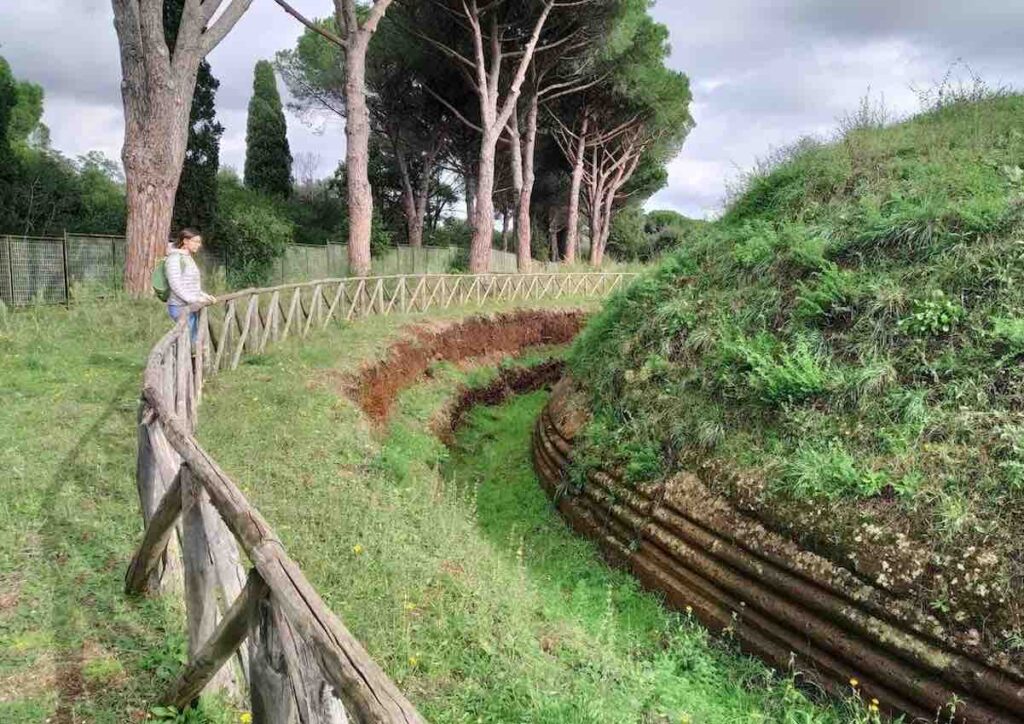
The Tuscia Romana region spreads northwest of Rome and is rich in the architectural vestiges of the Etruscan Civilization.
The Etruscans lived in central Italy between 9 and 3 centuries B.C., when they lost the long war against the Romans. The Romans recognized the cultural supremacy of the Etruscans, from whom they inherited hydraulic and architectural techniques and religious cults.
One of the most important remains attributed to the Etruscans is the Etruscan Necropolis of Cerveteri, which is a UNESCO World Heritage Site.
The site is about a kilometer away from the town of Cerveteri, which is itself very close to the Tyrrhenian coast with its large sandy beaches and beach clubs. After exploring one of the nicest medieval villages near the Eternal City you can have a walk by the beach.
TIP: If you visit in summer, try the excellent seafood at the restaurant of Six Beach House.
Cerveteri is the perfect place to combine a love of the sea with a love of history.
The monumental necropolis traces the structure of the acropolis of ancient Caere, one of the most important Etruscan cities.
The site has a part that is accessed for a fee where the large burial mounds of aristocratic families are located. Then there are two parts with free access that are also very interesting, especially the Way of the Underworld.
This road opens inside the rock, and on both sides, there are hundreds of caves hollowed out on several levels which you can access with a flashlight. The place is made even more fascinating by the vegetation growing on the ruins of the necropolis.
The Way of the Underworld is the beginning of one of the most famous trekking trails around Rome and in Italy, which goes all the way to the village of Castel Giuliano in a loop of about 15 km.
If you walk even a shorter section of this hike you will find dense forests and enchanting waterfalls. Totally off the beaten path!
Read also: Best hiking trails near Rome
4. Veio Park

If you want to spend a day immersed in beautiful nature near Rome, but not far from the city, then consider visiting the Veio Regional Park.
The park features about 15000 hectares of woods and pastures and has a great wealth of plant and animal biodiversity.
Looking for a day trip from Rome with kids? This might be the perfect place to entertain them, you may even come across calves and horses grazing freely.
The historical archaeological heritage is also abundant.
Veio in ancient times was an Etruscan city. Among the landmarks in the park are the ruins of the Etruscan Temple of Apollo, whose artifacts, including beautiful statues are on display at the National Etruscan Museum of Villa Giulia in Rome.
The best-preserved monument of Roman times is the Villa of Empress Livia, wife of Augustus. An example of an imperial villa of the ancient Roman countryside.
In my opinion, the part of the park most worth visiting is the Sorbo Valley, watered by the Cremera River, which forms enchanting waterfalls here.
The valley is home to the Sanctuary of the Madonna del Sorbo with a small church, which is a stop on the Via Francigena, an ancient pilgrimage path from Canterbury to Rome.
A curiosity about the Veio park: also of Etruscan origin are the underground passages that run for about 40 km and were probably intended to channel water.
The park can be accessed from the village of Isola Farnese on the outskirts of Rome or from the town of Formello.
5. Nepi

Nepi, a lesser-known destination located 50 km north of Rome in central Italy, invites travelers with its rich history and off-the-beaten-path appeal.
Positioned in the picturesque Tuscia region, which was home to the ancient Etruscans, Nepi features landscapes adorned with tufa-hill villages and lush forests.
The city’s name, derived from “nepa” meaning water, reflects its unique geography surrounded by rivers and waterfalls.
Over the centuries, Nepi formed alliances with Rome, withstanding Lombard invasions and thriving during the High Middle Ages.
You can explore the impressive Farnese Walls, delve into the Civic Museum housing artifacts from prehistoric times to the Renaissance, and marvel at the iconic Aqueduct of Nepi. The Borgia Castle, constructed on Roman ruins, offers panoramic views, and the Catacombs of Santa Savinilla provide a fascinating glimpse into early Christian history.
The historic center beckons with architectural treasures like the Municipal Palace, while the nearby Cavaterra Waterfall adds a natural wonder to the cityscape.
Nepi accessible by bus from Saxa Rubra station or ideally explored by private car.
6. Sutri

The town of Sutri, positioned around 50 km west of Nepi, holds a rich but often overlooked historical heritage.
Situated along the ancient Roman consular road, Via Cassia, Sutri has gained recognition for its cultural and artistic endeavors, obtaining the Orange Flag from the Italian Touring Club and earning a place among the “Most Beautiful Villages of Italy.”
A fitting addition to any Italy itinerary, Sutri is easily reachable for a day trip from Rome, though an overnight stay is recommended for a comprehensive exploration.
Highlights include the notable Roman amphitheater, a distinct structure excavated from tufa rock, the Etruscan necropolis featuring 64 chamber tombs, and the Mithraeum, a rock-hewn church adorned with 13th and 14th-century frescoes.
Villa Savorelli, a Renaissance residence, and the picturesque Piazza del Comune, situated on the ancient Roman forum, contribute to Sutri’s appeal.
The Doebbing Palace, a renovated episcopal seat transformed into an exhibition space for contemporary art, is also noteworthy.
Sutri has a legendary foundation linked to the god Saturn, as you can may guess from its name.
For local cuisine, I recommend Cantina del Drago, which offers an elegant dining experience.
7. Frascati
One of the most prominent places when it comes to the countryside near Rome are the Castelli Romani, an area located southeast of the capital and in the Alban Hills.
Composed of a multitude of small villages, the area is full of experiences to do, typical products to try, and places of interest not to be missed.
If you focus on visiting this area, make it at least a two-day trip from Rome.
Start with the most famous city of the Castelli Romani, Frascati, known not only for its food and wine specialties but also for the Tuscolane Villas, strongly desired by the Roman Renaissance nobility and often built on the remains of ancient Roman mansions.
The city is known for its fine wines that are imported all over the world, and it is here that the most famous taverns in the entire Castelli area are born: the fraschette.
The fraschette were venues originally conceived for the serving of new wine, which was often accompanied by savory food. Nowadays they are typical taverns, often furnished in a rustic way, with tools of the countryside and checkered placemats, where you can try the specialties of the area: the pasta of Lazio like carbonara, amatriciana, gricia, the cured meats, and the pickles of the area.
Above all, the typical food of the Castelli Romany is the porchetta, which is a baked pork belly roll stuffed with local herbs.
TIP:

Tradition has it that the best porchetta in Italy is the one from the village of Ariccia, located between the lakes Nemi and Albano.

Besides trying the tasty specialty, in this small village perched on the rocks, you can enjoy the magnificent view of Piazza di Corte designed by Bernini.
8. Nemi
If you are a lover of nature and hiking in the woods, the Castelli Romani have a wide variety of trails, some of them overlooking beautiful lakes.
The small town of Nemi dominates, from atop a rock, the tiny and secret Lake Nemi. The dense forest surrounding the lake holds truly enchanting historical and cultural remains, such as the ruins of the Roman Temple of Diana, which can still be visited today.
The volcanic lake of Castel Gandolfo, also known as Lake Albano is much bigger. You can walk the loop around the lake and enjoy a view surrounded by nature, appreciating the relaxation of the town that was once the summer residence of the popes.
The size of this body of water allows for a multitude of varied activities: canoeing, sailing, a boat ride or a rejuvenating walk along its banks.
Lake Nemi and Lake Albano are two of the nicest lakes near Rome, and you can visit them on the same day!
9. Grottaferrata
One of the most characteristic towns of the Castelli Romani is undoubtedly Grottaferrata, where food and tradition are never lacking. If you want to enjoy a truly unique panorama overlooking all of Rome, don’t miss a visit to the Greek abbey of San Nilo.
Visiting the interior you will be captivated by the colors that fill the church, but what will leave you breathless will be the view of the Roman hills that you can admire from the external walls of the abbey. I recommend going there in the sunset hour, both in summer and winter, to enjoy one of the most magical lights in the whole area.
10. Castel San Pietro Romano
Let us now move towards the center of Lazio and reach the symbolic location of the Prenestini Mountains: Castel San Pietro Romano. At 763 meters above sea level, this village is called an open-air museum.
Here the majesty of nature blends perfectly with the ancient history of the region, thus creating an unusual and wonderful combination, making it become, among other things, the set of numerous films.
The history of this village dates back as far as the Paleolithic period, and we today have evidence of the megalithic walls of Ancient Praeneste.
There is also a natural monument over 500 years old: the Palestrina Oak. At 22 meters tall and with a circumference of almost 7 meters, this incredible tree reigns over the Cannucceta Nature Park.
The history of this unique hamlet is not only to be found in its vegetation and monuments but also in its food. The Giglietto cookie is, in fact, a traditional recipe since 1630, characterized by very simple ingredients such as flour, eggs, sugar, and lemon and the unmistakable lily shape.
11. Genazzano
We continue to the eastern part of the Roman countryside and arrive in Genazzano, a small town about 45 km from Rome of just over five thousand inhabitants, but with a very rich plant and cultural heritage.
The two main parks in the area are Elcini Park, included in the Colonna Castle complex, and the La Selva Natural Monument, which has been a protected area since 2000. Both parks are perfect for a walk to discover a variety of scents and floral species.
The pride of this small town is, undoubtedly, the monumental Bramante Nymphaeum complex, dating back to the 16th century and built by Renaissance master Donato Bramante. The uniqueness of this work is due to the juxtaposition of ancient Roman art and classical Renaissance art, but also to the artist’s desire to build it in a place so immersed in nature, beside a watercourse and surrounded by varied vegetation. Visiting it will give you a truly fulfilling feeling of peace.
12. Olevano Romano – a terrace on Rome countryside
One of the easternmost towns in the Roman countryside, about 60 km from Rome, is Olevano Romano.
This small town is more than 2,000 years old and is built, like many others, on a tufa cliff.
Here, too, the medieval imprint is very strong, and we can see it by visiting the Colonna Castle and by the remains of the walls that served to protect the village around the 6th century B.C. from the Roman advance. What makes this village famous all over the world is undoubtedly the native grape, which gives rise to the wine “Cesanese” DOC: try it with local cheeses and cold cuts in one of the small local taverns, you will certainly not be disappointed!
13. Valmontone
Moving now toward the southern countryside we reach another small town perched on tufa rocks: Valmontone.
Its very ancient history was, unfortunately, razed to the ground by the bombings of the war, but with hard work and precise dedication the town has been rebuilt over the years. Now the historic center is a real gem where you can get lost among the typical flavors and wonderful architectural structures, including period fountains and centuries-old buildings.
Among these, the Collegiate Church of the Assumption, built on a 12th-century Gothic temple, and Palazzo Doria Pamphilj, one of the most precious guardians of 17th-century frescoes in the Roman countryside, are definitely worth a visit.
TIP:

Valmontone is popular among locals for hosting a shopping outlet. If you're into high fashion and want to find real deals, I recommend a visit to the Valmontone outlet.
14. Artena
Our tours of the Roman countryside end in one of the towns with the most distinctive origin, Artena.
This town is only 50 km away from Rome and is located in a limestone basin surrounded by a plain of alluvial origin. Here, too, monumental art reigns supreme, and if we can still admire architectural wonders today, it is also thanks to – who else but him? – to Cardinal Scipione Borghese, after whom the palace located in the heart of the city is named. But dominating the Artena Citadel is the Church of Santa Croce, which with its two Baroque-style bell towers keeps an eye on the whole valley, perfect for walks and picnics in the open area.
Conclusion
If you want to take a day trip to the countryside around Rome, choosing from these places that I have recommended will be hard to go wrong.
Although it may seem to you that it is easier to reach these villages by car, do not underestimate public transportation such as trains and long-distance buses.
In fact, the roads in the province of Rome are among the most poorly maintained in Italy, unfortunately.
FAQs Countryside near Rome
Is there countryside near Rome?
The city of Rome is surrounded by the countryside. Some areas are to be considered among the most beautiful countryside in Italy, for example, Sabina and Tuscia.
Until a few decades ago, Rome’s suburbs were less extensive. Now the city has moved much closer to the countryside.
Generally, with about 45 minutes by train from the center of Rome, traveling in any direction, one can reach the countryside or the sea.
What are the best neighborhoods outside of Rome?
According to the locals, some of the best neighborhoods to live in outside the historic center of Rome are:
- Nuovo Salario
- Monte Mario
- Appio Claudio
- Eur
- La Storta
What beautiful town is close to Rome?
These are some of the most picturesque towns close to Rome:
- Trevignano Romano
- Rocca di Papa
- Tivoli
- Cerveteri
- Cervara di Roma
What places surround Rome?
To enjoy the most beautiful nature near Rome, I recommend taking a day trip or a road trip to one of these areas near Rome:
- Tuscia, which stretches through the countryside north of Rome to the province of Viterbo
- Tyrrhenian Coast – if you prefer coastal landscapes you can reach them with a trip of just half an hour from the historic center of Rome
- Castelli Romani – one of the most popular weekend getaways from Rome, this region develops around Lake Albano
- Sabina – the area of the Sabine Hills northwest of Rome to the Abruzzo border
What is the closest beach to Rome?
The closest beach to Rome is Ostia beach. The beach is actually part of Rome’s metropolitan area and the town of Ostia is highly populated. If you’d like to visit some more quiet coastal towns near Rome, I recommend visiting:
- Fregene
- Nettuno
- Santa Marinella
Are there mountains outside of Rome?
Traveling from Rome, several mountains can be reached in about an hour’s time.
The most beautiful mountains around Rome are the Simbruini Mountains, Mount Navegna, and Mount Terminillo.