
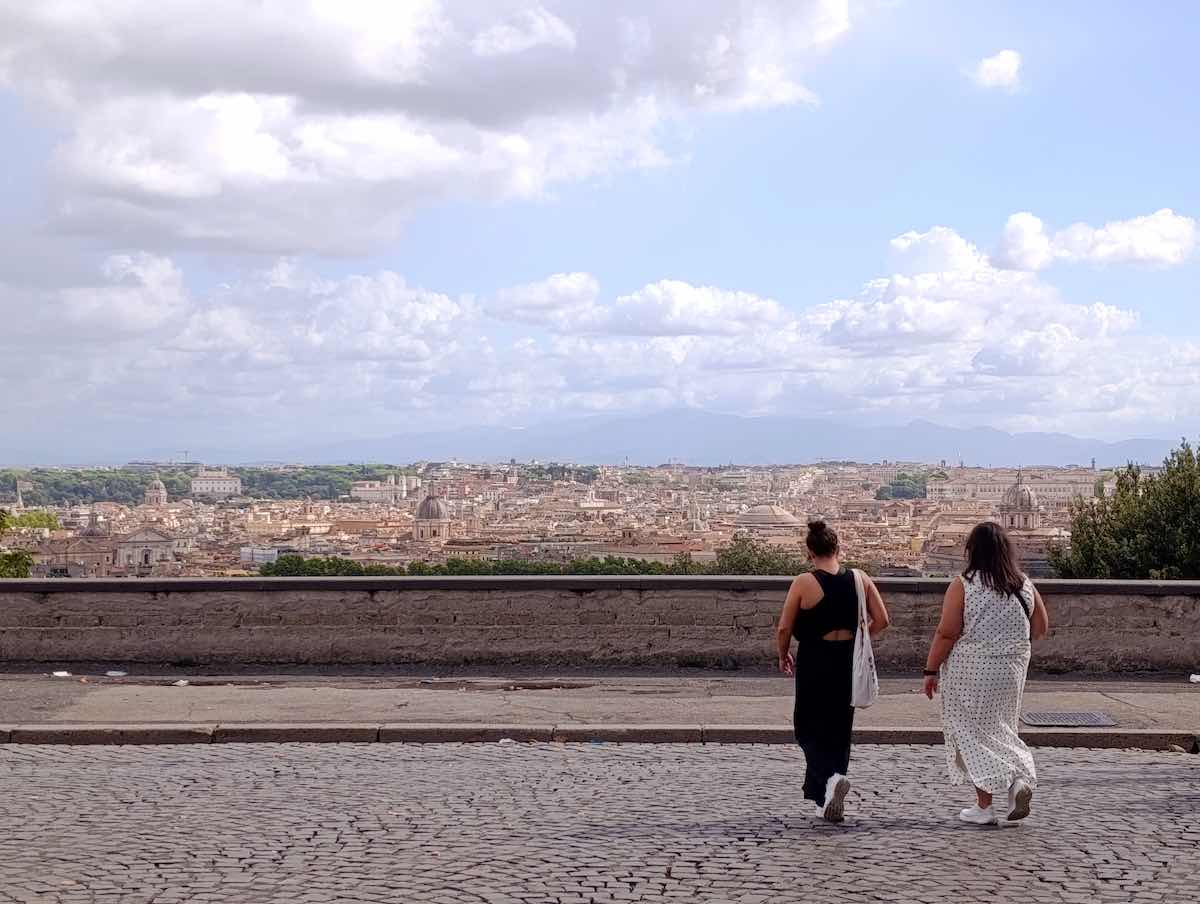
They say you haven’t truly visited Rome if you haven’t enjoyed at least one of its hilltop views. In this post, I’ll show you the 3 most worthwhile in the city and how to easily add them to your itinerary.
The legend says Rome was built on hills, so it shouldn’t be too difficult to climb one of them and enjoy the view.
However, to be precise, Rome has around 14 hills, and you won’t have time to explore them all in a single trip. But that’s not necessary in our case, because I’m about to show you the 3 hills with the most beautiful views over roofs, historic buildings, and domes of the Eternal City.
4 Local’s favorite hilltopviews in Rome
Janiculum Hill
The “Gianicolo,” as we locals call it, or “Janiculum” in English, is the most famous panoramic hill in Rome among locals. It is a hill just beyond the historic center, and at its foot lies the Trastevere district, known for food.
The summit of the hill, which has a circular shape, was redesigned after the unification of Italy in 1870, as remembered by the equestrian statue in the center, a monument to military commander Garibaldi. On one side of the large terrace, a bit in exile, you will see the dome of St. Peter’s Basilica.
On the other side, the main one, the Eternal City unfolds before you in all its splendor. It’s hard not to be moved by this view; in fact, it is also one of the most romantic spots in the city, especially at sunset.
Tradition says you should walk here from the Trastevere district, about a 20-minute uphill stroll. You can also take buses 115 or 870. Or I can take you there during the golf cart tour…
There are also other things to do on Gianicolo Hill besides the view.
I recommend coming here on your last day in Rome, so you can try to recognize some of the landmarks you’ve visited—you can spot them all, including the Colosseum.
Aventine Hill
The Aventine Hill is one of the legendary Seven Hills of Rome. Did you know Rome is said to have been built on seven hills?
In ancient times, this area was outside the official boundaries of the city. It was home to the oldest cemetery and the first place where foreigners settled in Rome, back in 250 BC.
Today, the top of the hill hosts the Savello Garden, better known as the Orange Garden, but also the Lovers’ Garden.
It’s a little gem: a park with benches, bitter orange trees, and a view over the Tiber River and the city.
The cherry on top is the view of St. Peter’s Dome framed by magnificent umbrella pines. Even though it can get busy in the high season, this place still feels off the beaten path.
I recommend adding this stop after visiting the Colosseum, Palatine Hill, or Circus Maximus. The ruins of the last one (the largest stadium of ancient Rome) are located right at the foot of this hill.
If you’re using public transport, take Metro Line B to Circo Massimo station and then continue on foot for about 20 minutes.
Pincio Hill

This hilltop view over Rome, although the easiest to reach, is hidden in plain sight.
Whenever I arrive here while guiding my Rome golf cart tour, travelers are always surprised by how peaceful this place is, despite being so close to the Spanish Steps.
More precisely, this panoramic view over the historic center of Rome is located in the Borghese Gardens, right next to the top of the Spanish Steps.
It is absolutely worth coming here to enjoy the privileged yet close-up view of all the domes of the churches unfolding in front of you, including St. Peter’s and the Pantheon.
The Borghese Gardens are the closest public gardens to the city’s main attractions. This monumental park is full of historic buildings and fountains; it is actually a complex of many different and beautiful gardens.
The Belvedere in the Borghese Gardens is the spot you need to reach for the view you’re looking for. It takes about 15 minutes on foot from the Church of Trinità dei Monti, at the top of the Spanish Steps, heading towards Villa Medici and the Borghese Gardens.
Monte Mario Hill
The hills I’ve listed so far should be enough to satisfy your thirst for panoramic views over the Eternal City. But let me add one more—this one is truly unknown to tourists.
Monte Mario Hill is located outside the city center and can be reached by crossing the 19th-century Prati district. To be clear, Prati is the neighborhood that hosts the Vatican.
This hill is the highest panoramic point within the city of Rome, which is why it is referred to as a “mount.”
The hill is also home to the Astronomical Observatory (not open to visitors), a café, and a park where locals go for walks with friends and dogs.
This hill offers the most spectacular view of St. Peter’s Dome. Come here if you’ve had enough of seeing tourists around you.
Important: one of the roads leading to the top of the hill has no sidewalk, so it is mandatory to reach it via Via Trionfale from Piazzale degli Eroi or by public transport to “Parco di Monte Mario.”
Conclusion:
As you can see, there are at least four panoramic hills offering breathtaking views over Rome. The first three I’ve introduced—the Gianicolo Hill, the Orange Garden (Giardino degli Aranci), and the Belvedere in the Borghese Gardens—are already more than enough, even for those visiting Rome for a second time.
The one I recommend to everyone, thanks to how easy it is to reach, is the Belvedere in the Borghese Gardens, with its terrace located right next to the historic event venue “Casina Valadier.”
Instead, if you truly want to enjoy the view most cherished by Romans themselves, make your way to the top of Gianicolo Hill. It may even be worth taking a taxi to get there.